

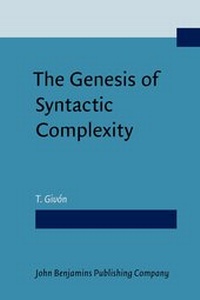
The Genesis of Syntactic Complexity
Diachrony, ontogeny, neuro-cognition, evolution
Published on 4. February 2009
Book
Paperback/Softback
366 pages
978-90-272-3254-0 (ISBN)
Description
Complex hierarchic syntax is a hallmark of human language. The highest level of syntactic complexity, recursive-embedded clauses, has been singled out by some for a special status as the evolutionary apex of the uniquely - human language faculty - evolutionary yet mysteriously immune to Darwinian adaptive selection. Prof. Givon's book treats syntactic complexity as an integral part of the evolutionary rise of human communication. The book first describes grammar as an adaptive instrument of communication, assembled upon the pre-existing platform of pre-linguistic object- and-event cognition and mental representation. It then surveys the two grand developmental trends of human language: diachrony, the communal enterprise directly responsible for fashioning synchronic morpho-syntax and cross-language diversity; and ontogeny, the individual endeavor directly responsible for acquiring the competent use of grammar. The genesis of syntactic complexity along these two developmental trends is compared with second language acquisition, pre-grammatical pidgin and pre-human communication. The evolutionary relevance of language diachrony, language ontogeny and pidginization is argued for on general bio-evolutionary grounds: It is the organism's adaptive on-line behavior- invention, learning and skill acquisition - that is the common thread running through all three developmental trends. The neuro-cognitive circuits that underlie language, and their evolutionary underpinnings, are described and assessed. Recursive embedding turns out to be not an adaptive target on its own, but the by-product of two distinct adaptive moves: (i) the recruitment of conjoined clauses as modal operators on, or referential specifiers of, other clauses; and (ii) the subsequent condensation of paratactic into syntactic structures.
More details
Language
English
Place of publication
Amsterdam
Netherlands
Target group
College/higher education
Professional and scholarly
Illustrations
+ index
Dimensions
Height: 240 mm
Width: 160 mm
Weight
680 gr
ISBN-13
978-90-272-3254-0 (9789027232540)
Copyright in bibliographic data and cover images is held by Nielsen Book Services Limited or by the publishers or by their respective licensors: all rights reserved.
Schweitzer Classification
Person
Content
1. Copyright acknowledgment; 2. Preface; 3. Part I. Background; 4. Chapter 1. Complexity: An overview; 5. Chapter 2. The adaptive approach to grammar; 6. Part II. Diachrony; 7. Chapter 3. The diachrony of grammar; 8. Chapter 4. Multiple routes to clause-union: The diachrony of complex verb phrases; 9. Chapter 5. The diachrony of relative clauses: Syntactic complexity in the noun phrase; 10. Part III. Ontogeny; 11. Chapter 6. Child language acquisition; 12. Chapter 7. The ontogeny of complex verb phrases: How children learn to negotiate fact and desire; 13. Chapter 8. The ontogeny of relative clauses: How children learn to negotiate complex reference; 14. Chapter 9. Second-language pidgin; 15. Part IV. Biology; 16. Chapter 10. From single words to verbal clauses: Where do simple clauses come from?; 17. Chapter 11. The neuro-cognition of syntactic complexity; 18. Chapter 12. Syntactic complexity and language evolution; 19. Bibliography; 20. Index