

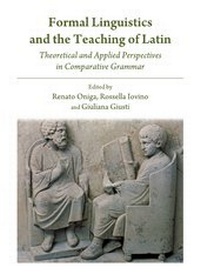
Formal Linguistics and the Teaching of Latin
Theoretical and Applied Perspectives in Comparative Grammar
Published on 24. June 2011
Book
Hardback
465 pages
978-1-4438-2988-5 (ISBN)
Description
This volume offers a coherent collection of 26 papers presented at an international conference held in November 2010, exploring the latest achievements of formal and comparative linguistics applied to the teaching of Latin. The three sections (syntax and morphology, semantics and pragmatics, history and theory of teaching) compare Latin with different ancient and modern languages, aiming to represent grammar rules as the product of mental processes. The book is addressed to linguists, teachers and students, who are looking for new perspectives to update their approach to classical Latin.
Reviews / Votes
"Formal linguistics is more explicit and more precise than other types of grammar. Since it has access to more sophisticated tools of grammatical analysis, it tends to achieve more explanatory results, which in turn leads to a deeper level of understanding on the part of the student. The 26 papers in this volume are arranged into three sections covering morphology and syntax (with emphasis on word order), semantics and pragmatics, and the history and theory of teaching. Various ways of bridging the gap between formal linguistics and more traditional approaches are discussed, and the potential applications of formal linguistics in the classroom are explored.The goals of this volume are as practically important as they are theoretically desirable. Latin teachers everywhere will greatly benefit from this presentation of recent theoretical ideas."- Andrew M. Devine, Professor of Classics, Stanford University, USA, Laurence D. Stephens, Adjunct Professor of Classics, University of North Carolina at Chapel Hill, USA "This book presents a valuable contribution to the Linguistics of Latin not only in relation to Romance languages stemming from it, but also in relation to Classical Greek and other languages of Europe. Some articles connect their theoretical observations with a methodology for the formal teaching of Latin. The reflection on the grammatical structures of a language used to be one of the main, if not the most important tool to foreign language learning. Nowadays, however, this approach is generally abandoned in the teaching of modern languages. But it is still the center of classical language teaching, which however calls for an update on new theoretical approaches and the advances reached by recent studies. The greatest merit of this volume lies in its attempt to match theoretical reflections on the linguistic structures of Latin with methodological issues of teaching."- Lorenzo Renzi, Professor of Romance Philology, Universita degli Studi di Padova, Italy, Vice-President of the Societe de Linguistique Romane.'What deserves special attantion is the unseen compactness of this volume. It is not the fragmented anthology we often meet. [...] the central motive remains crystal clear in every moment [.]' Lucie Pultrova, 'Listy Filologicke, Folia Philologica', 135/2012/1-2., p. 193.''We have to be very grateful to the editors of the volume inviting us to reflect seriously on the need to innovate the teaching of Latin with the support of a non-normative grammar. The study of Latin cannot be separated from learning a "high" grammar, in the sense of a "scientific" grammar, elaborated as a theory of language in response to questions about nature and functions of language.''- Valeria Viparelli, 'Bollettino di Studi Latini', 47 (2012), 874-876''The volume Formal Linguistics and the Teaching of Latin appears to be very consistent and this is not only due to fact that the main theme of the volume is Latin. In fact, the authors of each study pay attention to the advantages of deriving new methods from theoretical and formal linguistics to improve the teaching of Latin.''- Anna Farkas, 'Acta Antiqua Hungarica', 52 (2012), 85-87.More details
Edition
Unabridged edition
Language
English
Place of publication
Newcastle upon Tyne
United Kingdom
Target group
College/higher education
Professional and scholarly
Edition type
Unabridged edition
Product notice
With dust jacket
Dimensions
Height: 212 mm
Width: 148 mm
ISBN-13
978-1-4438-2988-5 (9781443829885)
Copyright in bibliographic data and cover images is held by Nielsen Book Services Limited or by the publishers or by their respective licensors: all rights reserved.
Schweitzer Classification
Other editions
Additional editions
Guiliana Giusti Rossella Iovino Renato Oniga
Formal Linguistics and the Teaching of Latin
Theoretical and Applied Perspectives in Comparative Grammar
E-Book
05/2011
1st Edition
Cambridge Scholars Publishing
€132.59
Available for download
Persons
Renato Oniga is Professor of Latin and Vice-Dean of the Faculty of Languages at the University of Udine, Italy. He has published numerous articles, monographs and editions of classical authors (Plautus, Sallust and Tacitus), as well as a book on nominal compounding and a generative introduction to Latin.Rossella Iovino is a PhD Student of Linguistics at the University Ca' Foscari of Venice, Italy. Her current research is devoted to the syntax of Latin nominal expressions.Giuliana Giusti is Associate Professor of Linguistics at the University Ca' Foscari of Venice, Italy. Her research is focused on the synchronic and diachronic syntax of nominal expressions in the Romance, Germanic and Balkan languages. She is also devoted to the dissemination of the advances in theoretical linguistics to language teaching.