

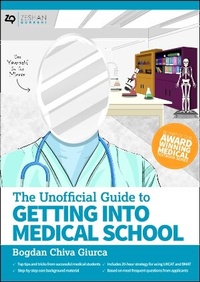
Unofficial Guide to Getting Into Medical School
Published on 1. August 2019
Book
Paperback/Softback
350 pages
978-1-910399-22-4 (ISBN)
Description
Medicine is arguably the most competitive university degree to apply for, with up to 20 applications per place, and that's only counting those that think they are good enough, not the 100s more that want to apply but don't know how. This book is unique in that it is based on real data from over 300 surveys and focus groups of successful medical students from over 32 medical schools, as well as live data from those currently applying for medical school, encapsulating their current anxieties and top tips (first book of its kind). The book starts by exploring motivations for entering medicine, so that the potential applicant is aware of the reality of the rewards and drawbacks of the profession. We then go on to describe essential concepts and knowledge required to understand the profession and appear knowledgeable in the interview. Next, an in depth focus on the application process, including work experience, personal statements, entrance exams, and interviews. Finally, we provide additional guidance for international students, mature students, and those applying having not been successful the first time.
Reviews / Votes
"This book comes from experience of the nightmare that many young students face trying to become doctors. I wish there had been such a useful and easy accessible guide when I decided medicine was for me! I can see it will be an invaluable tool to hold the hand of any prospective medical student and guide them along the first path towards becoming a medical practitioner. Luck has a part to play but preparation is paramount to make it over the first hurdle and this book has it all." --Professor Peter Abrahams MBBS FRCS(ED) FRCR DO(Hon) FHEA. Prof Emeritus of Clinical Anatomy"This highly readable book debunks some of the myths associated with successful application to medical school and will be of benefit to applicants, careers advisors and teachers. Painstakingly researched using personal testimonies from current medical students this book succeeds in demystifying the application process. Widening participation remains one of the big challenges in Medicine today. This book demystifies the application process and gives welcome encouragement to all contemplating applying to UK Medical schools." --Dr Kate Lovett. Dean, Royal College of Psychiatrists
"This book takes a refreshingly new approach to the issues of deciding to apply to medical school and the processes involved. It is particularly relevant in that it is written by medical students who have recently gone through the process. The work takes a practical and pragmatic approach to hurdles and advises how to overcome the problems associated with such a new venture for usually young persons. It is written in a light-hearted style and provides answers to many of the commoner questions that are asked by those launching into a new career and in an area that is quite frightening in many ways in that it deals with people and their bodies, their worries and their fears, their illnesses and their expectations." --Dr Christopher Gardner-Thorpe MD FRCP FRCPE FACP. Consultant Neurologist. President, Faculty of the History and Philosophy of Medicine and Pharmacy, and History Courses Director, Society of Apothecaries, London
"Every entry process has its hoops and processes and `The Unofficial Guide to Getting into Medical School' is designed to help you navigate these and demonstrate why you are special and why you should be offered a medical school place. It is written by a distinguished group of medical students, who have based their book on numerous surveys, discussions, and personal experience. This innovative book represents the definitive guide for anyone wanting to maximize their chances of becoming a doctor. As you go through the application process use this book as a guide through the toughest storms until you finally succeed. Endurance lies behind the success of every great doctor and this book will help you to reach that starting point of the best career ever." --Professor Michael Dixon LVO OBE FRCGP. Chair of the College of Medicine. Social Prescription Champion NHS England. Visiting Professor University College London
"This unique book represents a comprehensive step by step guide of the medical school application process. Its content is based on real life examples shared by hundreds of successful medical students and current applicants. The style of writing is inspirational and motivational at times, empowering medical applicants to aspire reaching their full potential." --Dr Mahiben Maruthappu. Senior Fellow to the CEO of the NHS and Chair of the UKMSA
"This is a great resource for any student who wants the inside view on effective approaches to tackling the medical application process, brought to life by the examples and knowledge from those who have been through the process." --Dr Marie Polley. Head, Patient Outcomes in Health, Westminster University
"I am really impressed with the concept of this book. It is very inspiring to see young students taking the initiative to create such a personal and insightful book. This book could start a generation of students that promote learning from one another and who share ideas to help each other succeed. This is the type of teamwork we need for the future. I am hopeful that this book will empower medical school applicants to take leadership in their own destiny to become the doctors of tomorrow to ensure that the NHS is the safest and best." --Dr Umesh Prabhu. Medical Director, Consultant Paediatrician
More details
Series
Language
English
Place of publication
Essex
United Kingdom
Target group
Adult education
Dimensions
Height: 286 mm
Width: 216 mm
Weight
1500 gr
ISBN-13
978-1-910399-22-4 (9781910399224)
Copyright in bibliographic data and cover images is held by Nielsen Book Services Limited or by the publishers or by their respective licensors: all rights reserved.
Schweitzer Classification
Other editions
New editions
Bogdan Chiva Giurca
The Unofficial Guide to Getting Into Medical School
Book
06/2024
2nd Edition
Churchill Livingstone
€37.50
Shipment within 15-20 days
Persons
Bogdan Chiva Giurca BMBS has worked globally in widening access to medical school, through setting up Medefine Education - a network of 500+ successful and enthusiastic medical students and doctors from all over the UK. For his achievements, he has been granted a series of outstanding awards including New Leaders Award (2018), Student Leader of the Year (2016-2017), Medical Student of the Year (2017-2018, College of Medicine), as well as meeting HRH Prince of Wales on two occasions and receiving an honorarium for community impact.
Content
Chapter 1. Introduction: Setting up the scene
Before we dig deep into each section of the medical school application process, you and I need to have a quick chat about your personal reasons for doing medicine. Your siblings, your parents, your grandparents, your neighbour and even the lady sat next to you on the bus will want to know WHY medicine. Together, we'll set some goals to help you plan your journey through the application process. We finish the chapter by providing you with honest insight from successful medical students regarding their hosting medical schools within the UK.
Chapter 2. Medicine: Past, Present, and Future
We continue with the first of four chapters aiming to equip you with the necessary theory before tackling each step of the application process. In this chapter, we learn by taking a time-traveling journey through the history of medicine. We then discuss current affairs and set the vision for the future of medicine - all key aspects that should form part of your background knowledge before applying.
Chapter 3. UK Medical Practice and Career Progression
How much do you already know about the medical school training programme within the UK? What about the NHS and other significant organisations? In this chapter, we lay out the inner works of the UK healthcare system, explore the various teaching methods used by medical schools as well as taking a look at career progression beyond medical school. If you're going to study and work in the UK, you first need to be acquainted with its methods of teaching, career prospects, and healthcare regulations.
Chapter 4. The Different Roles of a Doctor
Good awareness regarding the different masks worn by a doctor is key. Quite often, the general public associates the word "doctor" with its clinical duties only. Chapter 4 uncovers the various roles of a doctor, as outlined by the General Medical Council (GMC). We also explore important terminology that will make you knowledgeable during your medical school interview.
Chapter 5. Medical Ethics and Law
The final chapter focused on theory and background knowledge explores one of the most discussed topics during medical school interviews: medical ethics and law. We begin by briefly outlining the boring things first, including definitions and key differences. After equipping you with the necessary ethical principles and concepts, we put these into practice by exploring a few ethical dilemmas. We'll pass on the stethoscope down to you here - it's your turn to make decisions!
Chapter 6. Work Experience: Getting Involved
When should I start? What counts as work experience? How do I boost my chances for getting work experience? These are some of the most common questions asked by applicants like you. These and many other questions such as how to make the most of your work experience placements are explored in Chapter 6. At your request, we have also included a ready-to-use reflective template that can be used after each of your placements.
Chapter 7. Mastering the UKCAT
Perhaps the most dreadful and confusing subject of them all, the UKCAT is also known as one of the best predictors for success during your medical school application. This chapter outlines key strategies for tackling each section of the UKCAT, including our successful "20h rule for mastering the UKCAT" through which we have managed to significantly improve the scores of hundreds of applicants like you.
Chapter 8. Mastering the BMAT
We continue by outlining the basic principles and structure of the BMAT. Using real examples, we provide general tips from high-scoring medical students before delving deeper in each individual section of the test. The bulk of the chapter is made of tips, tricks, and strategies that you can apply when preparing and sitting for this exam.
Chapter 9. Dissecting the perfect Medical School Personal Statement
We next move into our own Autopsy lab. Here we conduct a dissection of successful personal statements provided by medical students from all over the UK. Furthermore, we are beginning the chapter with an attempt to provide an insight into the anatomy of a personal statement and analyse its structure, and components one by one.
Chapter 10. Acing the Medical School Interview
Now that you have successfully prepared your passport for the interview (your personal statement), you are ready to explore the different types of interviews and most commonly encountered questions as suggested by medical students throughout the UK. In this chapter, we focus on preparatory tips, answering techniques, as well as general tips to boost your chances of being selected following a medical school interview.
Chapter 11. A guide for Non-traditional applicants
The final chapter of the book is dedicated to those of you who may have an extra thing or two to think about of before applying. Graduates, internationals, and gap-year students all need to tailor their applications slightly different than their fellow undergraduate / Home (UK) colleagues. We finish this chapter by providing future hope and alternative ways of getting into medicine for those who may have not made it the first-time round.
Before we dig deep into each section of the medical school application process, you and I need to have a quick chat about your personal reasons for doing medicine. Your siblings, your parents, your grandparents, your neighbour and even the lady sat next to you on the bus will want to know WHY medicine. Together, we'll set some goals to help you plan your journey through the application process. We finish the chapter by providing you with honest insight from successful medical students regarding their hosting medical schools within the UK.
Chapter 2. Medicine: Past, Present, and Future
We continue with the first of four chapters aiming to equip you with the necessary theory before tackling each step of the application process. In this chapter, we learn by taking a time-traveling journey through the history of medicine. We then discuss current affairs and set the vision for the future of medicine - all key aspects that should form part of your background knowledge before applying.
Chapter 3. UK Medical Practice and Career Progression
How much do you already know about the medical school training programme within the UK? What about the NHS and other significant organisations? In this chapter, we lay out the inner works of the UK healthcare system, explore the various teaching methods used by medical schools as well as taking a look at career progression beyond medical school. If you're going to study and work in the UK, you first need to be acquainted with its methods of teaching, career prospects, and healthcare regulations.
Chapter 4. The Different Roles of a Doctor
Good awareness regarding the different masks worn by a doctor is key. Quite often, the general public associates the word "doctor" with its clinical duties only. Chapter 4 uncovers the various roles of a doctor, as outlined by the General Medical Council (GMC). We also explore important terminology that will make you knowledgeable during your medical school interview.
Chapter 5. Medical Ethics and Law
The final chapter focused on theory and background knowledge explores one of the most discussed topics during medical school interviews: medical ethics and law. We begin by briefly outlining the boring things first, including definitions and key differences. After equipping you with the necessary ethical principles and concepts, we put these into practice by exploring a few ethical dilemmas. We'll pass on the stethoscope down to you here - it's your turn to make decisions!
Chapter 6. Work Experience: Getting Involved
When should I start? What counts as work experience? How do I boost my chances for getting work experience? These are some of the most common questions asked by applicants like you. These and many other questions such as how to make the most of your work experience placements are explored in Chapter 6. At your request, we have also included a ready-to-use reflective template that can be used after each of your placements.
Chapter 7. Mastering the UKCAT
Perhaps the most dreadful and confusing subject of them all, the UKCAT is also known as one of the best predictors for success during your medical school application. This chapter outlines key strategies for tackling each section of the UKCAT, including our successful "20h rule for mastering the UKCAT" through which we have managed to significantly improve the scores of hundreds of applicants like you.
Chapter 8. Mastering the BMAT
We continue by outlining the basic principles and structure of the BMAT. Using real examples, we provide general tips from high-scoring medical students before delving deeper in each individual section of the test. The bulk of the chapter is made of tips, tricks, and strategies that you can apply when preparing and sitting for this exam.
Chapter 9. Dissecting the perfect Medical School Personal Statement
We next move into our own Autopsy lab. Here we conduct a dissection of successful personal statements provided by medical students from all over the UK. Furthermore, we are beginning the chapter with an attempt to provide an insight into the anatomy of a personal statement and analyse its structure, and components one by one.
Chapter 10. Acing the Medical School Interview
Now that you have successfully prepared your passport for the interview (your personal statement), you are ready to explore the different types of interviews and most commonly encountered questions as suggested by medical students throughout the UK. In this chapter, we focus on preparatory tips, answering techniques, as well as general tips to boost your chances of being selected following a medical school interview.
Chapter 11. A guide for Non-traditional applicants
The final chapter of the book is dedicated to those of you who may have an extra thing or two to think about of before applying. Graduates, internationals, and gap-year students all need to tailor their applications slightly different than their fellow undergraduate / Home (UK) colleagues. We finish this chapter by providing future hope and alternative ways of getting into medicine for those who may have not made it the first-time round.