

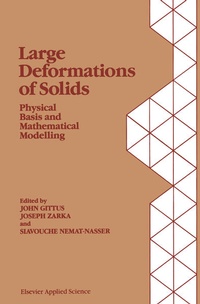
Large Deformations of Solids: Physical Basis and Mathematical Modelling
Published on 26. September 2011
Book
Paperback/Softback
502 pages
978-94-010-8023-1 (ISBN)
Description
A central problem in engineering is the deformation of structures. These may be structures made of metal, from concrete or other buildingmaterials,orfrom soilforexample. Generallyspeaking, the engineerrequiresthedeformationofastructuretoberelativelysmall, predictable, tolerable and non-damaging. Professor Jean Mandel devotedalargepartofhisprofessionalcareertostudiesofdeforma- tionandhewassuccessfulinidentifyingprinciplesandproceduresof wideapplicability.Accordingly,itisveryappropriatetobringtogether as we dointhis volume papers by world authorities concerned with deformationinmemoryofProfessorMandel. The papers in this volume were all invited contributions to an international CNRS colloquium which was held at the Ecole Poly- techniqueinParis, 30September-2October1985. Thevolumeconsidersthedeformationofmetals,rocks,composites, soils, sand and wood. The microscopic processes and theory of deformationaretreated, asarethegenerallawsrelatingdeformation with parameters such as stress system and temperature.
A central problemwhichhasbeensystematicallyattackedinthecaseofmetalsis the relationship between the behaviour of crystal defects such as dislocations and the deformationofa large specimenorengineering component.Itshould be possible to produce accurate predictionsof macroscopic deformation from a microscopic model and substantial progresstowardsthisendhasbeenmadeinrecentyears.Thefirsttwo sectionsofthe bookare largelyconcerned with progress in this very importantarea. A parallel theme which was established in earlier days is the developmentofcontinuummodelsfordeformation.Suchmodelswere proposedatatimewhenmicroscopyhadnotdevelopedtoitspresent levelofsophisticationsothat,forexample,itwasnotestablishedthat v VI PREFACE crystalsactuallycontaineddislocations.Thecontinuumtheorieswhich datebackmorethanacenturysoughttoexplainmicroscopicdeforma- tion in terms of abstract models involving mechanical elements of whichthespringand the dashpot wereprominentexamples.
Froma strictly practical standpoint these continuum models still have great utilitytoday, particularlyinareaswhere the materialsaresocompli- cated that the preferred route, linking microscopic behaviour with macroscopicbehaviour, is notyet available. Section3ofthe book is concernedthereforewiththecontinuumpointofviewformetals.
A central problemwhichhasbeensystematicallyattackedinthecaseofmetalsis the relationship between the behaviour of crystal defects such as dislocations and the deformationofa large specimenorengineering component.Itshould be possible to produce accurate predictionsof macroscopic deformation from a microscopic model and substantial progresstowardsthisendhasbeenmadeinrecentyears.Thefirsttwo sectionsofthe bookare largelyconcerned with progress in this very importantarea. A parallel theme which was established in earlier days is the developmentofcontinuummodelsfordeformation.Suchmodelswere proposedatatimewhenmicroscopyhadnotdevelopedtoitspresent levelofsophisticationsothat,forexample,itwasnotestablishedthat v VI PREFACE crystalsactuallycontaineddislocations.Thecontinuumtheorieswhich datebackmorethanacenturysoughttoexplainmicroscopicdeforma- tion in terms of abstract models involving mechanical elements of whichthespringand the dashpot wereprominentexamples.
Froma strictly practical standpoint these continuum models still have great utilitytoday, particularlyinareaswhere the materialsaresocompli- cated that the preferred route, linking microscopic behaviour with macroscopicbehaviour, is notyet available. Section3ofthe book is concernedthereforewiththecontinuumpointofviewformetals.
More details
Edition
Softcover reprint of the original 1st ed. 1986
Language
English
Place of publication
Dordrecht
Netherlands
Target group
Professional and scholarly
Research
Illustrations
502 p.
Dimensions
Height: 229 mm
Width: 152 mm
Thickness: 29 mm
Weight
750 gr
ISBN-13
978-94-010-8023-1 (9789401080231)
DOI
10.1007/978-94-009-3407-8
Schweitzer Classification
Other editions
Additional editions
J. Gittus | J. Zarka | S. Nemat-Nasser
Large Deformations of Solids: Physical Basis and Mathematical Modelling
E-Book
12/2012
Springer
€53.49
Available for download
J. Gittus | J. Zarka | S. Nemat-Nasser
Large Deformations of Solids: Physical Basis and Mathematical Modelling
Book
01/1987
Kluwer Academic Publishers
€135.50
Article not available at the moment
Content
Session I: General Concepts.- 1. Sur Quelques Concepts Fondamentaux de la Mécanique.- 2. The Statistical Basis of Polycrystal Plasticity.- 3. Modelling of Finite Deformations of Anisotropic Materials.- 4. Microlocal Aspects of Finite Deformations in the Light of Nonstandard Analysis.- Session II: Metals-Physical Point of View.- 5. Déformations Finies des Agrégats Métaux: Aspects Physiques et Métallurgiques.- 6. The Effect of Partial Reversibility of Dislocation Motion.- 7. Effective-cluster Simulation of Polycrystal Plasticity.- 8. Pseudoelasticity and Shape Memory.- 9. A Unified Elastic-Viscoplastic Theory with Large Deformations.- Session III: Metals-Continuum Point of View.- 10. Interaction between Physical Mechanisms and the Structure of Continuum Theories.- 11. Microstructure and Phenomenological Models for Metals.- 12. Study of the Constitutive Law for a Polycrystal and Analysis of Rate Boundary Value Problem in Finite Elastoplasticity.- 13. Thermodynamique et Viscoplasticité du Monocristal Métallique: Comparaison et Synthèse de Modèles à Variables Internes.- 14. Some Applications of the Self-consistent Scheme in the Field of Plasticity and Texture of Metallic Polycrystals.- 15. Fundamental Considerations in Micromechanical Modeling of Polycrystalline Metals at Finite Strain.- Session IV: Rocks and Composites.- 16. Generalization of the Mandel-Spencer Double-Slip Model.- 17. On the Structure of Single Slip and its Implications for Inelasticity.- 18. Kinematics in Plastically Deformed Rocks.- 19. A Theory for Coupled Stress and Fluid Flow Analysis in Jointed Rock Masses.- Session V: Soils.- 20. L'Effet de la Formation des Surfaces de Glissement dans les Milieux Continus.- 21. On Large Deformations of Rock-type Transversely Isotropic Materials.-22. Physical Bases for the Thermo-Hygro-Rheological Behaviours of Wood in Finite Deformations.- 23. Bifurcation par Localisation de la Déformation: Etude Expérimentale et Theorique à L'Essai Biaxial sur Sable.- 24. A Mechanical Description of Saturated Soils.- 25. Some Macroscopic Consequences of the Granular Structure of Sand.