

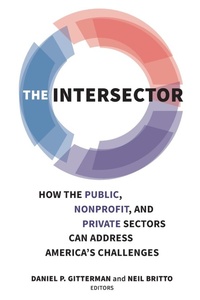
The Intersector
How the Public, Nonprofit, and Private Sectors Can Address America's Challenges
Published on 8. June 2021
Book
Paperback/Softback
305 pages
978-0-8157-3902-9 (ISBN)
Description
Exploring how cross-sector collaboration can solve seemingly intractable societal problems
Many people tend to think of the public, non-profit and private sectors as being distinctive components of the economy and broader society?each with its own missions and problems to address. This book describes how the three sectors can work together toward common purposes, accomplishing much more than if they work alone.
With the nation reeling from multiple challenges, more than ever the United States needs these sectors to collaborate to address what might seem to be intractable problems. Cross-sector collaborations and partnerships are more crucial than in the past as the country tries to recover from the economic, health, and broad social dislocations caused by the COVID-19 pandemic. At a time when trust in institutions, both public and private, is at an all-time low, cooperation among the sectors can be a confidence-inspiring approach to addressing public problems.
This book reviews the state of cross-sector collaborations, identifies emerging practices, and offers a range of perspectives from experts in the field. Practitioners show how cooperation among sectors is relevant to their core missions. Scholars from a wide range of disciplines discuss both the broad and specific concepts that advance understanding of cross-sector collaboration.
At a time when the United States must recover from and address new challenges, the book shows how cross-sector collaborations can help ensure a brighter future. Its core conclusions should be of particular interest to leaders in each of the broad sectors, as well as educators and students at both the undergraduate and graduate level.
Many people tend to think of the public, non-profit and private sectors as being distinctive components of the economy and broader society?each with its own missions and problems to address. This book describes how the three sectors can work together toward common purposes, accomplishing much more than if they work alone.
With the nation reeling from multiple challenges, more than ever the United States needs these sectors to collaborate to address what might seem to be intractable problems. Cross-sector collaborations and partnerships are more crucial than in the past as the country tries to recover from the economic, health, and broad social dislocations caused by the COVID-19 pandemic. At a time when trust in institutions, both public and private, is at an all-time low, cooperation among the sectors can be a confidence-inspiring approach to addressing public problems.
This book reviews the state of cross-sector collaborations, identifies emerging practices, and offers a range of perspectives from experts in the field. Practitioners show how cooperation among sectors is relevant to their core missions. Scholars from a wide range of disciplines discuss both the broad and specific concepts that advance understanding of cross-sector collaboration.
At a time when the United States must recover from and address new challenges, the book shows how cross-sector collaborations can help ensure a brighter future. Its core conclusions should be of particular interest to leaders in each of the broad sectors, as well as educators and students at both the undergraduate and graduate level.
Reviews / Votes
Our country faces daunting problems that cannot be solved by one sector alone. The pandemic, the economic contraction, climate change, and the disproportionate impacts of each on communities of color are among the challenges that require an all-of-society response. By offering a vision of 'intersector' solutions, this volume shows how to build trust among actors in the public, private, and nonprofit sectors, and forge alliances that allow us to manage shared dangers, steward shared resources, and show that our democracy can work if we work it.??Jane Wales, vice president and executive director of the Program on Philanthropy and Social Innovation, Aspen Institute;
?To facilitate an intersectoral approach as a method for addressing public problems, we need new forms of expertise, accountability, and information. . . . This book will give a new generation of leaders the knowledge and tools to make a difference in andfor our public life through cross-sector collaboration.?
?Bill Haslam, former governor of Tennessee (2011-2019) and chair of the board of trustees of the Wilson Center;
?As the contributors to this volume make clear, by working together and establishing the mutual respect needed to trust each other, public, private, and nonprofit sector leaders can solve many of the nation's problems. The possibilities for public goodemerging from such collaborations are almost limitless.?
?Erskine Bowles, former White House chief of staff (1996-1998) and president of the University of North Carolina System (2006-2011)
More details
Language
English
Place of publication
United States
Publishing group
Bloomsbury Publishing Plc
Target group
Professional and scholarly
Illustrations
5 tables
Dimensions
Height: 229 mm
Width: 152 mm
Thickness: 20 mm
Weight
544 gr
ISBN-13
978-0-8157-3902-9 (9780815739029)
Copyright in bibliographic data and cover images is held by Nielsen Book Services Limited or by the publishers or by their respective licensors: all rights reserved.
Schweitzer Classification
Other editions
Additional editions

Daniel P. Gitterman | Neil Britto
The Intersector
How the Public, Nonprofit, and Private Sectors Can Address America's Challenges
E-Book
06/2021
1st Edition
Brookings Institution
€32.99
Available for download

Daniel P. Gitterman | Neil Britto
The Intersector
How the Public, Nonprofit, and Private Sectors Can Address America's Challenges
E-Book
06/2021
1st Edition
Brookings Institution
€32.99
Available for download
Persons
Daniel P. Gitterman is Duncan MacRae '09 and Rebecca Kyle MacRae Professor and Chair of Public Policy at the University of North Carolina at Chapel Hill. He is a Senior Advisor to The Intersector Project at the Aspen Institute's Program on Philanthropy and Social Innovation.Neil Britto was Executive Director and Co-Founder of The Intersector Project, now an initiative of the Aspen Institute's Program on Philanthropy and Social Innovation where he serves as Project Lead. He is an Adjunct Professor at New York University's Wagner School of Public Service and has advised foundations, companies, and governments on cross-sector collaboration.
Content
Contents:
Foreword: The Origins and Future of the "Intersector," Frank A. Weil
Foreword: Government Cann6ot Do It Alone, Governor William E. Haslam
Foreword: Trust Is Everything, Erskine B. Bowles
Acknowledgments
Introduction: The Intersector as a Tool to Address Intractable Problems, Daniel P. Gitterman and Neil Britto
Part I: Scholarly Perspectives
1. Why Intersectional Governance Matters, Peter G. Klein and Anita M. McGahan
2. Cross-Sector Collaboration for the Sustainable Development Goals: A Global Necessity, Not Luxury, Rob van Tulder
3. Creating Value and Sharing Risk: The Next Frontier of Cross-Sector Collaboration, Mary Margaret Frank and Kathryn Babineau
4. Collaborative Governance Regimes: Informing Practice through Research, Kirk Emerson and Min Woo Ahn
5. Collaborative Governance and Rules of the Game in the United States, Lisa Blomgren Amsler
6. Is Public Health's Multisectoral Mission: Achieving Its Promise in the United States? Anita Chandra
7. Cross-Sector Collaboration in Education: The Apolitical Impulse, Jeffrey R. Henig
8. Three Lessons from a Research-Practice Partnership in Education, Ruth N. Lopez Turley and Brian Holzman
9. Collaboration for the People: Community Consultation and the Case of the El Paso Children's Museum, Eric J. Boyer
Part II: Practitioner and Philanthropy
10. Creating Cross-Sector Collaborations to Change Lives, Sonal R. Shah
11. Lift Every Voice: The Biden Administration and Partnerships with Faith-Based and Neighborhood Organizations, Melissa Rogers
12. Challenges in Cross-Sector Collaboration and Learning from Doing: Insights from Philanthropy, Zia Khan
13. How Philanthropy Can Amplify Multisector Stewardship to Support Health and Well-Being, Bobby Milstein, Beth Siegel, and Jane Erickson
14. Improving Economic Mobility through Cross-Sector Collaboration in America's Cities, Simone D. Brody
15. Building a Racially and Economically Inclusive Recovery: What Is the Role for Cross-Sector Collaboration? Erika C. Poethig
16. Social Capital and Quantifying Success Factors for Cross-Sector Collaboration: Insights from the Federal Reserve Bank of Boston, Erin M. Graves and Amy Higgins
17. Cracking the Collaboration Code: Why Do Some Regions Advance while Others Falter? John Melville, Francie Genz, and Lindsey Woolsey
18. The Costs and Benefits of Cross-Sector Partnerships: The Revitalization of New York City's Central Park, William B. Eimicke
19. Cross-Sector Collaboration at the Community Level: Perspectives from the National Neighborhood Indicators Partnership, Kathryn L. S. Pettit and Leah Hendey
20. Rural Place-Based Collaboration: The Transformation of Danville, Virginia, Karl N. Stauber
21. Collaboration at the Speed of Trust, Not Technology: Making Space for the Public Interest in Intersector Data Collaboration, Michelle Shevin and Maia Woluchem
22. Intersector Data-Sharing Strategies: Challenges, Risks, and Opportunities, Dan Wu and Aaron Truchil
23. Multisector Collaboration for Civic Engagement: The Case of Vote Early Day, Maxell Zorick and Joey Wozniak
Conclusion: The Future of Intersectoral Collaboration, Neil Britto and Daniel P. Gitterman
Contributors
Index
Foreword: The Origins and Future of the "Intersector," Frank A. Weil
Foreword: Government Cann6ot Do It Alone, Governor William E. Haslam
Foreword: Trust Is Everything, Erskine B. Bowles
Acknowledgments
Introduction: The Intersector as a Tool to Address Intractable Problems, Daniel P. Gitterman and Neil Britto
Part I: Scholarly Perspectives
1. Why Intersectional Governance Matters, Peter G. Klein and Anita M. McGahan
2. Cross-Sector Collaboration for the Sustainable Development Goals: A Global Necessity, Not Luxury, Rob van Tulder
3. Creating Value and Sharing Risk: The Next Frontier of Cross-Sector Collaboration, Mary Margaret Frank and Kathryn Babineau
4. Collaborative Governance Regimes: Informing Practice through Research, Kirk Emerson and Min Woo Ahn
5. Collaborative Governance and Rules of the Game in the United States, Lisa Blomgren Amsler
6. Is Public Health's Multisectoral Mission: Achieving Its Promise in the United States? Anita Chandra
7. Cross-Sector Collaboration in Education: The Apolitical Impulse, Jeffrey R. Henig
8. Three Lessons from a Research-Practice Partnership in Education, Ruth N. Lopez Turley and Brian Holzman
9. Collaboration for the People: Community Consultation and the Case of the El Paso Children's Museum, Eric J. Boyer
Part II: Practitioner and Philanthropy
10. Creating Cross-Sector Collaborations to Change Lives, Sonal R. Shah
11. Lift Every Voice: The Biden Administration and Partnerships with Faith-Based and Neighborhood Organizations, Melissa Rogers
12. Challenges in Cross-Sector Collaboration and Learning from Doing: Insights from Philanthropy, Zia Khan
13. How Philanthropy Can Amplify Multisector Stewardship to Support Health and Well-Being, Bobby Milstein, Beth Siegel, and Jane Erickson
14. Improving Economic Mobility through Cross-Sector Collaboration in America's Cities, Simone D. Brody
15. Building a Racially and Economically Inclusive Recovery: What Is the Role for Cross-Sector Collaboration? Erika C. Poethig
16. Social Capital and Quantifying Success Factors for Cross-Sector Collaboration: Insights from the Federal Reserve Bank of Boston, Erin M. Graves and Amy Higgins
17. Cracking the Collaboration Code: Why Do Some Regions Advance while Others Falter? John Melville, Francie Genz, and Lindsey Woolsey
18. The Costs and Benefits of Cross-Sector Partnerships: The Revitalization of New York City's Central Park, William B. Eimicke
19. Cross-Sector Collaboration at the Community Level: Perspectives from the National Neighborhood Indicators Partnership, Kathryn L. S. Pettit and Leah Hendey
20. Rural Place-Based Collaboration: The Transformation of Danville, Virginia, Karl N. Stauber
21. Collaboration at the Speed of Trust, Not Technology: Making Space for the Public Interest in Intersector Data Collaboration, Michelle Shevin and Maia Woluchem
22. Intersector Data-Sharing Strategies: Challenges, Risks, and Opportunities, Dan Wu and Aaron Truchil
23. Multisector Collaboration for Civic Engagement: The Case of Vote Early Day, Maxell Zorick and Joey Wozniak
Conclusion: The Future of Intersectoral Collaboration, Neil Britto and Daniel P. Gitterman
Contributors
Index