

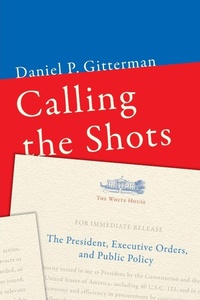
Calling the Shots
The President, Executive Orders, and Public Policy
Published on 14. February 2017
Book
Paperback/Softback
302 pages
978-0-8157-2902-0 (ISBN)
Description
Modern presidents are CEOs with broad powers over the federal government.
The United States Constitution lays out three hypothetically equal branches of government?the executive, the legislative, and the judicial?but over the years, the president, as head of the executive branch, has emerged as the usually dominant political and administrative force at the federal level. In fact, Daniel Gitterman tells us, the president is, effectively, the CEO of an enormous federal bureaucracy.
Using the unique legal authority delegated by thousands of laws, the ability to issue executive orders, and the capacity to shape how federal agencies write and enforce rules, the president calls the shots as to how the government is run on a daily basis. Modern presidents have, for example, used the power of the purchaser to require federal contractors to pay a minimum wage and to prohibit contracting with companies and contractors that knowingly employ unauthorized alien workers.
Presidents and their staffs use specific tools, including executive orders and memoranda to agency heads, as instruments of control and influence over the government and the private sector. For more than a century, they have used these tools without violating the separation of powers. Calling the Shots demonstrates how each of these executive powers is a powerful weapon of coercion and redistribution in the president's political and policymaking arsenal.
The United States Constitution lays out three hypothetically equal branches of government?the executive, the legislative, and the judicial?but over the years, the president, as head of the executive branch, has emerged as the usually dominant political and administrative force at the federal level. In fact, Daniel Gitterman tells us, the president is, effectively, the CEO of an enormous federal bureaucracy.
Using the unique legal authority delegated by thousands of laws, the ability to issue executive orders, and the capacity to shape how federal agencies write and enforce rules, the president calls the shots as to how the government is run on a daily basis. Modern presidents have, for example, used the power of the purchaser to require federal contractors to pay a minimum wage and to prohibit contracting with companies and contractors that knowingly employ unauthorized alien workers.
Presidents and their staffs use specific tools, including executive orders and memoranda to agency heads, as instruments of control and influence over the government and the private sector. For more than a century, they have used these tools without violating the separation of powers. Calling the Shots demonstrates how each of these executive powers is a powerful weapon of coercion and redistribution in the president's political and policymaking arsenal.
Reviews / Votes
The key contribution of the book is in its empirical heft. Professor Gitterman adds rich historical detail to a key assumption of presidential unilateralism: the simple equation that the growth of the administrative state empowers the president."- Congress & the Presidency;"Simply because the government is a major purchaser and a major employer, presidents have wide-ranging powers of unilateral action. That this is so has been implicit in the scholarly literature for years, yet scholars have largely missed the forest for the trees. Gitterman's forest is an interesting and important one. It helps make sense of a mass of unilateral actions by tracing them to common foundations that are readily identified and of considerable importance."- Terry M. Moe, William Bennett Munro Professor of Political Science, Stanford University, and Senior Fellow, Hoover Institution
More details
Language
English
Place of publication
United States
Publishing group
Bloomsbury Publishing Plc
Target group
Professional and scholarly
Illustrations
1 Table
Dimensions
Height: 229 mm
Width: 152 mm
Thickness: 18 mm
Weight
493 gr
ISBN-13
978-0-8157-2902-0 (9780815729020)
Copyright in bibliographic data and cover images is held by Nielsen Book Services Limited or by the publishers or by their respective licensors: all rights reserved.
Schweitzer Classification
Other editions
Additional editions
E-Book
02/2017
1st Edition
Brookings Institution
€28.99
Available for download
E-Book
02/2017
1st Edition
Brookings Institution
€28.99
Available for download
Person
Daniel Gitterman is Duncan MacRae '09 and Rebecca Kyle MacRae Professor and Chair of Public Policy at UNC-Chapel Hill. He also serves as Director of the Honors Seminar on Public Policy and Global Affairs in DC.