

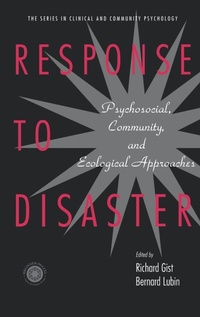
Response to Disaster
Psychosocial, Community, and Ecological Approaches
1st Edition
Published on 1. September 1999
Book
Hardback
232 pages
978-0-87630-998-8 (ISBN)
Description
Psychological service in the wake of cataclysmic life events has emerged as a prominent and visible component of social response. This has generated a bandwagon of potential service providers, service approaches, and service venues. Where once help was scarce, it has become plentiful enough to engender its own set of conflicts and contradictions along with its intended solace and aid. Response to Disaster reconciles the technical, theoretical, and applied interests represented in these various populations and provides a contemporary treatment that can help define the directions of their increasing interaction.
More details
Language
English
Place of publication
New York
United States
Publishing group
Taylor & Francis Ltd
Target group
Professional and scholarly
Professional Practice & Development
Dimensions
Height: 240 mm
Width: 161 mm
Thickness: 25 mm
Weight
740 gr
ISBN-13
978-0-87630-998-8 (9780876309988)
Copyright in bibliographic data and cover images is held by Nielsen Book Services Limited or by the publishers or by their respective licensors: all rights reserved.
Schweitzer Classification
Other editions
Additional editions
E-Book
11/2013
1st Edition
Routledge
€63.49
Available for download
E-Book
11/2013
1st Edition
Routledge
€63.49
Available for download
Book
09/1999
1st Edition
Brunner-Mazel Inc
€70.40
Shipment within 3-4 weeks
Persons
Gist, Richard; Lubin, Bernard
Content
Chapter 1 Psychosocial, Ecological, and Community Perspectives on Disaster Response, Richard Gist, Bernard Lubin, Bradley G. Redburn; Part 1 Theoretical Foundations; Chapter 2 The Experience of Disaster: Individuals and Communities Sharing Trauma, Krzysztof Kaniasty, Fran Norris; Chapter 3 The Short- and Long-Term Psychological Impact of Disasters: Implications for Mental Health Interventions and Policy, Mark S. Salzer, Leonard Bickman; Chapter 4 Assessing the Impact of Trauma in Work-Related Populations: Occupational and Cultural Determinants of Reactivity, Douglas Paton, Leigh M. Smith, Robert Ramsay, Debo Akande; Chapter 5 A Critical Look at PTSD: Constructs, Concepts, Epidemiology, and Implications, Jeffrey P. Staab, Carol S. Fullerton, Robert Ursano; Part 2 Community Strategies for Intervention; Chapter 6 The Help-Seeking Process for Distress after Disaster, Suzanne Yates, Danny Axsom, Karyn Tiedman; Chapter 7 Coping with Disastrous Events: An Empowerment Model of Community Healing, Julie van den Eynde, Arthur Veno; Chapter 8 Children's Responses to Disaster: Family and Systems Approaches, Eric M. Vernberg; Chapter 9 There Are No Simple Solutions to Complex Problems: The Rise and Fall of Critical Incident Stress Debriefing as a Response to Occupational Stress in the Fire Service, Richard Gist, S. Joseph Woodall; Part 3 Contemporary Issues in Community Systems Research and Practice; Chapter 10 Ethical Issues in Working with Communities in Crisis, Patrick O'Neill; Chapter 11 "And Then You Do the Hokey-Pokey and You Turn Yourself Around...", Richard Gist, S. Joseph Woodall, Lynn K. Magenheimer; Chapter 12 Pseudoscience and the Commercial Promotion of Trauma Treatments, Jeffrey M. Lohr, Robert W. Montgomery, Scott O. Lilienfeld, David F. Tolin; Chapter 13 In the Public Arena: Disaster as a Socially Constructed Problem, Lennis G. Echterling, Mary Lou Wylie; Epilogue;