

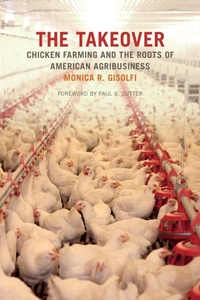
The Takeover
Chicken Farming and the Roots of American Agribusiness
Published on 15. April 2017
Book
Paperback/Softback
124 pages
978-0-8203-4971-8 (ISBN)
Description
Economists have described the upcountry Georgia poultry industry as the quintessential agribusiness. Following a trajectory from Reconstruction through the Great Depression to the present day, Monica R. Gisolfi shows how the poultry farming model of semivertical integration perfected a number of practices that had first underpinned the cotton-growing crop-lien system, ultimately transforming the poultry industry in ways that drove tens of thousands of farmers off the land and rendered those who remained dependent on large agribusiness firms.
Gisolfi argues that the inequalities inherent in the structure of modern poultry farming have led to steep human and environmental costs. Agribusiness firms-many of them descended from the cotton-era South's furnishing merchants-brought farmers into a system of feed-conversion contracts that placed all production decisions in the hands of the poultry corporations but at least half of the capital risks on the farmers. Along the way, the federal government aided and abetted-sometimes unwittingly-the consolidation of power by poultry firms through direct and indirect subsidies and favorable policies. Drawing on USDA files, oral history, congressional records, and poultry publications, Gisolfi puts a local face on one of the twentieth century's silent agribusiness revolutions.
Gisolfi argues that the inequalities inherent in the structure of modern poultry farming have led to steep human and environmental costs. Agribusiness firms-many of them descended from the cotton-era South's furnishing merchants-brought farmers into a system of feed-conversion contracts that placed all production decisions in the hands of the poultry corporations but at least half of the capital risks on the farmers. Along the way, the federal government aided and abetted-sometimes unwittingly-the consolidation of power by poultry firms through direct and indirect subsidies and favorable policies. Drawing on USDA files, oral history, congressional records, and poultry publications, Gisolfi puts a local face on one of the twentieth century's silent agribusiness revolutions.
Reviews / Votes
The Takeover tells us the story of a revolutionary transformation in agriculture's business model that drove tens of thousands of farmers off the land and rendered others dependent on large agribusiness firms. It is a complicated story, and Gisolfi tells it well. She has meticulously combed USDA files, congressional records, and poultry publications to reconstruct the protracted and convoluted transformation of the poultry business. A real strength of the work is her use of archived oral history interviews with poultry growers to put a human face on what, in the hands of another writer, would essentially be a business and institutional history. The Takeover offers poignant testimony of how independent landowners became, in essence, sharecroppers and shows the impact of that metamorphosis on them and their families. -- Melissa Walker * author of Southern Farmers and Their Stories: Memory and Meaning in Oral History * How did the modern poultry industry emerge from a region of cotton farms? What business model can explain why aspiring farmers ended up as powerless, as processed, and as exploited as their chickens? The Takeover deftly examines the agricultural and social history of Upcountry Georgia and reveals the matrix of contract growing, government subsidy, and rural impoverishment that enriched agribusiness integrators and freed these firms from financial and environmental risk. This is a big story about a small place. -- Sarah T. Phillips * author of This Land, This Nation: Conservation, Rural America, and the New Deal * This crucially important book shows ways in which today's chicken farming in North Georgia is essentially an extension of the means of production (or should be say "oppression") found in cotton agribusiness during Reconstruction. It shows how agribusiness retains control and profits while their contract farmers absorb most of the risk. Furthermore, this book illuminates ways that the federal government, through the USDA, has not only enabled this exploitative system, but also subsidized it. * Appalachian Mountain Books *More details
Series
Language
English
Place of publication
Georgia
United States
Target group
College/higher education
Product notice
Paperback (trade)
Dimensions
Height: 229 mm
Width: 152 mm
Thickness: 8 mm
Weight
214 gr
ISBN-13
978-0-8203-4971-8 (9780820349718)
Copyright in bibliographic data and cover images is held by Nielsen Book Services Limited or by the publishers or by their respective licensors: all rights reserved.
Schweitzer Classification
Other editions
Additional editions
E-Book
04/2017
University of Georgia Press
€26.49
Available for download
Persons
MONICA R. GISOLFI is an associate professor of history at the University of North Carolina, Wilmington.