

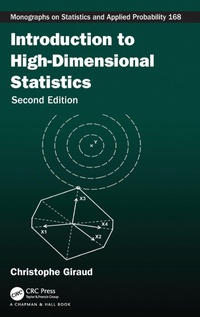
Introduction to High-Dimensional Statistics
2nd Edition
Published on 31. August 2021
Book
Hardback
364 pages
978-0-367-71622-6 (ISBN)
Description
Praise for the first edition:
"[This book] succeeds singularly at providing a structured introduction to this active field of research. ... it is arguably the most accessible overview yet published of the mathematical ideas and principles that one needs to master to enter the field of high-dimensional statistics. ... recommended to anyone interested in the main results of current research in high-dimensional statistics as well as anyone interested in acquiring the core mathematical skills to enter this area of research."
-Journal of the American Statistical Association
Introduction to High-Dimensional Statistics, Second Edition preserves the philosophy of the first edition: to be a concise guide for students and researchers discovering the area and interested in the mathematics involved. The main concepts and ideas are presented in simple settings, avoiding thereby unessential technicalities. High-dimensional statistics is a fast-evolving field, and much progress has been made on a large variety of topics, providing new insights and methods. Offering a succinct presentation of the mathematical foundations of high-dimensional statistics, this new edition:
Offers revised chapters from the previous edition, with the inclusion of many additional materials on some important topics, including compress sensing, estimation with convex constraints, the slope estimator, simultaneously low-rank and row-sparse linear regression, or aggregation of a continuous set of estimators.
Introduces three new chapters on iterative algorithms, clustering, and minimax lower bounds.
Provides enhanced appendices, minimax lower-bounds mainly with the addition of the Davis-Kahan perturbation bound and of two simple versions of the Hanson-Wright concentration inequality.
Covers cutting-edge statistical methods including model selection, sparsity and the Lasso, iterative hard thresholding, aggregation, support vector machines, and learning theory.
Provides detailed exercises at the end of every chapter with collaborative solutions on a wiki site.
Illustrates concepts with simple but clear practical examples.
"[This book] succeeds singularly at providing a structured introduction to this active field of research. ... it is arguably the most accessible overview yet published of the mathematical ideas and principles that one needs to master to enter the field of high-dimensional statistics. ... recommended to anyone interested in the main results of current research in high-dimensional statistics as well as anyone interested in acquiring the core mathematical skills to enter this area of research."
-Journal of the American Statistical Association
Introduction to High-Dimensional Statistics, Second Edition preserves the philosophy of the first edition: to be a concise guide for students and researchers discovering the area and interested in the mathematics involved. The main concepts and ideas are presented in simple settings, avoiding thereby unessential technicalities. High-dimensional statistics is a fast-evolving field, and much progress has been made on a large variety of topics, providing new insights and methods. Offering a succinct presentation of the mathematical foundations of high-dimensional statistics, this new edition:
Offers revised chapters from the previous edition, with the inclusion of many additional materials on some important topics, including compress sensing, estimation with convex constraints, the slope estimator, simultaneously low-rank and row-sparse linear regression, or aggregation of a continuous set of estimators.
Introduces three new chapters on iterative algorithms, clustering, and minimax lower bounds.
Provides enhanced appendices, minimax lower-bounds mainly with the addition of the Davis-Kahan perturbation bound and of two simple versions of the Hanson-Wright concentration inequality.
Covers cutting-edge statistical methods including model selection, sparsity and the Lasso, iterative hard thresholding, aggregation, support vector machines, and learning theory.
Provides detailed exercises at the end of every chapter with collaborative solutions on a wiki site.
Illustrates concepts with simple but clear practical examples.
Reviews / Votes
"This book summarizes many useful research tools for high-dimensional data analysis based on theoretical aspects or applications. It is a nice reference for readers to explore high-dimensional data analysis."Li-Pang Chen, National Chengchi Unicersity, Taiwan, Royal Statistical Society Series A.
More details
Series
Edition
2nd edition
Language
English
Place of publication
Oxford
United Kingdom
Publishing group
Taylor & Francis Ltd
Target group
Professional and scholarly
Academic
Illustrations
28 s/w Abbildungen, 28 s/w Zeichnungen, 1 s/w Tabelle
1 Tables, black and white; 28 Line drawings, black and white; 28 Illustrations, black and white
Dimensions
Height: 240 mm
Width: 161 mm
Thickness: 24 mm
Weight
710 gr
ISBN-13
978-0-367-71622-6 (9780367716226)
Copyright in bibliographic data and cover images is held by Nielsen Book Services Limited or by the publishers or by their respective licensors: all rights reserved.
Schweitzer Classification
Other editions
Additional editions
Christophe Giraud
Introduction to High-Dimensional Statistics
E-Book
08/2021
2nd Edition
Chapman & Hall/CRC
€73.99
Available for download
Christophe Giraud
Introduction to High-Dimensional Statistics
E-Book
08/2021
2nd Edition
Chapman & Hall/CRC
€73.99
Available for download
Previous edition
Christophe Giraud
Introduction to High-Dimensional Statistics
Book
01/2015
1st Edition
Apple Academic Press Inc.
€97.98
Withdrawn from sale
Person
Christophe Giraud was a student of the Ecole Normale Superieure de Paris, and he received a Ph.D in probability theory from the University Paris 6. He was assistant professor at the University of Nice from 2002 to 2008. He has been associate professor at the Ecole Polytechnique since 2008 and professor at Paris Sud University (Orsay) since 2012. His current research focuses mainly on the statistical theory of high-dimensional data analysis and its applications to life sciences.
Content
1. Introduction. 2. Model Selection. 3. Minimax Lower Bounds. 4. Aggregation of Estimators. 5. Convex Criteria. 6. Iterative Algorithms. 7. Estimator Selection. 8. Multivariate Regression. 9. Graphical Models. 10. Multiple Testing. 11. Supervised Classification. 12. Clustering.