

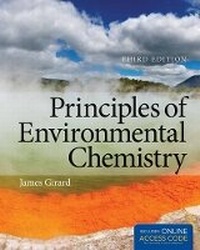
Principles Of Environmental Chemistry
3rd Edition
Published on 28. February 2013
Book
Hardback
712 pages
978-1-4496-9352-7 (ISBN)
Description
Includes access to the Student Companion Website
Appropriate for students with a general chemistry background, Principles of Environmental Chemistry helps students understand the underlying chemical processes that are operating in the environment while demonstrating how difficult it is to measure these systems. The author emphasizes that all living and nonliving parts of our environment are comprised of chemicals and that all of the natural processes continuously occurring in the environment involve chemical reactions. With this concept of interdependence, students begin to see that without some understanding of chemistry, it is impossible to fully understand environmental issues such as ozone depletion, global warming, air and water pollution, and the hazards of radioactivity. The Third Edition includes a new chapter on Green Chemistry as well as numerous updates throughout to address the changes in the field.
Key Features:
- Includes a new chapter on Green Chemistry.
- A new key term glossary is now included at the end of the text.
- New feature boxes assess students understanding of chapter material with analytical questions and problems.
- Includes additional chemical equations throughout the text reinforce important concepts.
- Available with a new electronic student study guide and solutions manual
- Instructor's resources include PowerPoint (R) Lecture Outlines, answers to end of chapter problems, and a testbank.
- A student companion website includes chapter outlines, interactive glossary, flashcards, and weblinks.
Appropriate for students with a general chemistry background, Principles of Environmental Chemistry helps students understand the underlying chemical processes that are operating in the environment while demonstrating how difficult it is to measure these systems. The author emphasizes that all living and nonliving parts of our environment are comprised of chemicals and that all of the natural processes continuously occurring in the environment involve chemical reactions. With this concept of interdependence, students begin to see that without some understanding of chemistry, it is impossible to fully understand environmental issues such as ozone depletion, global warming, air and water pollution, and the hazards of radioactivity. The Third Edition includes a new chapter on Green Chemistry as well as numerous updates throughout to address the changes in the field.
Key Features:
- Includes a new chapter on Green Chemistry.
- A new key term glossary is now included at the end of the text.
- New feature boxes assess students understanding of chapter material with analytical questions and problems.
- Includes additional chemical equations throughout the text reinforce important concepts.
- Available with a new electronic student study guide and solutions manual
- Instructor's resources include PowerPoint (R) Lecture Outlines, answers to end of chapter problems, and a testbank.
- A student companion website includes chapter outlines, interactive glossary, flashcards, and weblinks.
More details
Edition
3rd Revised edition
Language
English
Place of publication
Sudbury
United States
Target group
College/higher education
Edition type
Revised edition
Weight
1616 gr
ISBN-13
978-1-4496-9352-7 (9781449693527)
Copyright in bibliographic data and cover images is held by Nielsen Book Services Limited or by the publishers or by their respective licensors: all rights reserved.
Schweitzer Classification
Other editions
Previous edition
James E. Girard
Principles of Environmental Chemistry
Book
08/2009
2nd Edition
Jones and Bartlett Publishers, Inc
€302.08
Article exhausted; check for reprint
Person
Dr. James Girard is Professor and Chairman of the Chemistry Department at American University. He teaches analytical, environmental and forensic chemistry, as well as chemistry for non-science majors. 'Since he has been at the American University, he has received more than 25 grants totaling more than 3 million dollars and has published over 60 research articles. Professor Girard is a specialist in analytical chemistry. His research focuses on the methods and techniques used to separate and identify complex mixtures. He has also developed methods for the analysis of environmental pollutants in soil and water, the amount of neurotransmitter present in human serum, the concentration of disinfectants in hospital disinfectants, the composition of polymers and the separation and identification of genetic material from DNA.' At American University he has supervised over 25 Masters Theses and 30 PhD dissertations.Professor Girard is the recipient of awards for excellence in teaching and scholarship. He was the 1995 recipient of the Leo Schubert Award for Outstanding Teaching of Science at the College Level from the Washington Academy of Sciences. In addition, Professor Girard has served as an expert witness in court cases involving environmental, patent infringement and personal injury.