

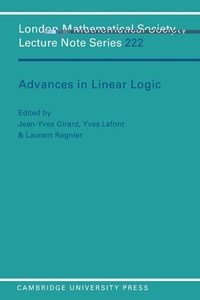
Advances in Linear Logic
Published on 22. June 1995
Book
Paperback/Softback
400 pages
978-0-521-55961-4 (ISBN)
Description
Linear logic, introduced in 1986 by J.-Y. Girard, is based upon a fine grain analysis of the main proof-theoretical notions of logic. The subject develops along the lines of denotational semantics, proof nets and the geometry of interaction. Its basic dynamical nature has attracted computer scientists, and various promising connections have been made in the areas of optimal program execution, interaction nets and knowledge representation. This book is the refereed proceedings of the first international meeting on linear logic held at Cornell University, in June 1993. Survey papers devoted to specific areas of linear logic, as well as an extensive general introduction to the subject by J.-Y. Girard, have been added, so as to make this book a valuable tool both for the beginner and for the advanced researcher.
More details
Series
Language
English
Place of publication
Cambridge
United Kingdom
Target group
Professional and scholarly
Product notice
Paperback (trade)
Illustrations
Worked examples or Exercises
Dimensions
Height: 229 mm
Width: 152 mm
Thickness: 23 mm
Weight
647 gr
ISBN-13
978-0-521-55961-4 (9780521559614)
Copyright in bibliographic data and cover images is held by Nielsen Book Services Limited or by the publishers or by their respective licensors: all rights reserved.
Schweitzer Classification
Other editions
Additional editions
Jean-Yves Girard | Yves LaFont | Laurent Regnier
Advances in Linear Logic
E-Book
01/2011
1st Edition
Cambridge University Press
€66.49
Available for download
Persons
Content
Linear logic: its syntax and semantics J. Y. Girard; Part I. Categories and Semantics: 1. Bilinear logic in algebra and linguistics J. Lambek; 2. A category arising in linear logic, complexity theory and set theory A. Blass; 3. Hypercoherences: a strongly stable model of linear logic T. Erhard; Part II. Complexity and Expressivity: 4. Deciding provability of linear logic formulas P. D. Lincoln; 5. The direct simulation of Minsky machines in linear logic M. I. Kanovich; 6. Stochastic interaction and linear logic P. D. Lincoln, J. Mitchell and A. Scedrov; 7. Inheritance with exceptions C. Fouquere and J. Vauzeilles; Part III. Proof Theory: 8. On the fine structure of the exponential rule S. Martini and A. Masini; 9. Sequent calculi for second order logic V. Danos, J. B. Joinet and H. Schellinx; Part IV. Proff Nets: 10. From proof nets to interaction nets Y. Lafont; 11. Empires and kingdoms in MLL G. Bellin and J. Van De Wiele; 12. Noncommutative proof nets V. M. Abrusci; 13. Volume of multiplicative formulas and provability F. Metayer; Part V. Geometry of Interaction: 14. Proof nets and Hilbert space V. Danos and L. Regnier; 15. Geometry of interacion III: accomodating the additives J. Y. Girard.