

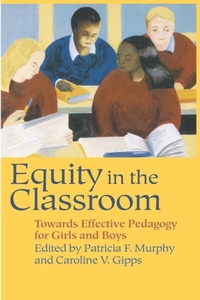
Equity in the Classroom
Towards Effective Pedagogy for Girls and Boys
Published on 18. November 1996
Book
Paperback/Softback
294 pages
978-0-7507-0541-7 (ISBN)
Description
Concerned with pedagogy and the learning achievement of both girls and boys, this book examines international trends in subject performance throughout schooling and looks critically at a range of interventions in difference contexts and countries, all aimed at enhancing equity in schools and higher education institutions.; The book argues that pedagogy can not be isolated from the overarching gender-education system. What can be done, it claims, is that teachers can be provided with a range of pedagogic strategies which can be used to make education, as it is experienced by students and reflected in their achievements, more just.
More details
Language
English
Place of publication
London
United Kingdom
Publishing group
Taylor & Francis Ltd
Target group
College/higher education
Professional and scholarly
Dimensions
Height: 234 mm
Width: 156 mm
Thickness: 16 mm
Weight
453 gr
ISBN-13
978-0-7507-0541-7 (9780750705417)
Copyright in bibliographic data and cover images is held by Nielsen Book Services Limited or by the publishers or by their respective licensors: all rights reserved.
Schweitzer Classification
Other editions
Additional editions
Caroline V. Gipps | Patricia F. Murphy
Equity in the Classroom
Towards Effective Pedagogy for Girls and Boys
E-Book
09/2003
Routledge
€76.49
Available for download
Caroline V. Gipps | Patricia F. Murphy
Equity in the Classroom
Towards Effective Pedagogy for Girls and Boys
E-Book
09/2003
Routledge
€76.49
Available for download
Caroline V. Gipps | Patricia F. Murphy
Equity in the Classroom
Towards Effective Pedagogy for Girls and Boys
Book
11/1996
Routledge Falmer
€217.01
Article not available for order
Persons
Caroline V. Gipps, Patricia F. Murphy
Content
Part 1 Pedagogy and gender: defining pedagogy, Patricia Murphy; a girls' pedagogy in relationship, Jane Roland Martin; citizenship, difference and marginality in schools - spatial and embodied aspects of gender consumption, Tuula Gordon; the pedagogy of difference - an African perspective, Sheila Parvyn; gender identity and cognitive style, John Head. Part 2 Differential learning and performance: scholarship, gender and mathematics, Elizabeth Fennema; girls and information technology, Karen Littleton; research on English and the teaching of girls, Janet White; girls' achievement in science and technology - implications for pedagogy, Jan Harding; is there space for the achieving girl?, Michele Cohen; a socially just pedagogy for the teaching of mathematics, Leone Burton. Part 3 Interventions: redefining achievement, Gaell M. Hildebrand; single-sex settings - pedagogies for girls and boys in Danish schools, Anne Mette Kruse; intervention programmes in science and engineering education from secondary schools to universities, Sue Lewis; how do we influence educators about gender equality?, Jo Sanders; Teachers' Voices, Liz Wyatt Et Al; The Emotional Dimensions Of Feminist pedagogy in schools, Jane Kenway et al; reviews and conclusion, Caroline Gipps.