

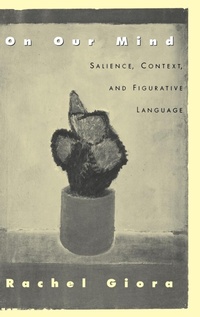
On Our Mind
Salience, Context, and Figurative Language
Published on 5. June 2003
Book
Hardback
272 pages
978-0-19-513616-6 (ISBN)
Description
How do we learn to produce and comprehend non-literal language? Competing theories have only partially accounted for the variety of language comprehension evoked in metaphor, irony, and jokes. Rachel Giora has developed a novel and comprehensive theory, the Graded Salience Hypothesis, to explain figuative language comprehension. Giora contends that the salience of meanings (i.e., the cognitive priority we ascribe to words encoded in our mental lexicon) has the primary role in language comprehension and production.
Reviews / Votes
She has single-handedly lifted a current paradigm out of its hinges and placed it on a new footing, .. despite the many technical explanations, the book is easy to read and the experiments are easy to follow. The well-argued plausibility of Giora's model is at least an eye-opener, if not a refreshing alternative, for people subscribing to different paradigms and who are being helped not least by the pleasant lightheartedness which is an overall positive feature of Giora's book, making it a good read, even for non-professionals. * J.L.Mey, Lingua *More details
Language
English
Place of publication
New York
United States
Target group
Professional and scholarly
Illustrations
2 halftones and numerous figures
Dimensions
Height: 240 mm
Width: 161 mm
Thickness: 19 mm
Weight
575 gr
ISBN-13
978-0-19-513616-6 (9780195136166)
Copyright in bibliographic data and cover images is held by Nielsen Book Services Limited or by the publishers or by their respective licensors: all rights reserved.
Schweitzer Classification
Other editions
Additional editions

E-Book
05/2003
1st Edition
OUP USA
€40.49
Available for download
Person
(Associate Professor of Linguistics, Tel Aviv University, Israel)
Content
1: Prologue
2: Salience and Context
3: Lexical Access
4: Irony
5: Metaphors and Idioms
6: Jokes
7: Innovation
8: Evidence from Other Research
9: Coda: Unaddressed Questions--Food for Future Thought
Notes
References
Author Index
General Index
2: Salience and Context
3: Lexical Access
4: Irony
5: Metaphors and Idioms
6: Jokes
7: Innovation
8: Evidence from Other Research
9: Coda: Unaddressed Questions--Food for Future Thought
Notes
References
Author Index
General Index