

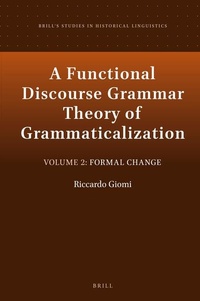
A Functional Discourse Grammar Theory of Grammaticalization
Volume 2: Formal Change
Published on 16. February 2023
Book
Hardback
252 pages
978-90-04-52045-5 (ISBN)
Description
In this volume, long-standing assumptions about the formal changes involved in grammaticalization are evaluated in the light of the striking diversity of human languages. To this end, the traditional notions of morphological coalescence, syntactic fixation and phonological erosion are reassessed with regard to their relationship with the diachronic changes affecting the function of the construction and with larger-scale typological changes that affect the language as a whole (especially, shifts in morphological type and word-order patterns). The author reaches the conclusion that suprasegmental phonological erosion and syntactic fixation (redefined in a template-based framework) are direct consequences of functional change and are therefore significant indicators of grammaticalization, whereas coalescence and segmental erosion are independently motivated by psycholinguistic, rather than strictly grammatical factors.
More details
Series
Language
English
Place of publication
Leiden
Netherlands
Target group
Professional and scholarly
Dimensions
Height: 235 mm
Width: 155 mm
Thickness: 21 mm
Weight
547 gr
ISBN-13
978-90-04-52045-5 (9789004520455)
Copyright in bibliographic data and cover images is held by Nielsen Book Services Limited or by the publishers or by their respective licensors: all rights reserved.
Schweitzer Classification
Person
Riccardo Giomi, Ph.D. (2020), University of Lisbon, is a postdoctoral fellow at the University of Liege. He has authored several publications on Functional Discourse Grammar, among which Headedness and modification in Functional Discourse Grammar (Glossa 5.1, 2020) and The place of interpersonal lexemes in linguistic theory, with special reference to Functional Discourse Grammar (Corpus Pragmatics 5.2, 2021).
Content
List of Tables and Figures
Abbreviations
1 Introduction
2 Syntagmatic Weight
?2.1?Introduction
?2.2?Fusional Languages
?2.3?Agglutinating Languages
?2.4?Isolating Languages
?2.5?Summary and Conclusions
3 Syntagmatic Cohesion
?3.1?The Nature of Bondedness and Its Relations to Other Parameters
?3.2?On the Reliability and Typological Relevance of Coalescence as an Indicator of Grammaticalization
?3.3?Coalescence and Change of Morphological Type
?3.4?Coalescence in Grammaticalization and Lexicalization
?3.5?Summary and Conclusions
4 Syntagmatic Variability
?4.1?Introduction
?4.2?Re(de)fining Syntagmatic Variability
?4.3?Syntagmatic Variability and Word Order Change
?4.4?Summary and Conclusions
5 Phonological Autonomy
?5.1?Segmental Erosion
?5.2?Suprasegmental Erosion
?5.3?Summary and Conclusions
6 Formal Change in FDG
?6.1?Introduction
?6.2?Syntagmatic Cohesion in FDG
?6.3?Syntagmatic Variability in FDG
?6.4?Phonological Autonomy in FDG
?6.5?Conclusions
7 Conclusions
?7.1?In Defence of Complexity
?7.2?Conclusions Proper
References
Language Index
Subject Index
Abbreviations
1 Introduction
2 Syntagmatic Weight
?2.1?Introduction
?2.2?Fusional Languages
?2.3?Agglutinating Languages
?2.4?Isolating Languages
?2.5?Summary and Conclusions
3 Syntagmatic Cohesion
?3.1?The Nature of Bondedness and Its Relations to Other Parameters
?3.2?On the Reliability and Typological Relevance of Coalescence as an Indicator of Grammaticalization
?3.3?Coalescence and Change of Morphological Type
?3.4?Coalescence in Grammaticalization and Lexicalization
?3.5?Summary and Conclusions
4 Syntagmatic Variability
?4.1?Introduction
?4.2?Re(de)fining Syntagmatic Variability
?4.3?Syntagmatic Variability and Word Order Change
?4.4?Summary and Conclusions
5 Phonological Autonomy
?5.1?Segmental Erosion
?5.2?Suprasegmental Erosion
?5.3?Summary and Conclusions
6 Formal Change in FDG
?6.1?Introduction
?6.2?Syntagmatic Cohesion in FDG
?6.3?Syntagmatic Variability in FDG
?6.4?Phonological Autonomy in FDG
?6.5?Conclusions
7 Conclusions
?7.1?In Defence of Complexity
?7.2?Conclusions Proper
References
Language Index
Subject Index