

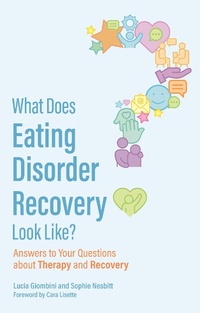
What Does Eating Disorder Recovery Look Like?
Answers to Your Questions about Therapy and Recovery
Published on 21. August 2023
Book
Paperback/Softback
208 pages
978-1-83997-220-1 (ISBN)
Description
Do you have questions about eating disorders that you are afraid to ask? How about questions you did ask, but couldn't get an answer to?
From the causes of eating disorders to the most effective treatment approaches, this guide offers honest answers to difficult questions. Drawing on their experience supporting young people and adults with eating disorders, the authors provide insight into treatment and share information about recovery that is often harder to find.
Ideal for individuals and families at every stage of the recovery process, this book is relevant and sensitive to all types of eating disorder and has been developed to include insights from first-hand experience, alongside expert guidance. It also acknowledges the specific questions families, carers and non-medical professionals might have, helping them to understand the recovery process and better support others.
From the causes of eating disorders to the most effective treatment approaches, this guide offers honest answers to difficult questions. Drawing on their experience supporting young people and adults with eating disorders, the authors provide insight into treatment and share information about recovery that is often harder to find.
Ideal for individuals and families at every stage of the recovery process, this book is relevant and sensitive to all types of eating disorder and has been developed to include insights from first-hand experience, alongside expert guidance. It also acknowledges the specific questions families, carers and non-medical professionals might have, helping them to understand the recovery process and better support others.
Reviews / Votes
An important read for patients, families and clinicians to learn about what eating disorder recovery looks like from two experienced clinicians. Very interesting work. -- Professor Kate Tchanturia, King's College London A book that goes to the heart of the problem with eating disorders - their complexity - and makes that complexity more understandable not only to those who suffer from these conditions, but to family carers and friends, too. Giombini and Nesbitt, together with the voices of some of their patients and carers, write with brave honesty about how frustratingly difficult, unpredictable, messy and imperfect recovery from an eating disorder is, but also about how, notwithstanding this, it is all about learning to trust - oneself and those who reach out to help. -- Dr Giulia Sciolli, Department of Social Anthropology, University of Cambridge An absolute must read! It invites us to think about the meaning of recovery in a very compassionate, holistic and human way. I would encourage everyone to read it. -- Paola Falcoski, Advanced Special Eating Disorder Dietician A very readable book for young people and families experiencing eating disorders. It offers a realistic perspective of the challenges and weaves stories of recovery and hope throughout. -- Claire Higgins, Clinical PsychologistMore details
Language
English
Place of publication
London
United Kingdom
Product notice
Paperback (UK-trade)
Dimensions
Height: 139 mm
Width: 216 mm
Thickness: 17 mm
Weight
224 gr
ISBN-13
978-1-83997-220-1 (9781839972201)
Copyright in bibliographic data and cover images is held by Nielsen Book Services Limited or by the publishers or by their respective licensors: all rights reserved.
Schweitzer Classification
Other editions
Additional editions
Lucia Giombini | Sophie Nesbitt
What Does Eating Disorder Recovery Look Like?
Answers to Your Questions about Therapy and Recovery
E-Book
08/2023
Jessica Kingsley Publishers
€19.99
Available for download
Persons
Lucia Giombini and Sophie Nesbitt are Clinical Psychologists specialising in supporting young people and adults with eating disorders. They are based at Rhodes Wood Hospital, a specialist inpatient unit for childhood and adolescent ED in Hatfield, UK. Both authors are associate fellow members of the British Psychological Society, and work in private practice within their own clinics.