

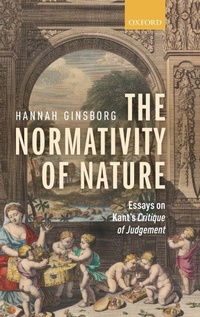
The Normativity of Nature
Essays on Kant's Critique of Judgement
Published on 27. November 2014
Book
Hardback
374 pages
978-0-19-954797-5 (ISBN)
Description
Most philosophers have taken the importance of Kant's Critique of Judgement to lie primarily in its contributions to aesthetics and to the philosophy of biology. Hannah Ginsborg, however, sees the Critique of Judgement as representing a central contribution to the understanding of human cognition more generally. The fourteen essays collected here advance a common interpretive project: that of bringing out the philosophical significance of the notion of judgement which figures in the third Critique and showing its importance both to Kant's own theoretical philosophy and to contemporary views of human thought and cognition. To possess the capacity of judgment, on the interpretation presented here, is to respond to the world in a way which involves the recognition of one's responses as normatively appropriate to the objects which cause them. It is through this capacity that we are able not merely to respond discriminatively to objects, as animals do, but to bring them under concepts and so to make claims about them which can be true or false. The Critique of Judgement, on this reading, rejects the traditional dichotomy between the natural and the normative, taking nature itself both human nature and nature outside us to be comprehensible only in normative terms. The essays in this book develop this reading in its own right, and draw on it to address interpretive debates in Kant's aesthetics, theory of knowledge, and philosophy of biology. They also bring out its relevance to contemporary debates about concept-acquisition, the content of perception, and skepticism about rule-following and meaning.
Reviews / Votes
Hannah Ginsborg's The Normativity of Nature is a tour de force and arguably the most philosophically stimulating book written on Kant's third Critique * Karl Ameriks, British Journal of Aesthetics * The appearance of Ginsborg's book... is particularly gratifying for me in that there is no writer on Kant from whom I have learned more about how Kant's third Critique matters to specifically aesthetic concerns. Her writings on this text have always stood out for me for their steadfast concern to be faithful to aesthetic experience and judgement, as well as for the systematic reading of the third Critique in the context of Kant's general theory of judgement. * Richard Moran, British Journal of Aesthetics * Ginsborg's interpretation of [Kant's] project is sophisticated and highly original. Having her papers available in one collection is important not only for the sake of convenience but also because it draws attention to a tight thematic thread running through the diverse and seemingly disunified parts of the third Critique on her reading. It thereby draws attention to the deep unity of Ginsborg's own ideas on such prima facie disconnected topics such as beauty, concept formation, and biology. * Angela Breitenbach, British Journal of Aesthetics * Over the past twenty-five years, Ginsborg has been building an original body of work that helps us rediscover the third Critique as making a pivotal contribution to Kant's theory of cognition and thus as a necessary complement to the first Critique. Now presented as a whole, The Normativity of Nature embodies the full force of these careful and transformative efforts * Samantha Matherne, The Philosophical Review * A historic landmark in Kant scholarship ... Ginsborg's book will undoubtedly serve as a definitive critical benchmark for scholarship on the third Critique and Kantas Idealism as a whole for decades to come. * Gerad Gentry, The Journal of Aesthetics and Art Criticism * Ginsborg's interpretive analysis of the Critique of Judgement is masterful, thought-provoking, and timely. It has the capacity of bringing unity to a seemingly non-unified corpus of Kantas reflections on aesthetics and teleology. It is attentive to Kant's text without ever being exegetical. It is an essential contribution to contemporary trends on normativity, as much as it speaks to contemporary debates in aesthetics and philosophy of biology too. This is Kant scholarship at its best. * Michela Massimi, Intellectual History Review * Over the last 25 years, Hannah Ginsborg has developed a systematic and highly original line of thought that connects questions about what it means to look at the natural world through the lens of teleology to puzzles about aesthetic judgments and about the ability to acquire concepts. ... the collection's achievement is to lay out detailed answers to specific problems while revealing the systematic unity across the solutions. ... Whether or not readers accept all of Ginsborg's many expertly crafted solutions, they will benefit from her skill at framing very basic, but intricate, philosophical puzzles in an exceptionally clear way. ... The focus of this important collection is on advancing philosophical understanding. * Patricia Kitcher, Notre Dame Philosophical Reviews *More details
Language
English
Place of publication
Oxford
United Kingdom
Target group
College/higher education
Professional and scholarly
Dimensions
Height: 240 mm
Width: 161 mm
Thickness: 25 mm
Weight
725 gr
ISBN-13
978-0-19-954797-5 (9780199547975)
Copyright in bibliographic data and cover images is held by Nielsen Book Services Limited or by the publishers or by their respective licensors: all rights reserved.
Schweitzer Classification
Other editions
Additional editions
Book
11/2014
Oxford University Press
€57.03
Shipment within 15-20 days
E-Book
11/2014
1st Edition
OUP eBook
€29.49
Available for download
E-Book
11/2014
1st Edition
OUP eBook
€29.49
Available for download
Person
Hannah Ginsborg is Professor of Philosophy at the University of California, Berkeley. She received a B.A. in Philosophy and Modern Languages from the University of Oxford, and a Ph.D. in Philosophy from Harvard University. Her publications include articles on Kant's theory of knowledge, aesthetics, and philosophy of biology, as well as on contemporary issues such as rule-following, the normativity of meaning, the content of perception, and the relation between perception and belief.
Content
I. AESTHETICS; II. COGNITION; III. TELEOLOGY