

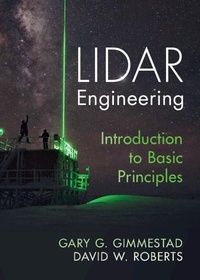
Lidar Engineering
Introduction to Basic Principles
Published on 23. February 2023
Book
Hardback
366 pages
978-0-521-19851-6 (ISBN)
Description
Explore the spectrum of lidar engineering in this one-of-a-kind introduction. For the first time, this multidisciplinary resource covers all the scientific and engineering aspects of atmospheric lidar - including atmospheric science, spectroscopy, lasers and eye safety, classical optics and electro-optics, electrical and mechanical engineering, and software algorithms - in a single comprehensive and authoritative book. Discover up-to-date material not included in any other book, including simple treatments of the lidar crossover range and depolarization in lidar signals, an improved explanation of lidar data inversion algorithms, digital signal processing applications in lidar, and statistical limitations of lidar signal-to-noise ratios. This is an ideal standalone text for students seeking a thorough grounding in lidar, whether through a taught course or self-study.
More details
Language
English
Place of publication
Cambridge
United Kingdom
Product notice
sewn/stitched
Cloth over boards
Illustrations
Worked examples or Exercises
Dimensions
Height: 251 mm
Width: 180 mm
Thickness: 27 mm
Weight
768 gr
ISBN-13
978-0-521-19851-6 (9780521198516)
Copyright in bibliographic data and cover images is held by Nielsen Book Services Limited or by the publishers or by their respective licensors: all rights reserved.
Schweitzer Classification
Persons
Gary G. Gimmestad is an Instructor in Professional Education at the Georgia Institute of Technology, Atlanta, USA. He is a fellow of the IEEE, OSA, AAAS, and SPIE, and is a Fulbright Scholar. He has twice received Order or Merit awards for service to the lidar community for organizing and presenting Lidar Tutorials at International Laser Radar Conferences. David W. Roberts is Chief Engineer at MicroDynamics LLC. He worked for the Georgia Tech Research Institute's Electro-Optical Systems Laboratory for thirty years where he developed innovative atmospheric lidar systems for measuring aerosols, ozone, water vapor, and optical turbulence.
Content
1. Introduction; 2. The basic lidar models; 3. The molecular atmosphere; 4. Particles in the atmosphere; 5. Lidar transmitters; 6. Lidar receivers and the geometrical function; 7. Optomechanics; 8. Optical detection; 9. Data systems; 10. Lidar data analysis; 11. Applications; Appendix.