

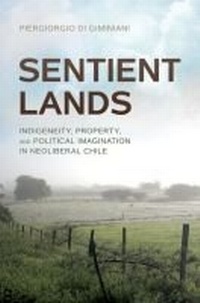
Sentient Lands
Indigeneity, Property, and Political Imagination in Neoliberal Chile
Published on 30. November 2018
Book
Hardback
264 pages
978-0-8165-3552-1 (ISBN)
Description
In 1990, when Augusto Pinochet's 17-year military dictatorship ended, democratic rule returned to Chile. Since then, Indigenous organizations have mobilized to demand restitution of their ancestral territories seized over the past 150 years.
Sentient Lands is a historically grounded ethnography of the Mapuche people's engagement with state-run reconciliation and land-restitution efforts. Piergiorgio Di Giminiani analyzes environmental relations, property, state power, market forces, and indigeneity to illustrate how land connections are articulated, both in landscape experiences and in land claims. Rather than viewing land claims as simply bureaucratic procedures imposed on local understandings and experiences of land connections, Di Giminiani reveals these processes to be disputed practices of world making.
Ancestral land formation is put in motion by the entangled principles of Indigenous and legal land ontologies, two very different and sometimes conflicting processes. Indigenous land ontologies are based on a relation between two subjects-land and people-both endowed with sentient abilities. By contrast, legal land ontologies are founded on the principles of property theory, wherein land is an object of possession that can be standardized within a regime of value. Governments also use land claims to domesticate Indigenous geographies into spatial constructs consistent with political and market configurations.
Exploring the unexpected effects on political activism and state reparation policies caused by this entanglement of legal and Indigenous land ontologies, Di Giminiani offers a new analytical angle on Indigenous land politics.
Sentient Lands is a historically grounded ethnography of the Mapuche people's engagement with state-run reconciliation and land-restitution efforts. Piergiorgio Di Giminiani analyzes environmental relations, property, state power, market forces, and indigeneity to illustrate how land connections are articulated, both in landscape experiences and in land claims. Rather than viewing land claims as simply bureaucratic procedures imposed on local understandings and experiences of land connections, Di Giminiani reveals these processes to be disputed practices of world making.
Ancestral land formation is put in motion by the entangled principles of Indigenous and legal land ontologies, two very different and sometimes conflicting processes. Indigenous land ontologies are based on a relation between two subjects-land and people-both endowed with sentient abilities. By contrast, legal land ontologies are founded on the principles of property theory, wherein land is an object of possession that can be standardized within a regime of value. Governments also use land claims to domesticate Indigenous geographies into spatial constructs consistent with political and market configurations.
Exploring the unexpected effects on political activism and state reparation policies caused by this entanglement of legal and Indigenous land ontologies, Di Giminiani offers a new analytical angle on Indigenous land politics.
Reviews / Votes
Di Giminiani offers a compelling and historically grounded exploration of Mapuche territorial claims. He illustrates the importance of understanding these claims in terms of both strategic engagement with neoliberal norms, and embodied understandings of land as subject rather than object.""-Kathryn Hicks, Department of Anthropology, University of Memphis""Di Giminiani skillfully describes and analyzes the fragmentation and ambiguities within Mapuche farmers' lived worlds using theoretical currents from anthropology (e.g., economic and political anthropology, landscape anthropology, and Amazonian and Andean studies) and beyond (e.g., geography and philosophy).""-Jose Antonio Kelly, author of State Healthcare and Yanomami Transformations
""Deftly interweaving political economy, phenomenology, and the so-called ontological turn in the social sciences, Di Giminiani has produced an ethnography indispensable for understanding the potential role of Indigenous mobilization in the Anthropocene.""-Mario Blaser, Canada Research Chair in Aboriginal Studies, Memorial University of Newfoundland
More details
Language
English
Place of publication
Tucson
United States
Target group
Professional and scholarly
Illustrations
13 Black & white photographs, 3 maps
Dimensions
Height: 229 mm
Width: 152 mm
Thickness: 22 mm
Weight
513 gr
ISBN-13
978-0-8165-3552-1 (9780816535521)
Copyright in bibliographic data and cover images is held by Nielsen Book Services Limited or by the publishers or by their respective licensors: all rights reserved.
Schweitzer Classification
Person
Piergiorgio Di Giminiani is an associate professor of anthropology at the Pontificia Universidad Catolica de Chile.