

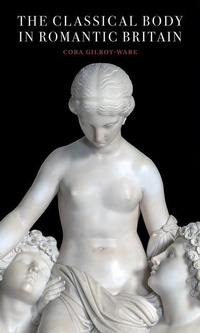
The Classical Body in Romantic Britain
Published on 14. April 2020
Book
Hardback
320 pages
978-1-913107-06-2 (ISBN)
Description
A radical, lively departure from received notions about art of the Romantic period
For many, the term "neoclassicism" has come to imply discipline, order, restraint, and a certain myopia. Leaving the term behind, this book radically challenges enduring assumptions about the art produced from the late 18th century to the early Victorian period, casting new light on appropriations of the classical body by British artists. It is the first to foreground the intersections of gender, race, and class in discussions of British visual classicism, laying bare artists' alternately politicizing and emphatically sensual engagements with Greco-Roman art. Rather than rely exclusively on subsequent scholarship, the book takes up the poet John Keats (1795-1821) as a theoretical framework. Eschewing the "Golden Age" narrative, which sees J. M. W. Turner (1775-1851) as the pinnacle of the period's artistic achievement, the book examines overlooked artists, such as Henry Howard (1769-1847) and John Graham Lough (1798-1876). The result is a fresh account of underappreciated works of British painting and sculpture.
Distributed for the Paul Mellon Centre for Studies in British Art
For many, the term "neoclassicism" has come to imply discipline, order, restraint, and a certain myopia. Leaving the term behind, this book radically challenges enduring assumptions about the art produced from the late 18th century to the early Victorian period, casting new light on appropriations of the classical body by British artists. It is the first to foreground the intersections of gender, race, and class in discussions of British visual classicism, laying bare artists' alternately politicizing and emphatically sensual engagements with Greco-Roman art. Rather than rely exclusively on subsequent scholarship, the book takes up the poet John Keats (1795-1821) as a theoretical framework. Eschewing the "Golden Age" narrative, which sees J. M. W. Turner (1775-1851) as the pinnacle of the period's artistic achievement, the book examines overlooked artists, such as Henry Howard (1769-1847) and John Graham Lough (1798-1876). The result is a fresh account of underappreciated works of British painting and sculpture.
Distributed for the Paul Mellon Centre for Studies in British Art
Reviews / Votes
"Cora Gilroy-Ware mounts a refreshing, combative argument for the radical links of white marble statuary."-Marina Warner, Times Literary Supplement 'Books of the Year'More details
Language
English
Place of publication
United Kingdom
Target group
Professional and scholarly
Product notice
Cloth over boards
Illustrations
109 color + b-w illus.
Dimensions
Height: 292 mm
Width: 178 mm
Thickness: 28 mm
Weight
1247 gr
ISBN-13
978-1-913107-06-2 (9781913107062)
Copyright in bibliographic data and cover images is held by Nielsen Book Services Limited or by the publishers or by their respective licensors: all rights reserved.
Schweitzer Classification
Person
Cora Gilroy-Ware is a scholar, artist, and curator currently working with Isaac Julien CBE RA.