

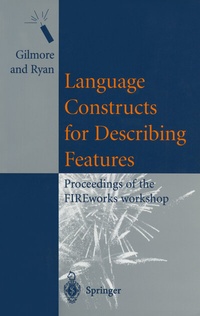
Language Constructs for Describing Features
Proceedings of the FIREworks workshop
1st Edition
Published on 27. November 2000
Book
Paperback/Softback
X, 233 pages
978-1-85233-392-8 (ISBN)
Description
A feature is a small modification or extension of a system which can be seen as having a self-contained functional role, such as Call Forwarding, Automatic Call back and Voice Mail in telephone services, to which users can subscribe. Feature interaction happens when one feature modifies or subverts the operation of another, and this problem has received a great deal of attention from industry and academics, especially in the field of telecommunications, where new services are constantly being developed and deployed. This volume contains refereed papers resulting from the ESPRIT FIREworks working group. The papers focus on the language constructs which have been developed describing features, and advocate a feature-oriented approach to software design including requirements specification languages and verifications logics.
More details
Edition
1st Edition
Language
English
Place of publication
London
United Kingdom
Target group
Professional and scholarly
Research
Illustrations
10 s/w Abbildungen
X, 233 p. 10 illus.
Dimensions
Height: 235 mm
Width: 155 mm
Thickness: 14 mm
Weight
376 gr
ISBN-13
978-1-85233-392-8 (9781852333928)
DOI
10.1007/978-1-4471-0287-8
Schweitzer Classification
Other editions
Additional editions
Stephen Gilmore | Mark Ryan
Language Constructs for Describing Features
Proceedings of the FIREworks workshop
E-Book
12/2012
Springer
€53.49
Available for download
Content
Structuring telecommunications features.- Feature-oriented description, formal methods, and DFC.- Use case maps as a feature description notation.- An incremental method for the design of feature-oriented systems.- Abstraction and refinement of features.- Proving feature non-interaction with Alternating-Time Temporal Logic.- Algebraic treatment of feature-oriented systems.- The PEPA feature construct.- A heuristic algorithm to detect feature interactions in requirements.- Defining features for CSP: Reflections on the feature interaction contest.- Stack service model.- The declarative language STR (State Transition Rule).- Modular feature integration and validation in a synchronous context.