

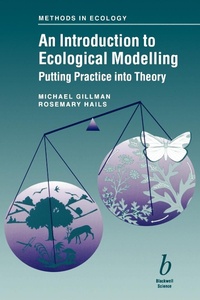
Introduction to Ecological Modelling
1st Edition
Published on 27. February 1997
Book
Paperback/Softback
216 pages
978-0-632-03634-9 (ISBN)
Description
At present, most books on ecological modelling rely on very complex mathematics, resulting in students and researchers shying away from investigating the potential uses of ecological models and their methods of construction.
This new book aims to open up this exciting area to a much wider audience. Assuming only basic mathematical knowledge, the text uses case studies to show how a relatively small set of techniques of model construction can be used in a wide range of important applications. Researchers will find it an invaluable guide to using ecological models in their work.
Uses case studies to clearly demonstrate the applications of ecological models.
Avoids complex mathematics.
A practical how-to guide for ecological researchers.
Sample ecological models available via this web site.
This new book aims to open up this exciting area to a much wider audience. Assuming only basic mathematical knowledge, the text uses case studies to show how a relatively small set of techniques of model construction can be used in a wide range of important applications. Researchers will find it an invaluable guide to using ecological models in their work.
Uses case studies to clearly demonstrate the applications of ecological models.
Avoids complex mathematics.
A practical how-to guide for ecological researchers.
Sample ecological models available via this web site.
Reviews / Votes
"Teachers of courses on ecological modelling will find [this book] a useful source-book at a competitive price."More details
Series
Language
English
Place of publication
Hoboken
United Kingdom
Publishing group
John Wiley and Sons Ltd
Target group
College/higher education
Professional and scholarly
Product notice
Paperback (trade)
Unsewn / adhesive bound
Dimensions
Height: 234 mm
Width: 156 mm
Thickness: 12 mm
Weight
336 gr
ISBN-13
978-0-632-03634-9 (9780632036349)
Copyright in bibliographic data and cover images is held by Nielsen Book Services Limited or by the publishers or by their respective licensors: all rights reserved.
Schweitzer Classification
Persons
Mike Gillman has been based at the Open University since 1990. He has contributed to a diverse set of undergraduate and postgraduate courses in biological and environmental science. His research interests are equally broad, spanning population dynamics, community ecology and evolutionary biology. He has a particular interest in the environment and conservation of Neotropical forests.
Rosemary Hails is a professor at the Centre for Ecology & Hydrology in Wallingford, UK. She was educated at Oxford University, where she earned a BA Honours in Zoology. Hails is a vice president and member of council for the British Ecological Society - BES -.
Rosemary Hails is a professor at the Centre for Ecology & Hydrology in Wallingford, UK. She was educated at Oxford University, where she earned a BA Honours in Zoology. Hails is a vice president and member of council for the British Ecological Society - BES -.
Content
Introduction: Themes Of Ecological Modelling. Probability Of Population Extinction.
Looking For Cycles: The Dynamics Of Predators And Their Prey.
Population Dynamics Of Species With Complex Life-Histories.
Dynamics Of Ecological Communities.
Spatial Models And Thresholds.
Disease And Biological Control.
Answers To Questions.
Glossary Of Symbols And Terms.
References.
Index
Looking For Cycles: The Dynamics Of Predators And Their Prey.
Population Dynamics Of Species With Complex Life-Histories.
Dynamics Of Ecological Communities.
Spatial Models And Thresholds.
Disease And Biological Control.
Answers To Questions.
Glossary Of Symbols And Terms.
References.
Index