

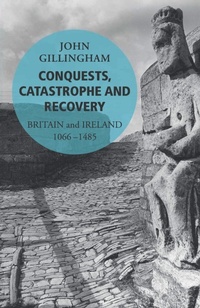
Conquests, Catastrophe and Recovery
Britain and Ireland 1066-1485
Published on 30. October 2014
Book
Paperback/Softback
368 pages
978-0-09-956324-2 (ISBN)
Description
Beginning with the Norman Conquest of England, these tumultuous centuries and their invasions shaped the languages and political geography of present-day Britain and Ireland.
The Irish, Scots and Welsh fought their battles against the English with varying success - struggles which, like the events of 1066 in England, produced spectacular upheavals and left enduring national memories. But there was still a common enemy: the Black Death - still the greatest catastrophe in their history.
There were significant advances, too. Hundreds of new towns were founded; slavery, still prevalent until the twelfth century, died out; magnificent cathedrals built, schools and universities established; clocks, gunpowder and the printing press. Magna Carta set new standards for holding governments to account and trial by jury won a central place in the legal systems of England and Scotland.
Tracing the political, religious and material cultures of the period, as well as what might have been, John Gillingham seeks to define the ways in which lives changed during these turbulent times. With the words of contemporaries to guide us, we can understand more than ever before about national identities and the differences which came to define and ultimately untie these islands.
The Irish, Scots and Welsh fought their battles against the English with varying success - struggles which, like the events of 1066 in England, produced spectacular upheavals and left enduring national memories. But there was still a common enemy: the Black Death - still the greatest catastrophe in their history.
There were significant advances, too. Hundreds of new towns were founded; slavery, still prevalent until the twelfth century, died out; magnificent cathedrals built, schools and universities established; clocks, gunpowder and the printing press. Magna Carta set new standards for holding governments to account and trial by jury won a central place in the legal systems of England and Scotland.
Tracing the political, religious and material cultures of the period, as well as what might have been, John Gillingham seeks to define the ways in which lives changed during these turbulent times. With the words of contemporaries to guide us, we can understand more than ever before about national identities and the differences which came to define and ultimately untie these islands.
Reviews / Votes
No other single volume offers so comprehensive a consideration of the geography, economy, politics, society and religion of medieval Britain in so engaging and accessible a fashion as Gillingham's -- Sarah Foot * BBC History Magazine * Excellent -- Dan Snow Clear, concise and utterly compelling. You won't find a better general history of medieval Britain -- Marc MorrisMore details
Language
English
Place of publication
London
United Kingdom
Publishing group
Vintage Publishing
Product notice
Paperback (UK-B)
Dimensions
Height: 198 mm
Width: 129 mm
Thickness: 22 mm
Weight
438 gr
ISBN-13
978-0-09-956324-2 (9780099563242)
Copyright in bibliographic data and cover images is held by Nielsen Book Services Limited or by the publishers or by their respective licensors: all rights reserved.
Schweitzer Classification
Other editions
Additional editions
E-Book
10/2014
1st Edition
Vintage Digital
€12.99
Available for download
Person
John Gillingham is Emeritus Professor of History at the London School of Economics and Political Science and a Fellow of the British Academy. His books include Richard I (1999), The English in the Twelfth Century: Imperialism, National Identity and Political Values (2000) and The Angevin Empire (2001).