

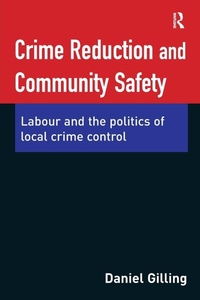
Crime Reduction and Community Safety
Labour and the politics of local crime control
1st Edition
Published on 1. November 2007
Book
Paperback/Softback
272 pages
978-1-84392-251-3 (ISBN)
Description
This book analyses Labour's policies of local crime control from 1997 through to 2006. Picking up on the Conservative legacy, it follows the establishment of local crime and disorder reduction partnerships and tracks developments from Labour's attempts to subject them to a centrally-imposed performance management regime, through to the emergence of a strong neighbourhoods agenda, combined with the imposition of a largely enforcement-oriented attack on anti-social behaviour. It also explores Labour's attempts to address the causes of crime through a policy agenda that has crystallised around themes of social exclusion, social capital, community cohesion and civil renewal; and that operates through an architecture that aspires to be joined up centrally and locally, and neighbourhood-based.
The main focus of the book is upon the unfolding of Labour's 'third way' political project from the centre downwards, but the limitations of this project are exposed through an exploration of a number of key themes. These include Labour's dependence upon the different translations of local practitioners, with whom it engages in a discursive politics of crime reduction versus community safety, and through whom the conceptual and practical weaknesses of evidence-based practice, performance management and joined-up government are revealed.
The main focus of the book is upon the unfolding of Labour's 'third way' political project from the centre downwards, but the limitations of this project are exposed through an exploration of a number of key themes. These include Labour's dependence upon the different translations of local practitioners, with whom it engages in a discursive politics of crime reduction versus community safety, and through whom the conceptual and practical weaknesses of evidence-based practice, performance management and joined-up government are revealed.
Reviews / Votes
'Daniel Gilling's text provides us with the definitive criminological analysis of New Labour's national project on community safety and crime prevention over the last decade. Written in an authoritative yet accessible style, it will become a classic case study of the contradictions of this UK government's ambitious if flawed governmental experiment in local crime control. Gilling's careful and penetrating diagnosis of government rhetoric and policy is measured, provocative and ultimately profoundly disturbing. 'Must read' for students, teachers, researchers and, you'd hope, practitioners and policy makers in the UK and beyond.' - Professor Gordon Hughes, Cardiff UniversityMore details
Language
English
Place of publication
Cullompton
United Kingdom
Publishing group
Taylor & Francis Ltd
Target group
Professional and scholarly
College/higher education
Dimensions
Height: 234 mm
Width: 156 mm
Thickness: 15 mm
Weight
430 gr
ISBN-13
978-1-84392-251-3 (9781843922513)
Copyright in bibliographic data and cover images is held by Nielsen Book Services Limited or by the publishers or by their respective licensors: all rights reserved.
Schweitzer Classification
Other editions
Additional editions
Daniel Gilling
Crime Reduction and Community Safety
E-Book
01/2013
1st Edition
Willan Publishing
€55.49
Available for download
Daniel Gilling
Crime Reduction and Community Safety
E-Book
01/2013
1st Edition
Willan Publishing
€55.49
Available for download
Book
11/2007
1st Edition
Willan Publishing
€163.42
Shipment within 3-4 weeks
Person
Daniel Gilling is Associate Professor in Criminal Justice Studies at the University of Plymouth, UK.
Content
1. Introduction 2. Labour's political project 3. Imposing the crime reduction agenda 4. From crime reduction to community safety? 5. Getting tough: anti-social behaviour and the politics of enforcement 6. Going soft? Tackling the causes of Labour's crime problem 7. Losing control: from politics into practice 8. Leaving its mark: Labour and the new landscape of local crime control