

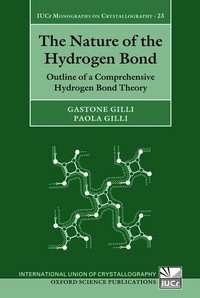
The Nature of the Hydrogen Bond
Outline of a Comprehensive Hydrogen Bond Theory
Published on 11. April 2013
Book
Paperback/Softback
336 pages
978-0-19-967347-6 (ISBN)
Description
Hydrogen bond (H-bond) effects are known: it makes sea water liquid, joins cellulose microfibrils in trees, shapes DNA into genes and polypeptide chains into wool, hair, muscles or enzymes. Its true nature is less known and we may still wonder why O-H...O bond energies range from less than 1 to more than 30 kcal/mol without apparent reason. This H-bond puzzle is re-examined here from its very beginning on the ground of an inclusive compilation of experimental H-bond energies and geometries.
New concepts emerge from this analysis: new classes of systematically strong H-bonds (CAHBs and RAHBs: charge- and resonance-assisted H-bonds); full H-bond classification in six classes (the six chemical leitmotifs); and assessment of the covalent nature of strong H-bonds. This leads to three distinct but inter-consistent models able to rationalize the H-bond and predict its strength, based on classical VB theory, matching of donor-acceptor acid-base parameters (PA or pKa), or shape of the H-bond proton-transfer pathway.
Applications survey a number of systems where strong H-bonds play an important functional role, namely drug-receptor binding, enzymatic catalysis, ion-transport through cell membranes, crystal design and molecular mechanisms of functional materials.
New concepts emerge from this analysis: new classes of systematically strong H-bonds (CAHBs and RAHBs: charge- and resonance-assisted H-bonds); full H-bond classification in six classes (the six chemical leitmotifs); and assessment of the covalent nature of strong H-bonds. This leads to three distinct but inter-consistent models able to rationalize the H-bond and predict its strength, based on classical VB theory, matching of donor-acceptor acid-base parameters (PA or pKa), or shape of the H-bond proton-transfer pathway.
Applications survey a number of systems where strong H-bonds play an important functional role, namely drug-receptor binding, enzymatic catalysis, ion-transport through cell membranes, crystal design and molecular mechanisms of functional materials.
Reviews / Votes
A real contribution to the field. * Gautam R. Desiraju, University of Hyderabad * This book should be required reading for biochemists as well as for anyone who designs or interprets empirical models that need to reproduce systems where H-bonding is important. A valuable contribution to our understanding of H-bonds. The Gillis should be commended for the considerable time and effort they must have spent on this endeavor. * Journal of the American Chemical Society *More details
Series
Language
English
Place of publication
Oxford
United Kingdom
Target group
College/higher education
Professional and scholarly
Researchers, lecturers, and postgraduates in crystallography, chemistry, molecular biology and pharmacology, molecular material sciences, and solid-state physics.
Product notice
Paperback (trade)
Unsewn / adhesive bound
Illustrations
120 b/w line illustrations and 6 page colour plate section
Dimensions
Height: 233 mm
Width: 154 mm
Thickness: 25 mm
Weight
603 gr
ISBN-13
978-0-19-967347-6 (9780199673476)
Copyright in bibliographic data and cover images is held by Nielsen Book Services Limited or by the publishers or by their respective licensors: all rights reserved.
Schweitzer Classification
Other editions
Additional editions
Gastone Gilli | Paola Gilli
The Nature of the Hydrogen Bond
Outline of a Comprehensive Hydrogen Bond Theory
Book
06/2009
Oxford University Press
€188.80
Shipment within 15-20 days
Persons
Professor Gastone Gilli
Full Professor of Physical Chemistry and Director of the Centre for Structural Diffractometry
University of Ferrara, Italy
Dr Paola Gilli
Researcher of Physical Chemistry
University of Ferrara, Italy
Full Professor of Physical Chemistry and Director of the Centre for Structural Diffractometry
University of Ferrara, Italy
Dr Paola Gilli
Researcher of Physical Chemistry
University of Ferrara, Italy
Content
Introduction ; 1. A century of hydrogen bond (H-bond) ; 2. Generalities, definitions and preliminary classification ; 3. Modelling the H-bond by crystallographic methods ; 4. Modelling the H-bond by thermodynamic methods ; 5. The empirical laws governing the H-bond: A summary ; 6. Outline of a novel transition-state H-bond theory (TSHBT) ; 7. The strength of the H-bond: Definitions and thermodynamics ; 8. The role of strong H-bonds in nature: A gallery of functional H-bonds ; References