

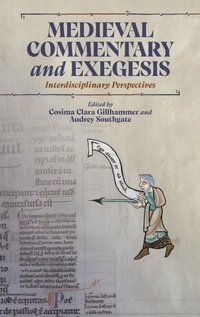
Medieval Commentary and Exegesis
Interdisciplinary Perspectives
Will be published approx. on 24. February 2026
Book
Hardback
304 pages
978-1-84384-767-0 (ISBN)
Description
Interdisciplinary study of the medieval commentary tradition, covering a range of sources from the Wycliffite Bible and French Marian Lyric to John Lydgate and Anselm of Canterbury.
Textual and material survivals from across medieval Europe testify to a pervasive commentary culture on Scripture. The biblical text becomes a central object of explication and comment, generating a variety of interpretive texts and genres. But precisely because it is so ubiquitous, medieval commentary can also prove elusive, requiring perspectives from different disciplines. How can we define commentary, and how does it develop and function in different linguistic and geographical areas? What role do commentaries play in the formation and reformulation of personal and national identities across the period? How can contemporary scholars best approach this fundamental genre of the medieval world?
Exploring these among many other questions, this volume revises and refines our current understanding of the intellectual, cultural, and literary dynamics of the medieval commentary tradition. Contributors consider matters such asauthority, patronage, readership, textual genesis, and material contexts of commentary, as well as the absences and lacunae in our knowledge, and how we might take these into account from today's perspective. Expansive in their chronological, methodological, and disciplinary scope, the chapters here illuminate the origins and forms of commentary from Late Antiquity to the late medieval period in Western Europe, extending across Hebrew, Latin and vernacular texts, and examine a wide range of literary and cultural artefacts, from single-authored works to manuscript compilations.
Textual and material survivals from across medieval Europe testify to a pervasive commentary culture on Scripture. The biblical text becomes a central object of explication and comment, generating a variety of interpretive texts and genres. But precisely because it is so ubiquitous, medieval commentary can also prove elusive, requiring perspectives from different disciplines. How can we define commentary, and how does it develop and function in different linguistic and geographical areas? What role do commentaries play in the formation and reformulation of personal and national identities across the period? How can contemporary scholars best approach this fundamental genre of the medieval world?
Exploring these among many other questions, this volume revises and refines our current understanding of the intellectual, cultural, and literary dynamics of the medieval commentary tradition. Contributors consider matters such asauthority, patronage, readership, textual genesis, and material contexts of commentary, as well as the absences and lacunae in our knowledge, and how we might take these into account from today's perspective. Expansive in their chronological, methodological, and disciplinary scope, the chapters here illuminate the origins and forms of commentary from Late Antiquity to the late medieval period in Western Europe, extending across Hebrew, Latin and vernacular texts, and examine a wide range of literary and cultural artefacts, from single-authored works to manuscript compilations.
More details
Language
English
Place of publication
Cambridge
United Kingdom
Publishing group
Boydell & Brewer Ltd
Target group
Professional and scholarly
Product notice
Cloth over boards
Illustrations
11 b/w illus.
Dimensions
Height: 240 mm
Width: 161 mm
Thickness: 22 mm
Weight
652 gr
ISBN-13
978-1-84384-767-0 (9781843847670)
Copyright in bibliographic data and cover images is held by Nielsen Book Services Limited or by the publishers or by their respective licensors: all rights reserved.
Schweitzer Classification
Persons
COSIMA CLARA GILLHAMMER is a Career Development Fellow in Medieval English at Lady Margaret Hall, University of Oxford AUDREY SOUTHGATE is currently an Academic Visitor in Oxford's English faculty, teaching Old and Middle English and researching the pedagogical reception history of the Psalms. AUDREY SOUTHGATE is currently an Academic Visitor in Oxford's English faculty, teaching Old and Middle English and researching the pedagogical reception history of the Psalms. COSIMA CLARA GILLHAMMER is a Career Development Fellow in Medieval English at Lady Margaret Hall, University of Oxford
Content
INTRODUCTION
Why Commentary?
Lesley Smith
PART I: GENRES AND FORMS
1 Iohannes Apostolus and Anselm of Laon: Foundations of the Glossa Ordinaria and Twelfth-Century Biblical Commentary Practices
Simon Whedbee
2 Parables, Beatitudes, and History: Early Medieval Exegesis of Matthew 13 in an Augustinian Mode
David J. Elliott
3 The Children from Stones: Michael Suchenschatz on Metaphors and Magic from the Gospels
Edit Anna Lukacs
4 Translation as Commentary? Literal and Expository Modes in the Wycliffite Bible
Elizabeth Solopova
PART II: IDENTITIES
5 Conversing with the Sage King Solomon: Hellenistic Jewish Sages' Commentary on Wisdom of Solomon and Sirach
Jiani Sun
6 The Association of Punic and Hebrew in North African Exegesis and Ecclesial Identity
Joshua Caminiti
7 Biblical Commentary and Royal Patronage in Carolingian Europe
Zachary Guiliano
8 Anselm of Canterbury as Biblical Commentator?
Rachel Cresswell
PART III: TRANSFORMATIONS
9 'This law did not apply to her': Marian Lyric as Commentary on Esther
Anna Wilmore
10 The Chess of Love, Text and Gloss: From Evrart de Conty to John Lydgate
Alastair Minnis
11 Reading Eleanor Hull's Commentary on the Penitential Psalms through St Thomas Aquinas's Treatise on Human Nature
Eduardo de Oliveira Correia
12 Authority in the Margins: The Apparatus of Biblical Commentary in a Fifteenth-Century Middle English Devotional Compilation
Alexandra Barnes
13 Editing Middle English Biblical Glosses in Oxford, Bodleian Library MS Bodley 554
Michael P. Kuczynski
AFTERWORD
William Marx
Index of Manuscripts
Why Commentary?
Lesley Smith
PART I: GENRES AND FORMS
1 Iohannes Apostolus and Anselm of Laon: Foundations of the Glossa Ordinaria and Twelfth-Century Biblical Commentary Practices
Simon Whedbee
2 Parables, Beatitudes, and History: Early Medieval Exegesis of Matthew 13 in an Augustinian Mode
David J. Elliott
3 The Children from Stones: Michael Suchenschatz on Metaphors and Magic from the Gospels
Edit Anna Lukacs
4 Translation as Commentary? Literal and Expository Modes in the Wycliffite Bible
Elizabeth Solopova
PART II: IDENTITIES
5 Conversing with the Sage King Solomon: Hellenistic Jewish Sages' Commentary on Wisdom of Solomon and Sirach
Jiani Sun
6 The Association of Punic and Hebrew in North African Exegesis and Ecclesial Identity
Joshua Caminiti
7 Biblical Commentary and Royal Patronage in Carolingian Europe
Zachary Guiliano
8 Anselm of Canterbury as Biblical Commentator?
Rachel Cresswell
PART III: TRANSFORMATIONS
9 'This law did not apply to her': Marian Lyric as Commentary on Esther
Anna Wilmore
10 The Chess of Love, Text and Gloss: From Evrart de Conty to John Lydgate
Alastair Minnis
11 Reading Eleanor Hull's Commentary on the Penitential Psalms through St Thomas Aquinas's Treatise on Human Nature
Eduardo de Oliveira Correia
12 Authority in the Margins: The Apparatus of Biblical Commentary in a Fifteenth-Century Middle English Devotional Compilation
Alexandra Barnes
13 Editing Middle English Biblical Glosses in Oxford, Bodleian Library MS Bodley 554
Michael P. Kuczynski
AFTERWORD
William Marx
Index of Manuscripts