

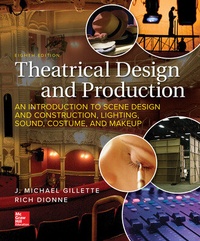
Theatrical Design and Production: An Introduction to Scene Design and Construction, Lighting, Sound, Costume, and Makeup
8th Edition
Published on 8. May 2019
Book
Paperback/Softback
615 pages
978-1-259-92230-5 (ISBN)
Description
Theatrical Design and Production is a comprehensive and practical survey that examines the technical and design aspects of play production, including scene design and construction, lighting, sound, costume, and makeup. Design is presented as both an art closely integrated with the director's, actor's, and playwright's visions, and a craft that provides practical solutions for the physical manipulation of stage space.
Instructors and students can now access their course content through the Connect digital learning platform by purchasing either standalone Connect access or a bundle of print and Connect access. McGraw-Hill Connect (R) is a subscription-based learning service accessible online through your personal computer or tablet. Choose this option if your instructor will require Connect to be used in the course. Your subscription to Connect includes the following:
* SmartBook (R) - an adaptive digital version of the course textbook that personalizes your reading experience based on how well you are learning the content.
* Access to your instructor's homework assignments, quizzes, syllabus, notes, reminders, and other important files for the course.
* Progress dashboards that quickly show how you are performing on your assignments and tips for improvement.
* The option to purchase (for a small fee) a print version of the book. This binder-ready, loose-leaf version includes free shipping.
Complete system requirements to use Connect can be found here: http://www.mheducation.com/highered/platforms/connect/training-support-students.html
Instructors and students can now access their course content through the Connect digital learning platform by purchasing either standalone Connect access or a bundle of print and Connect access. McGraw-Hill Connect (R) is a subscription-based learning service accessible online through your personal computer or tablet. Choose this option if your instructor will require Connect to be used in the course. Your subscription to Connect includes the following:
* SmartBook (R) - an adaptive digital version of the course textbook that personalizes your reading experience based on how well you are learning the content.
* Access to your instructor's homework assignments, quizzes, syllabus, notes, reminders, and other important files for the course.
* Progress dashboards that quickly show how you are performing on your assignments and tips for improvement.
* The option to purchase (for a small fee) a print version of the book. This binder-ready, loose-leaf version includes free shipping.
Complete system requirements to use Connect can be found here: http://www.mheducation.com/highered/platforms/connect/training-support-students.html
More details
Edition
8th edition
Language
English
Place of publication
OH
United States
Target group
College/higher education
Illustrations
Illustrations
Weight
1479 gr
ISBN-13
978-1-259-92230-5 (9781259922305)
Copyright in bibliographic data and cover images is held by Nielsen Book Services Limited or by the publishers or by their respective licensors: all rights reserved.
Schweitzer Classification
Persons
J. Michael Gillette is a Professor Emeritus from the School of Theatre, Film and Television at the University of Arizona. In addition to being the author of the eight editions of Theatrical Design and Production, Gillette has authored seven editions of Designing With Light and co-authored the third edition of Stage Scenery: Its Construction and Rigging. He authored numerous articles and technical presentations on theatrical design and production for a variety of professional organizations and journals. During his career he taught technical production, stage lighting, sound for the theatre, scene design, cinematography, media lighting. He also designed sets, lights, sound and projections for numerous academics and professional productions. He also authored a published novel and screenplay.
Rich Dionne holds an MFA in Theatre from Purdue University. He is a clinical associate professor in the Patti and Rusty Rueff School of Design, Art, and Performance at Purdue in the Department of Theatre, where he researches control systems for live entertainment and instructional design and pedagogy. At Purdue, he teaches and mentors students in technical direction and in the theatre engineering concentration of the Multidisciplinary Engineering program. He has published articles in TD&T and Stage Directions Magazine, in The Design of Learning Experience: The Future of Educational Technology (Springer, 2015), Hokanson, et al, eds., New Directions in Teaching Theatre Arts (Palgrave Macmillan, 2018), Fliotsos, Medford, eds., and has recently released Project Planning for the Stage: Tools and Techniques for Managing Extraordinary Performances (Southern Illinois University Press, 2018). Lewis Vaughn is the author of numerous textbooks in philosophy, critical thinking, and ethics, including The Power of Critical Thinking, sixth edition (2019); Concise Guide to Critical Thinking (2017); Philosophy Here and Now, third edition (2019); Living Philosophy: A Historical Introduction to Philosophical Ideas, second edition (2018); Doing Ethics: Moral Reasoning, Theory, and Contemporary Issues, fifth edition (2019); Beginning Ethics: An Introduction to Moral Philosophy (2015); Bioethics: Principles, Issues, and Cases, third edition (2017); and Writing Philosophy, Second Edition (2018).
Rich Dionne holds an MFA in Theatre from Purdue University. He is a clinical associate professor in the Patti and Rusty Rueff School of Design, Art, and Performance at Purdue in the Department of Theatre, where he researches control systems for live entertainment and instructional design and pedagogy. At Purdue, he teaches and mentors students in technical direction and in the theatre engineering concentration of the Multidisciplinary Engineering program. He has published articles in TD&T and Stage Directions Magazine, in The Design of Learning Experience: The Future of Educational Technology (Springer, 2015), Hokanson, et al, eds., New Directions in Teaching Theatre Arts (Palgrave Macmillan, 2018), Fliotsos, Medford, eds., and has recently released Project Planning for the Stage: Tools and Techniques for Managing Extraordinary Performances (Southern Illinois University Press, 2018). Lewis Vaughn is the author of numerous textbooks in philosophy, critical thinking, and ethics, including The Power of Critical Thinking, sixth edition (2019); Concise Guide to Critical Thinking (2017); Philosophy Here and Now, third edition (2019); Living Philosophy: A Historical Introduction to Philosophical Ideas, second edition (2018); Doing Ethics: Moral Reasoning, Theory, and Contemporary Issues, fifth edition (2019); Beginning Ethics: An Introduction to Moral Philosophy (2015); Bioethics: Principles, Issues, and Cases, third edition (2017); and Writing Philosophy, Second Edition (2018).
Content
Theatrical Design and Production, 8e
CHAPTER 1: Production Organization and Management
CHAPTER 2: The Design Process
CHAPTER 3: A Brief History of Theatre Architecture and Stage Technology
CHAPTER 4: The Stage and Its Equipment
CHAPTER 5: Style, Composition, and Design
CHAPTER 6: Color
CHAPTER 7: Mechanical Drafting
CHAPTER 8: Perspective Drawing
CHAPTER 9: Scenic Design
CHAPTER 10: Tools and Materials
CHAPTER 11: Scenic Production Techniques
CHAPTER 12: Scene Painting
CHAPTER 13: Stage Properties
CHAPTER 14: Lighting Design
CHAPTER 15: Electrical Theory and Practice
CHAPTER 16: Lighting Production
CHAPTER 17: Projections and Media
CHAPTER 18: Costume Design
CHAPTER 19: Costume Construction
CHAPTER 20: Makeup
CHAPTER 21: Sound Design and Technology
CHAPTER 22: Drawing and Rendering
CHAPTER 1: Production Organization and Management
CHAPTER 2: The Design Process
CHAPTER 3: A Brief History of Theatre Architecture and Stage Technology
CHAPTER 4: The Stage and Its Equipment
CHAPTER 5: Style, Composition, and Design
CHAPTER 6: Color
CHAPTER 7: Mechanical Drafting
CHAPTER 8: Perspective Drawing
CHAPTER 9: Scenic Design
CHAPTER 10: Tools and Materials
CHAPTER 11: Scenic Production Techniques
CHAPTER 12: Scene Painting
CHAPTER 13: Stage Properties
CHAPTER 14: Lighting Design
CHAPTER 15: Electrical Theory and Practice
CHAPTER 16: Lighting Production
CHAPTER 17: Projections and Media
CHAPTER 18: Costume Design
CHAPTER 19: Costume Construction
CHAPTER 20: Makeup
CHAPTER 21: Sound Design and Technology
CHAPTER 22: Drawing and Rendering