

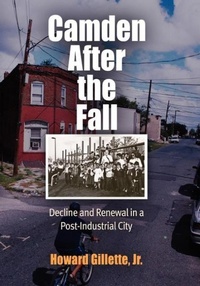
Camden After the Fall
Decline and Renewal in a Post-Industrial City
Published on 9. August 2006
Book
Paperback/Softback
344 pages
978-0-8122-1968-5 (ISBN)
Description
What prevents cities whose economies have been devastated by the flight of human and monetary capital from returning to self-sufficiency? Looking at the cumulative effects of urban decline in the classic post-industrial city of Camden, New Jersey, historian Howard Gillette, Jr., probes the interaction of politics, economic restructuring, and racial bias to evaluate contemporary efforts at revitalization. In a sweeping analysis, Gillette identifies a number of related factors to explain this phenomenon, including the corrosive effects of concentrated poverty, environmental injustice, and a political bias that favors suburban amenity over urban reconstruction.
Challenging popular perceptions that poor people are responsible for the untenable living conditions in which they find themselves, Gillette reveals how the effects of political decisions made over the past half century have combined with structural inequities to sustain and prolong a city's impoverishment. Even the most admirable efforts to rebuild neighborhoods through community development and the reinvention of downtowns as tourist destinations are inadequate solutions, Gillette argues. He maintains that only a concerted regional planning response-in which a city and suburbs cooperate-is capable of achieving true revitalization. Though such a response is mandated in Camden as part of an unprecedented state intervention, its success is still not assured, given the legacy of outside antagonism to the city and its residents.
Deeply researched and forcefully argued, Camden After the Fall chronicles the history of the post-industrial American city and points toward a sustained urban revitalization strategy for the twenty-first century.
Challenging popular perceptions that poor people are responsible for the untenable living conditions in which they find themselves, Gillette reveals how the effects of political decisions made over the past half century have combined with structural inequities to sustain and prolong a city's impoverishment. Even the most admirable efforts to rebuild neighborhoods through community development and the reinvention of downtowns as tourist destinations are inadequate solutions, Gillette argues. He maintains that only a concerted regional planning response-in which a city and suburbs cooperate-is capable of achieving true revitalization. Though such a response is mandated in Camden as part of an unprecedented state intervention, its success is still not assured, given the legacy of outside antagonism to the city and its residents.
Deeply researched and forcefully argued, Camden After the Fall chronicles the history of the post-industrial American city and points toward a sustained urban revitalization strategy for the twenty-first century.
Reviews / Votes
"A fascinating and frequently eloquent exploration of the city's history since World War II." (Camden Courier Post) "The best study so far about the virtual collapse in the late twentieth century of South Jersey's largest city." (New York Times) "A masterly narrative. . . . An invaluable primer to understanding the dynamics, parameters, institutions, and politics of urban renewal after the Great Society." (Journal of American History) "A thorough, well-researched, and important book. Through a careful analysis of people and politics, Gillette challenges the accepted narrative of postwar urban decline. The story of Camden is of special consequence to urban historians, historians of late twentieth-century U.S. political economy, and students of contemporary urban policy. Gillette is certainly the person to tell that story." (Robert Self, Brown University) "With keen insight, Howard Gillette movingly details how de-industrialization, suburbanization, racial isolation, and political exploitation reduced Camden from industrial powerhouse to America's third poorest city. Through the rich biography of one city, Camden's fall could be the story of the half-century decline of many industrial cities and their struggles to revive, just more so. Camden After the Fall will become a classic in the field of urban history." (David Rusk, author of Inside Game/Outside Game: Winning Strategies for Saving Urban America)More details
Series
Language
English
Place of publication
Pennsylvania
United States
Target group
College/higher education
Product notice
Paperback (trade)
Illustrations
34 illus.
Dimensions
Height: 226 mm
Width: 150 mm
Thickness: 23 mm
Weight
476 gr
ISBN-13
978-0-8122-1968-5 (9780812219685)
Copyright in bibliographic data and cover images is held by Nielsen Book Services Limited or by the publishers or by their respective licensors: all rights reserved.
Schweitzer Classification
Person
Howard Gillette, Jr., is Professor of History at Rutgers University and the author of Between Justice and Beauty: Race, Planning, and the Failure of Urban Policy in Washington, D.C, also available from the University of Pennsylvania Press.
Content
Preface
Introduction
PART I. SHIFTING FORTUNES
Chapter 1. A City That Worked
Chapter 2. Camden Transformed
PART II. SHIFTING POWER
Chapter 3. To Save Our City
Chapter 4. From City to County: The Rise of the Suburban Power Structure
PART III. SHIFTING STRATEGY
Chapter 5. The Downtown Waterfront: Changing Camden's Image
Chapter 6. The Neighborhoods: Not by Faith Alone
Chapter 7. The Courts: Seeking Justice and Fairness
PART IV. SHIFTING PROSPECTS
Chapter 8. The Politics of Recovery
Chapter 9. Future Camden: Reinventing the City, Engaging the Region
Conclusion
Note on Sources
Notes
Index
Acknowledgments
Introduction
PART I. SHIFTING FORTUNES
Chapter 1. A City That Worked
Chapter 2. Camden Transformed
PART II. SHIFTING POWER
Chapter 3. To Save Our City
Chapter 4. From City to County: The Rise of the Suburban Power Structure
PART III. SHIFTING STRATEGY
Chapter 5. The Downtown Waterfront: Changing Camden's Image
Chapter 6. The Neighborhoods: Not by Faith Alone
Chapter 7. The Courts: Seeking Justice and Fairness
PART IV. SHIFTING PROSPECTS
Chapter 8. The Politics of Recovery
Chapter 9. Future Camden: Reinventing the City, Engaging the Region
Conclusion
Note on Sources
Notes
Index
Acknowledgments