

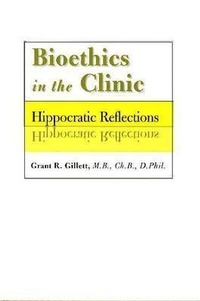
Bioethics in the Clinic
Hippocratic Reflections
Published on 16. July 2004
Book
Hardback
328 pages
978-0-8018-7843-5 (ISBN)
Description
What is so special about human life? What is the relationship between flesh and blood and the human soul? Is there a kind of life that is worse than death? Can a person die and yet the human organism remain in some real sense alive? Can souls become sick? What justifies cutting into a living human body? These and other questions, writes neurosurgeon and philosopher Grant Gillett, pervade hospital wards, clinical offices, and operating rooms. In Bioethics in the Clinic: Hippocratic Reflections, Gillett brings the tools of philosophy to bear on some of the most pressing issues confronting bioethicists today. Gillett draws on many schools of thought, including analytic, moral, and postmodern philosophy; utilitarianism; classical ethical theory; phenomenology; and metaphysics. He engages the reasoning of such philosophers as Aristotle, Nietzsche, Wittgenstein, Foucault, Habermas, Levinas, and Martha Nussbaum, and offers both practical and clinical insights into such topics as the principle of "Do no harm," informed consent, confidentiality, cloning, and euthanasia.
Opening with an explanation of the axioms to be traced throughout succeeding discussions, with special emphasis on Hippocratic principles, Gillett focuses on general and specific problems of clinical practice, particularly as they affect the physician-patient relationship. The author then goes on to address ethical problems related to both the end of life, including euthanasia, and the beginning of life, such as embryo and stem cell research. Rigorous and elegant, this book will be of interest to those in medical fields, to students and scholars of philosophy, and to lay readers interested in the profound ethical dramas played out in hospitals and doctors' offices every day.
Opening with an explanation of the axioms to be traced throughout succeeding discussions, with special emphasis on Hippocratic principles, Gillett focuses on general and specific problems of clinical practice, particularly as they affect the physician-patient relationship. The author then goes on to address ethical problems related to both the end of life, including euthanasia, and the beginning of life, such as embryo and stem cell research. Rigorous and elegant, this book will be of interest to those in medical fields, to students and scholars of philosophy, and to lay readers interested in the profound ethical dramas played out in hospitals and doctors' offices every day.
Reviews / Votes
His choice of subjects is refreshingly eclectic, including some of the usual subjects, but also ones less often covered in bioethics books... it is both philosophical and practical... worthy of consideration. Bulletin of Medical Ethics 2004 The writing is accessible, and this book is useful for those who seek a practical approach to some of the more difficult issues in bioethics today. Doody's Book Review Service His lucid analysis strikes at the core normative issues of modern medical practice and paves the way for genuinely useful discussions among philosophers, physicians, and others interested in the future of medicine... Not only innovative but insightful. Choice 2005 This book comes highly recommended to all health practitioners, and especially... where standard care can have major ethical implications. -- Tony O'Brien, RN, M.Phil. Metapsychology 2006More details
Language
English
Place of publication
Baltimore, MD
United States
Target group
Professional and scholarly
Dimensions
Height: 235 mm
Width: 164 mm
Thickness: 28 mm
Weight
682 gr
ISBN-13
978-0-8018-7843-5 (9780801878435)
DOI
10.56021/9780801878435
Copyright in bibliographic data and cover images is held by Nielsen Book Services Limited or by the publishers or by their respective licensors: all rights reserved.
Schweitzer Classification
Person
Grant R. Gillett, M.B. Ch.B., D.Phil. is a professor of medical ethics at the University of Otago Medical School in Dunedin, New Zealand. He is the author of The Mind and Its Discontents: An Essay in Discursive Psychiatry, Consciousness and Intentionality, and Representation, Meaning, and Thought.
Content
Preface and Acknowledgments
Introduction
Part I: Foundations
Chapter 1. The Case of the Empty Head: Cultures, Values, and Bioethics
Chapter 2. Hippocrates' Children
Chapter 3. What is Medical Truth?
Part II: Clinical Practice
Chapter 4. Getting over Informed Consent
Chapter 5. Listening to the Silences
Chapter 6. Surgeons, Patients, and Unnecessary Holes in the Head
Chapter 7. When Good Doctors Do Bad Things
Chapter 8. Is AIDS the Postmodern Illness?
Chapter 9. Healthy Bodies, the Medical Panopticon, and Alternative Medicine
Part III: The Endings of Life
Chapter 10. The Endings of Life
Chapter 11. Ethics in Limbo
Chapter 12. Euthanasia, the Pause, and the Last Rights
Part IV: The Beginnings of Human Lives
Chapter 13. Ethics, Embryos, and Stem Cell Research
Chapter 14. Save the Life of My Child
Chapter 15. Joanna May Revisited: The Cloning Debate
Epilogue: Mildly Philosophical Remarks
Appendix A. On Metaethics
Appendix B. Narrative Metaphysics
Appendix C. The Idea of a Form
References
Index
Introduction
Part I: Foundations
Chapter 1. The Case of the Empty Head: Cultures, Values, and Bioethics
Chapter 2. Hippocrates' Children
Chapter 3. What is Medical Truth?
Part II: Clinical Practice
Chapter 4. Getting over Informed Consent
Chapter 5. Listening to the Silences
Chapter 6. Surgeons, Patients, and Unnecessary Holes in the Head
Chapter 7. When Good Doctors Do Bad Things
Chapter 8. Is AIDS the Postmodern Illness?
Chapter 9. Healthy Bodies, the Medical Panopticon, and Alternative Medicine
Part III: The Endings of Life
Chapter 10. The Endings of Life
Chapter 11. Ethics in Limbo
Chapter 12. Euthanasia, the Pause, and the Last Rights
Part IV: The Beginnings of Human Lives
Chapter 13. Ethics, Embryos, and Stem Cell Research
Chapter 14. Save the Life of My Child
Chapter 15. Joanna May Revisited: The Cloning Debate
Epilogue: Mildly Philosophical Remarks
Appendix A. On Metaethics
Appendix B. Narrative Metaphysics
Appendix C. The Idea of a Form
References
Index