

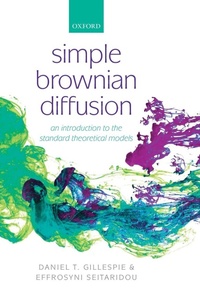
Simple Brownian Diffusion
An Introduction to the Standard Theoretical Models
Published on 18. October 2012
Book
Hardback
288 pages
978-0-19-966450-4 (ISBN)
Description
Brownian diffusion is the motion of one or more solute molecules in a sea of very many, much smaller solvent molecules. Its importance today owes mainly to cellular chemistry, since Brownian diffusion is one of the ways in which key reactant molecules move about inside a living cell. This book focuses on the four simplest models of Brownian diffusion: the classical Fickian model, the Einstein model, the discrete-stochastic (cell-jumping) model, and the Langevin model. The authors carefully develop the theories underlying these models, assess their relative advantages, and clarify their conditions of applicability. Special attention is given to the stochastic simulation of diffusion, and to showing how simulation can complement theory and experiment. Two self-contained tutorial chapters, one on the mathematics of random variables and the other on the mathematics of continuous Markov processes (stochastic differential equations), make the book accessible to researchers from a broad spectrum of technical backgrounds.
Reviews / Votes
In a lively tutorial style, the authors discuss some of the most widely used mathematical formulations of diffusion. They have endeavored to organize and present the subject matter from a purely logical perspective. They emphasize the basic physical assumptions and the conditions for the validity of each of the mathematical formalisms. No subtlety is bypassed, and no limitation of the theory is swept under the carpet. * Debashish Chowdhury, Physics today * In a lively tutorial style, the authors discuss some of the most widely used mathematical formulations of diffusion. They have endeavored to organize and present the subject matter "from a purely logical perspective". They emphasize the basic physical assumptions and the conditions for the validity of each of the mathematical formalisms. No subtlety is bypassed, and no limitation of the theory is swept under the carpet. * Physics Today *More details
Language
English
Place of publication
Oxford
United Kingdom
Target group
College/higher education
Graduate students, post-doctoral students, professors, and researchers in physics, chemistry, biology, computer science, and engineering, whose theoretical or experimental work concerns the chemistry of living cells.
Illustrations
58 b/w line illustrations
Dimensions
Height: 260 mm
Width: 183 mm
Thickness: 20 mm
Weight
741 gr
ISBN-13
978-0-19-966450-4 (9780199664504)
Copyright in bibliographic data and cover images is held by Nielsen Book Services Limited or by the publishers or by their respective licensors: all rights reserved.
Schweitzer Classification
Other editions
Additional editions
Daniel Thomas Gillespie | Effrosyni Seitaridou
Simple Brownian Diffusion
An Introduction to the Standard Theoretical Models
E-Book
10/2012
1st Edition
OUP eBook
€96.49
Available for download
Daniel Thomas Gillespie | Effrosyni Seitaridou
Simple Brownian Diffusion
An Introduction to the Standard Theoretical Models
E-Book
10/2012
1st Edition
OUP eBook
€96.49
Available for download
Persons
Dan Gillespie is a physicist, with a B.A. from Rice University and a Ph.D. from Johns Hopkins University. He is best known as the inventor of the Gillespie algorithm for numerically simulating the discrete-stochastic time evolution of chemical reactions inside living cells. He has written two previous books in science: A Quantum Mechanics Primer (in print from 1970 to 1986 from International Textbook Co.), and Markov Processes: An Introduction for Physical Scientists (1992, Academic Press). He was for 30 years a civilian research scientist for the U. S. Navy in China Lake, California. Since his retirement from there in 2001 he has been a private consultant in stochastic chemical kinetics, working collaboratively with researchers at the University of California at Santa Barbara and the California Institute of Technology.
Effrosyni Seitaridou is an Associate Professor of Physics at Oxford College of Emory University in Atlanta, Georgia. In 2002 she received a B.A. in physics from Smith College and also a B.E. in Materials Science from Dartmouth College. She did post-graduate studies at the California Institute of Technology as a Moore Fellow in the Rob Phillips research group. There she received her M.S. (2004) and Ph.D. (2008) in applied physics, with a focus on biochemical systems and microfluidics devices. She is currently conducting experiments with undergraduate students on diffusion in biofilms. She is also designing interdisciplinary experiments for the introductory physics curriculum. In 2009 she received formal recognition from Phi Beta Kappa for her excellence in teaching.
Effrosyni Seitaridou is an Associate Professor of Physics at Oxford College of Emory University in Atlanta, Georgia. In 2002 she received a B.A. in physics from Smith College and also a B.E. in Materials Science from Dartmouth College. She did post-graduate studies at the California Institute of Technology as a Moore Fellow in the Rob Phillips research group. There she received her M.S. (2004) and Ph.D. (2008) in applied physics, with a focus on biochemical systems and microfluidics devices. She is currently conducting experiments with undergraduate students on diffusion in biofilms. She is also designing interdisciplinary experiments for the introductory physics curriculum. In 2009 she received formal recognition from Phi Beta Kappa for her excellence in teaching.
Content
1. The Fickian theory of diffusion ; 2. A review of random variable theory ; 3. Einstein's theory of diffusion ; 4. Implications and limitations of the Einstein theory of diffusion ; 5. The discrete-stochastic approach ; 6. Master equations and simulation algorithms for the discrete-stochastic approach ; 7. Continuous Markov process theory ; 8. Langevin's theory of diffusion ; 9. Implications of Langevin's theory ; 10. Diffusion in an external force field ; 11. The first-passage time approach