

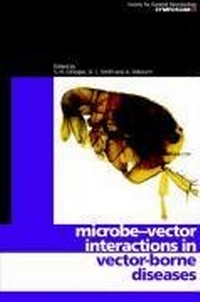
Microbe-vector Interactions in Vector-borne Diseases
Published on 6. May 2004
Book
Hardback
396 pages
978-0-521-84312-6 (ISBN)
Description
Several billion people are at daily risk of life threatening vector-borne diseases such as malaria, trypanosomiasis and dengue. This volume describes the way in which the causal pathogens of such diseases interact with the vectors that transmit them. It details the elegant biological adaptations that have enabled pathogens to live with their vectors and, in some circumstances, to control them. This knowledge has led to novel preventative strategies in the form of antibiotics and new vaccines which are targeted not at the pathogen itself but at its specific vector.
Reviews / Votes
'The authors describe the advantages of insects as vectors and their numerous barriers to infection, including physico-chemical barriers, the gut, haemolymph, and the salivary glands themselves.' ASM NewsMore details
Series
Language
English
Place of publication
Cambridge
United Kingdom
Target group
Professional and scholarly
Product notice
Unsewn / adhesive bound
Paper over boards
Illustrations
14 Tables, unspecified; 9 Halftones, unspecified; 26 Line drawings, unspecified; 10 Line drawings, color
Dimensions
Height: 235 mm
Width: 160 mm
Thickness: 23 mm
Weight
744 gr
ISBN-13
978-0-521-84312-6 (9780521843126)
Copyright in bibliographic data and cover images is held by Nielsen Book Services Limited or by the publishers or by their respective licensors: all rights reserved.
Schweitzer Classification
Other editions
Additional editions
S. H. Gillespie | G. L. Smith | A. Osbourn
Microbe-vector Interactions in Vector-borne Diseases
E-Book
02/2006
Cambridge University Press
€103.99
Available for download
Persons
Stephen H. Gillespie is Professor of Medical Microbiology in the Department of Infectious Diseases at University College London, UK. Geoffrey L. Smith is a Wellcome Trust Principal Research Fellow and Head of Department of Virology at Imperial College London, UK. Anne Osbourn is a Group leader in the Sainsbury Laboratory, John Innes Centre, Norwich,UK.
Content
Preface; 1. Vector-borne diseases B. W. J. Mahy; 2. Evolution of tick-borne disease systems S. E. Randolph; 3. Insect transmission of viruses S. Blanc; 4. Interactive silencing of host gene expression S. W. Ding; 5. Reducing the prevalence of Borrelia in ticks A. G. Barbour; 6. Bunyavirus/mosquito interactions R. M. Elliott; 7. How do mosquito vectors live with their viruses? S. Higgs 8. Induction of vector competence S. Weaver; 9. Environmental influences on arbovirus infections and vectors P. S. Mellor; 10. Vector immunity N. A. Ratcliffe and M. M. A. Whitten; 11. Transmission of plant viruses by nematodes S. MacFarlane and D. J. Robinson; 12. Wolbachia host-symbiont interactions M. J. Taylor; 13. Pathogenic strategies of Anaplasma phagocytophilum, a unique bacterium that colonizes neutrophils J. A. Carlyon and E. Fikrig; 14. Interactions of Yersinia pestis with its flea vector that lead to the transmission of plague B. J. Hinnebusch; 15. Transgenic malaria P. W. Atkinson; 16. Vaccines targeting vectors G. A. T. Targett; Index.