

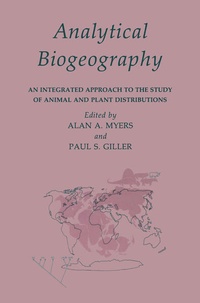
Analytical Biogeography
An Integrated Approach to the Study of Animal and Plant Distributions
Published on 3. October 2013
Book
Paperback/Softback
XIII, 578 pages
978-94-010-7033-1 (ISBN)
Description
Biogeography may be defined simply as the study of the geographical distribution of organisms, but this simple definition hides the great complexity of the subject. Biogeography transcends classical subject areas and involves a range of scientific disciplines that includes geogra phy, geology and biology. Not surprisingly, therefore, it means rather different things to different people. Historically, the study of biogeogra phy has been concentrated into compartments at separate points along a spatio-temporal gradient. At one end of the gradient, ecological biogeography is concerned with ecological processes occurring over short temporal and small spatial scales, whilst at the other end, historical biogeography is concerned with evolutionary processes over millions of years on a large, often global scale. Between these end points lies a third major compartment concerned with the profound effects of Pleistocene glaciations and how these have affected the distribution of recent organisms. Within each of these compartments along the scale gradient, a large number of theories, hypotheses and models have been proposed in an attempt to explain the present and past biotic distribution patterns. To a large extent, these compartments of the subject have been non-interactive, which is understandable from the different interests and backgrounds of the various researchers. Nevertheless, the distribu tions of organisms across the globe cannot be fully understood without a knowledge of the full spectrum of ecological and historical processes. There are no degrees in biogeography and today's biogeographers are primarily born out of some other discipline.
More details
Edition
Softcover reprint of the original 1st ed. 1988
Language
English
Place of publication
Dordrecht
Netherlands
Target group
Professional and scholarly
Research
Illustrations
10 s/w Abbildungen
XIII, 578 p. 10 illus.
Dimensions
Height: 235 mm
Width: 155 mm
Thickness: 32 mm
Weight
890 gr
ISBN-13
978-94-010-7033-1 (9789401070331)
DOI
10.1007/978-94-009-1199-4
Schweitzer Classification
Other editions
Additional editions
Paul Giller
Analytical Biogeography
An Integrated Approach to the Study of Animal and Plant Distributions
E-Book
12/2012
Springer
€96.29
Available for download

A. a. Myers | Paul S. Giller
Analytical Biogeography
Book
08/1988
Chapman and Hall
€89.13
Article exhausted; check different version
Content
I Biogeographic Perspectives.- 1 Process, Pattern and Scale in Biogeography.- II Biogeographic Patterns.- 2 Biogeographic Patterns: A Perceptual Overview.- 2.1 Introduction.- 2.2 Patterns.- 2.3 Approaches to biogeography.- 2.4 Aims of biogeography: a question of levels.- 2.5 Pure biogeography: the biogeographical system.- 2.6 Levels, and their implications for historical patterns.- 2.7 Summary and conclusions.- 3 Species Diversity.- 3.1 Introduction.- 3.2 Definition and measurement.- 3.3 The patterns.- 3.4 Hypotheses.- 3.5 Evaluation of hypotheses.- 3.6 Conclusions.- 4 Relationship of Species Number To Area, Distance And Other Variables.- 4.1 Introduction.- 4.2 Description of the phenomena.- 4.3 Explanation of the species-area effect.- 4.4 The nature of environmental heterogeneity.- 4.5 The effect of other variables on the species-area.- 4.6 Consequences of the species-area effect.- 5 Endemism: A Botanical Perspective.- 5.1 Introduction.- 5.2 Biogeographical significance.- 5.3 A measure of endemism.- 5.4 Extent of and ecological variation in endemism.- 5.5 Endemism from various viewpoints.- 5.6 Endemism in contemporary biogeography.- 5.7 The future.- III Biological Processes in Biogeography.- 6 Adaptation.- 6.1 What is adaptation?.- 6.2 Species' distributions.- 6.3 Comparisons among species.- 6.4 Mole rats - a transition to the genetic level.- 6.5 Variation within species.- 6.6 Adaptation and stressful environments.- 6.7 Conclusion.- 6.8 Summary.- 7 Speciation.- 7.1 Introduction.- 7.2 The nature of species.- 7.3 Modes of speciation.- 7.4 Biogeography and speciation.- 7.5 Conclusions.- 8 Extinction.- 8.1 Introduction.- 8.2 Diversity.- 8.3 Turnover.- 8.4 Biases affecting extinction patterns.- 8.5 Extinction patterns.- 8.6 Extinction susceptibility.- 8.7Extinction causes and processes.- 8.8 Conclusions.- 9 Ecological Interactions.- 9.1 Introduction.- 9.2 Background.- 9.3 Community characteristics.- 9.4 Species' characteristics.- 9.5 Complementarities in species' distributions and abundances: bridging the community and individual- species approaches.- 9.6 Conclusion.- IV Biogeographic Reconstruction.- 10 Refugia.- 10.1 Introduction.- 10.2 The Pleistocene rain forest refugia hypothesis.- 10.3 Testing strategies.- 10.4 Conclusions.- 11 Phylogenetic Biogeography.- 11.1 Introduction.- 11.2 Phylogenetic biogeography.- 11.3 Vicariance biogeography.- 11.4 Dispersal biogeography.- 11.5 Significance of fossils to biogeographic hypothesis.- 11.6 Conclusions.- 12 Cladistic Biogeography.- 12.1 Introduction.- 12.2 Cladistics and biogeography.- 12.3 Applications of cladistics to biogeography.- 12.4 Cladistic biogeography.- 12.5 Conclusions.- 13 Panbiogeography: Method and Synthesis in Biogeography.- 13.1 Space-time and biogeography: philosophical considerations.- 13.2 Panbiogeography and phylogeny.- 13.3 Spatial analysis in biogeography.- 13.4 Dispersal, vicariance and panbiogeographic models of Southern Hemisphere and New Zealand biogeography: a comparison.- 13.5 Conclusions.- 14 From Fossils To Earth History: Applied Historical Biogeography.- 14.1 Relevant parts of the biogeographical system and overview of methods.- 14.2 Constraints.- 14.3 Methods based on distributional change.- 14.4 Methods based on originations.- 14.5 Discussion.- 14.6 Conclusions.- 15 Experimental Island Biogeography.- 15.1 Introduction.- 15.2 An equilibrium theory.- 15.3 Implications of island biogeography theory.- 15.4 Summary.- References.