

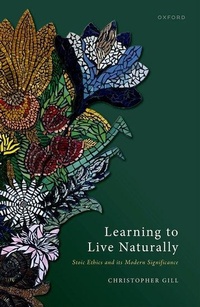
Learning to Live Naturally
Stoic Ethics and its Modern Significance
Published on 1. December 2022
Book
Hardback
378 pages
978-0-19-886616-9 (ISBN)
Description
At a time of unprecedented interest in Stoicism among scholars and the general public, this book offers a sustained examination of the core Stoic ethical claims and their significance for modern moral theory. The first part considers the Stoic ideas of happiness as the life according to nature and virtue as expertise in leading a happy life and explores the senses of 'nature' (both human and universal) relevant for ethics. The second part studies Stoic thinking on ethical development (learning to live naturally), bringing out the interconnections between growth in ethical understanding, forming social relationships, and emotional responses. The third part discusses how Stoic ethics, as interpreted here, can contribute to contemporary moral theory, especially virtue ethics. It suggests that Stoic thinking on the virtue-happiness relationship offers a cogent alternative to Aristotle, currently the main ancient prototype for virtue ethical theory, and it explores ways in which Stoic ideas on human and universal nature can contribute to modern ethical debates, notably on how to respond effectively to the pressing challenge of climate breakdown. It also highlights the value of Stoic guidance for virtue ethics as well as contemporary 'life-guidance'. A further distinctive feature of the book is the close and extended study of key sources for Stoic ethics, including Cicero's On Ends and On Duties, which enables readers of different kinds to interpret these source for themselves.
Reviews / Votes
This book acts both as an introduction to Stoic ethics and as a challenge to scholars to think about Stoic ethics...That being said, Gill is careful to lay out his argument, previous interpretations of the material, and his novel points in a judicious and straightforward manner in this successful monograph. * Christopher Trinacty, Bryn Mawr Classical Review * Christopher Gill offers a robust defence of Stoic ethics. He calls into question a number of common and stubbornly persistent misconceptions of Stoicism, and the account that emerges may strike some as unexpected, even provocative. Among other things, he argues that Stoicism has a lot to offer modern virtue ethics and that, in many respects, Stoic ethics is more coherent and cogent than Aristotle's ethics. The book, while no doubt of interest to specialists in ancient philosophy, has much wider ambitions and aims to make a contribution to contemporary ethical debates. As such, it has the potential to be of interest to a wide philosophical audience. * John Sellars, Notre Dame Philosophical Reviews *More details
Language
English
Place of publication
Oxford
United Kingdom
Target group
College/higher education
Product notice
sewn/stitched
Cloth over boards
Dimensions
Height: 235 mm
Width: 158 mm
Thickness: 30 mm
Weight
698 gr
ISBN-13
978-0-19-886616-9 (9780198866169)
Copyright in bibliographic data and cover images is held by Nielsen Book Services Limited or by the publishers or by their respective licensors: all rights reserved.
Schweitzer Classification
Other editions
Additional editions
E-Book
11/2022
1st Edition
OUP eBook
€75.49
Available for download
E-Book
11/2022
1st Edition
OUP eBook
€75.49
Available for download
Person
Christopher Gill is Emeritus Professor of Ancient Thought at the University of Exeter. His interests focus on Greek and Roman ethics and psychology, including ancient ideas of personality and self, and the philosophical therapy of emotions. He is also concerned with the relationship between ancient and modern ideas on these topics. He has published a number of monographs and edited volumes on these subjects, especially with Oxford University Press.
Content
Preface
Note on Conventions
Introduction
Part One: Living Naturally
1: Virtue and Happiness
2: Virtue, Indifferents, and Practical Deliberation
3: Ethics and Nature
Part Two: Learning to Live Naturally
Introduction to Part Two
4: 'Appropriation': Ethical Development as Natural
5: Emotional Development
Part Three: Stoic Ethics and Modern Moral Theory
6: Stoicism and Modern Virtue Ethics
7: Stoic Ethics, Human Nature, and the Environment
8: Stoic Development and Guidance and Modern Thought
References
Index of Ancient Passages
General Index
Note on Conventions
Introduction
Part One: Living Naturally
1: Virtue and Happiness
2: Virtue, Indifferents, and Practical Deliberation
3: Ethics and Nature
Part Two: Learning to Live Naturally
Introduction to Part Two
4: 'Appropriation': Ethical Development as Natural
5: Emotional Development
Part Three: Stoic Ethics and Modern Moral Theory
6: Stoicism and Modern Virtue Ethics
7: Stoic Ethics, Human Nature, and the Environment
8: Stoic Development and Guidance and Modern Thought
References
Index of Ancient Passages
General Index