

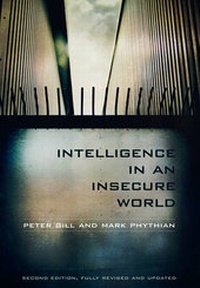
Intelligence in an Insecure World
Published on 5. October 2012
Book
Hardback
272 pages
978-0-7456-5278-8 (ISBN)
Description
Over a decade on from the terrorist attacks of 9/11, intelligence continues to be of central importance to the contemporary world. Today there is a growing awareness of the importance of intelligence, and an increasing investment in it, as individuals, groups, organizations and states all seek timely and actionable information in order to increase their sense of security. But what exactly is intelligence? Who seeks to develop it and how? What happens to intelligence once it is produced, and what dilemmas does this generate? How can liberal democracies seek to mitigate problems of intelligence, and what do we mean by intelligence failure? In a fully revised and expanded new edition of their classic guide to the field, Peter Gill and Mark Phythian explore these and other questions. Together they set out a comprehensive framework for the study of intelligence, discussing how intelligence can best be understood, how it is collected, analysed, disseminated and acted upon, how it raises ethical problems, and how and why it fails.
Drawing on a range of contemporary examples, Intelligence in an Insecure World is an authoritative and accessible guide to a rapidly expanding area of enquiry - one which everyone has an interest in understanding.
Drawing on a range of contemporary examples, Intelligence in an Insecure World is an authoritative and accessible guide to a rapidly expanding area of enquiry - one which everyone has an interest in understanding.
Reviews / Votes
"Gill and Phythian have done it again: produced a comprehensive, readable, nicely illustrated, and thought-provoking examination of national security intelligence in today's uncertain and dangerous world. Want to know all about espionage, covert action, and counterintelligence? Here's an excellent place to begin." Loch K. Johnson, University of Georgia "Gill and Phythian provide the best introduction to the study of security and intelligence in democratic societies. They have done so by marrying the rigour of academic analysis with the accessibility of more popular accounts no mean trick. The new edition is not only updated to include the most contemporary developments, but also expands and deepens the authors critical reflections on the state of intelligence in the post-9/11 world. This is a must-read for everyone concerned with security in the face of terrorism and for democratic freedoms in the face of the expansion of state security powers." Reg Whitaker, York University, OntarioMore details
Edition
2nd Edition
Language
English
Place of publication
Oxford
United Kingdom
Target group
Professional and scholarly
Dimensions
Height: 250 mm
Width: 179 mm
Thickness: 21 mm
Weight
678 gr
ISBN-13
978-0-7456-5278-8 (9780745652788)
Copyright in bibliographic data and cover images is held by Nielsen Book Services Limited or by the publishers or by their respective licensors: all rights reserved.
Schweitzer Classification
Other editions
New editions
Peter Gill | Mark Phythian
Intelligence in An Insecure World
Book
08/2018
3rd Edition
Polity Press
€31.50
Shipment within 15-20 days
Peter Gill | Mark Phythian
Intelligence in An Insecure World
Book
08/2018
3rd Edition
Polity Press
€73.00
Shipment within 15-20 days
Additional editions
Peter Gill | Mark Phythian
Intelligence in an Insecure World
E-Book
08/2013
2nd Edition
Polity Press
€29.99
Available for download
Peter Gill | Mark Phythian
Intelligence in an Insecure World
Book
10/2012
2nd Edition
Polity Press
Unfortunately, price unknown
Article exhausted; check for reprint
Persons
Content
List of Figures, Tables and Boxes Preface Abbreviations 1 Introduction 2 How Do We Understand Intelligence? 3 Who Does Intelligence? 4 How Do They Gather Information? 5 How is Information Turned into Intelligence? 6 What Do They Do with the Intelligence? 7 Why Does Intelligence Fail? 8 Can Intelligence be Democratic? 9 Intelligence for a more secure world? Notes Selected Further Reading