

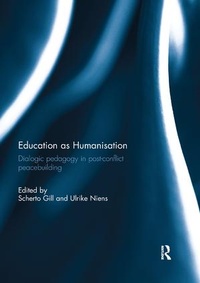
Education as Humanisation
Dialogic pedagogy in post-conflict peacebuilding
1st Edition
Published on 22. December 2017
Book
Paperback/Softback
152 pages
978-1-138-50257-4 (ISBN)
Description
Over the past decades, there has been a consistent and poignant ambiguity with regard to the role of education in the context of post-conflict and divided societies working towards building peace. Most recently, global developments, including the after-effects of the Arab Spring, the devastating wars in Syria, and the refugee crisis in Europe, have directed our attention once more to the part that education can play in building peace at many levels.
In this context, it is timely to create a space for a focused inquiry and scholarly debate about peace-oriented pedagogies and how they might affect the post-conflict reconstruction in divergent settings. Thus both the subject and the content of this book are important in the light of the current needs in many societies emerging from conflicted community relations. In particular, they propose a refreshing and transformative view of peace based on a humanising conception of education and dialogic pedagogy as a key avenue for peacebuilding.
Through both conceptual inquiries and empirical case studies, the book will appeal to educational thinkers, researchers, practitioners, policy-makers, NGO workers, and the public in re-examining some of the key concepts identifying pivotal underlying issues in the field. Furthermore, by offering a principled, persuasive conceptual framework and by problematising implementations and interventions in practice, this book can serve to provoke more appraisals, evaluations, and constructive critiques of humanisation and dialogic pedagogy in peacebuilding education.
This book was originally published as a special issue of Compare: A Journal of Comparative and International Education.
In this context, it is timely to create a space for a focused inquiry and scholarly debate about peace-oriented pedagogies and how they might affect the post-conflict reconstruction in divergent settings. Thus both the subject and the content of this book are important in the light of the current needs in many societies emerging from conflicted community relations. In particular, they propose a refreshing and transformative view of peace based on a humanising conception of education and dialogic pedagogy as a key avenue for peacebuilding.
Through both conceptual inquiries and empirical case studies, the book will appeal to educational thinkers, researchers, practitioners, policy-makers, NGO workers, and the public in re-examining some of the key concepts identifying pivotal underlying issues in the field. Furthermore, by offering a principled, persuasive conceptual framework and by problematising implementations and interventions in practice, this book can serve to provoke more appraisals, evaluations, and constructive critiques of humanisation and dialogic pedagogy in peacebuilding education.
This book was originally published as a special issue of Compare: A Journal of Comparative and International Education.
More details
Language
English
Place of publication
London
United Kingdom
Publishing group
Taylor & Francis Ltd
Target group
College/higher education
Professional and scholarly
Postgraduate, Professional, and Undergraduate
Dimensions
Height: 246 mm
Width: 174 mm
Weight
280 gr
ISBN-13
978-1-138-50257-4 (9781138502574)
Copyright in bibliographic data and cover images is held by Nielsen Book Services Limited or by the publishers or by their respective licensors: all rights reserved.
Schweitzer Classification
Other editions
Additional editions
Scherto Gill | Ulrike Niens
Education as Humanisation
Dialogic pedagogy in post-conflict peacebuilding
E-Book
10/2017
1st Edition
Routledge
€68.49
Available for download
Scherto Gill | Ulrike Niens
Education as Humanisation
Dialogic pedagogy in post-conflict peacebuilding
E-Book
10/2017
1st Edition
Routledge
€68.49
Available for download
Scherto Gill | Ulrike Niens
Education as Humanisation
Dialogic pedagogy in post-conflict peacebuilding
Book
03/2016
1st Edition
Routledge
€241.20
Shipment within 10-20 days
Persons
Scherto Gill is a Research Fellow at the Guerrand-Hermes Foundation for Peace, Brighton, UK, and Visiting Research Fellow at the University of Sussex, Brighton, UK. She writes in the fields of education, peace and dialogue, her most recent publications including Rethinking Secondary Education (2013), Religion, Spirituality and Human Flourishing (2014), and Why Love Matters: Values in Governance (2015).
Ulrike Niens has worked as a researcher and senior lecturer at Ulster University, Coleraine, Northern Ireland, and Queen's University Belfast, Northern Ireland. Her research and teaching focused on education for peace and democracy in divided societies. She was a member of the editorial and the international editorial board of Compare from 2009-2014. She is currently taking a career break and is working as a clinical psychologist in Germany.
Ulrike Niens has worked as a researcher and senior lecturer at Ulster University, Coleraine, Northern Ireland, and Queen's University Belfast, Northern Ireland. Her research and teaching focused on education for peace and democracy in divided societies. She was a member of the editorial and the international editorial board of Compare from 2009-2014. She is currently taking a career break and is working as a clinical psychologist in Germany.
Content
Introduction - Education as humanisation: dialogic pedagogy in post-conflict peacebuilding 1. Education as humanisation: a theoretical review on the role of dialogic pedagogy in peacebuilding education 2. Contextual and pedagogical considerations in teaching for forgiveness in the Arab world 3. Global citizenship as education for peacebuilding in a divided society: structural and contextual constraints on the development of critical dialogic discourse in schools 4. Articulating injustice: an exploration of young people's experiences of participation in a conflict transformation programme that utilises the arts as a form of dialogue 5. Lebanese youth narratives: a bleak post-war landscape 6. Reconciliation through dialogical nostalgia in post-conflict societies: a curriculum to intersect