

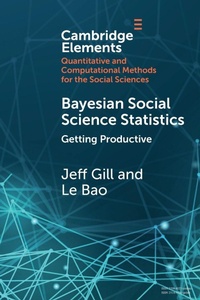
Bayesian Social Science Statistics: Volume 2
Getting Productive
Will be published approx. on 31. December 2025
Book
Paperback/Softback
75 pages
978-1-009-34097-7 (ISBN)
Description
This Element introduces the basics of Bayesian regression modeling using modern computational tools. This Element only assumes that the reader has taken a basic statistics course and has seen Bayesian inference at the introductory level of Gill and Bao (2024). Some matrix algebra knowledge is assumed but the authors walk carefully through the necessary structures at the start of this Element. At the end of the process readers will fully understand how Bayesian regression models are developed and estimated, including linear and nonlinear versions. The sections cover theoretical principles and real-world applications in order to provide motivation and intuition. Because Bayesian methods are intricately tied to software, code in R and Python is provided throughout.
More details
Series
Language
English
Place of publication
Cambridge
United Kingdom
Illustrations
Worked examples or Exercises
Dimensions
Height: 229 mm
Width: 152 mm
Thickness: 7 mm
Weight
181 gr
ISBN-13
978-1-009-34097-7 (9781009340977)
Copyright in bibliographic data and cover images is held by Nielsen Book Services Limited or by the publishers or by their respective licensors: all rights reserved.
Schweitzer Classification
Other editions
Additional editions
Book
approx. 12/2025
Cambridge University Press
€68.80
Not yet published
Persons
Content
1. Introduction: the purpose and scope of this element; 2. A review of Bayesian principles and inference; 3. Monte Carlo tools for computational power; 4. A simple introduction to the mathematics of Markov Chains; 5. Markov Chain Monte Carlo for estimating Bayesian models; 6. Basic Bayesian regression models; 7. Nonlinear Bayesian regression models; 8. Model evaluation and mechanical issues with MCMC estimation; 9. Final remarks; References.