

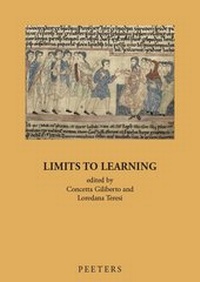
Limits to Learning
The Transfer of Encyclopaedic Knowledge in the Early Middle Ages
1st Edition
Published on 28. March 2013
Book
Paperback/Softback
309 pages
978-90-429-2708-7 (ISBN)
Unfortunately, price unknown
Available (delivery time upon request)
Not available
Description
In the history of early medieval culture in Western Europe, limits and
boundaries define the intellectual landscape. These landmarks range from
manuscript contexts to 'genres', from authorial shortcomings to the
paucity of books and means, from moral or doctrinal constraints to
self-imposed limitations for didactic purposes, and from the origin of
the world (Genesis) to its conclusion (Doomsday) - the temporal limits
of the Christian narratio of human history. Sometimes these
confines were perceived as being too narrow, inviting extension and
transgression. At other times, they were seen as necessary and
functional, especially for didactic or pedagogical reasons. Boundaries,
in short, constitute frameworks which help us understand the
significance or role of a given text in a given context.
The essays here gathered focus on the production, adaptation and
recontextualisation of letters, words, texts or clusters of texts in the
context of the early medieval intellectual tradition. Hailing from
either the vernacular or the classical tradition, such wholesome
learning was often modified to create new systems of scholarship, for
new purposes, in new cultural milieux. Subject to the perimeters of
these cultural environments, this reinterpretation of scholarship often
served to reduce tensions between different conceptual frameworks, such
as between secular learning and religious orthodoxy, between pagan
vestiges and Christian belief, or, simply, between two different
didactic approaches.
The articles in this volume were first presented at the third workshop
of the 'Storehouses of Wholesome Learning' project (Leeuwarden, 2007).
Once put together like the pieces of a jigsaw puzzle, the articles -
whether devoted to such writers as Bede, Alcuin and AElfric, or to, for
example, the anonymous De diebus malis - provide an overall
picture. The 'limits to learning' are often overcome, but there is a
keen awareness of the difficulties faced by a medieval author who had to
cope with languages such as Greek and Latin, and deal with works such as
the Bible or the De nuptiis Philologiae et Mercurii. As witnesses
to the circulation of these texts, manuscripts also set their physical
boundaries. It is within a codex or even within a single folio that an
image, an alphabet series, a colophon, a comment or a text lived and is
given new life. A renewed awareness of the spatial collocation of the
works under examination in this volume has allowed its contributors to
look beyond the limits of the past.
boundaries define the intellectual landscape. These landmarks range from
manuscript contexts to 'genres', from authorial shortcomings to the
paucity of books and means, from moral or doctrinal constraints to
self-imposed limitations for didactic purposes, and from the origin of
the world (Genesis) to its conclusion (Doomsday) - the temporal limits
of the Christian narratio of human history. Sometimes these
confines were perceived as being too narrow, inviting extension and
transgression. At other times, they were seen as necessary and
functional, especially for didactic or pedagogical reasons. Boundaries,
in short, constitute frameworks which help us understand the
significance or role of a given text in a given context.
The essays here gathered focus on the production, adaptation and
recontextualisation of letters, words, texts or clusters of texts in the
context of the early medieval intellectual tradition. Hailing from
either the vernacular or the classical tradition, such wholesome
learning was often modified to create new systems of scholarship, for
new purposes, in new cultural milieux. Subject to the perimeters of
these cultural environments, this reinterpretation of scholarship often
served to reduce tensions between different conceptual frameworks, such
as between secular learning and religious orthodoxy, between pagan
vestiges and Christian belief, or, simply, between two different
didactic approaches.
The articles in this volume were first presented at the third workshop
of the 'Storehouses of Wholesome Learning' project (Leeuwarden, 2007).
Once put together like the pieces of a jigsaw puzzle, the articles -
whether devoted to such writers as Bede, Alcuin and AElfric, or to, for
example, the anonymous De diebus malis - provide an overall
picture. The 'limits to learning' are often overcome, but there is a
keen awareness of the difficulties faced by a medieval author who had to
cope with languages such as Greek and Latin, and deal with works such as
the Bible or the De nuptiis Philologiae et Mercurii. As witnesses
to the circulation of these texts, manuscripts also set their physical
boundaries. It is within a codex or even within a single folio that an
image, an alphabet series, a colophon, a comment or a text lived and is
given new life. A renewed awareness of the spatial collocation of the
works under examination in this volume has allowed its contributors to
look beyond the limits of the past.
More details
Series
Language
English
Place of publication
Leuven
Belgium
Target group
Professional and scholarly
ISBN-13
978-90-429-2708-7 (9789042927087)
Copyright in bibliographic data and cover images is held by Nielsen Book Services Limited or by the publishers or by their respective licensors: all rights reserved.
Schweitzer Classification