

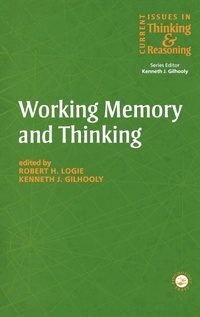
Working Memory and Thinking
Current Issues In Thinking And Reasoning
1st Edition
Published on 27. February 1998
Book
Hardback
176 pages
978-0-86377-514-7 (ISBN)
Description
Thinking and memory are inextricably linked. However, a "divide and rule" approach has led cognitive psychologists to study these two areas in relative isolation. With contributions from some of the leading international researchers on working memory and thinking, the present volume aims to break down the scientific divisions and foster scientific integration in the connections between these two core functions of cognition. Broadly defined, thinking comprises mentally driven change in current representations. The processes involved in such change include application of logical rules, heuristics, problem solving strategies, decision making, planning and comprehension of complex material. Memory involves the encoding, retention and retrieval of information, and the retention may be temporary or in a long-term knowledge base.; Thinking cannot occur in a vacuum; it relies on the long-term memory base and a temporary mental workspace. Despite the apparent limitations on mental workspace, humans can drive a car and hold a conversation, or store partial solutions while tackling other aspects of a problem. So too, some aspects of thinking are relatively resilient in the face of quite extensive brain damage, yet other aspects are remarkably vulnerable to neuroanatomical insults. Humans can solve complex problems with many alternative choice points and yet seem to be able to consider only a few hypotheses at any one time. These apparent paradoxes present significant scientific challenges as to how humans can be such successful thinkers despite their very limited working memory. The chapters herein represent a diversity of views as regards the nature or working memory and forms of human thinking. The links between working memory and thinking are directly addressed and made explicit, and in so doing this volume offers an increasingly integrated understanding of human thinking and memory.
Reviews / Votes
'The book is a useful resource for cognitive psychologists insofar as it gives a good account of current research in the area the editors of this book have succeeded in their aim of providing an integrated understanding of human thinking and memory.' - John T.E. Richardson, Brunel University in Neuropsychologia 38 2000More details
Series
Language
English
Place of publication
Hove
United Kingdom
Publishing group
Taylor & Francis Ltd
Target group
College/higher education
Professional and scholarly
Dimensions
Height: 240 mm
Width: 161 mm
Thickness: 14 mm
Weight
440 gr
ISBN-13
978-0-86377-514-7 (9780863775147)
Copyright in bibliographic data and cover images is held by Nielsen Book Services Limited or by the publishers or by their respective licensors: all rights reserved.
Schweitzer Classification
Other editions
Additional editions
Kenneth Gilhooly | Robert H. Logie
Working Memory and Thinking
Current Issues In Thinking And Reasoning
Book
01/2019
1st Edition
Routledge
€52.70
Shipment within 10-20 days
Kenneth Gilhooly | Robert H. Logie
Working Memory and Thinking
Current Issues In Thinking And Reasoning
E-Book
08/2004
Routledge
€45.99
Available for download
Kenneth Gilhooly | Robert H. Logie
Working Memory and Thinking
Current Issues In Thinking And Reasoning
E-Book
08/2004
Routledge
€45.99
Available for download
Persons
Kenneth Gilhooly, Robert H. Logie
Content
K.J. Gilhooly, R.H. Logie, Thinking in Working Memory. K.J. Gilhooly, Memory, Strategies, and Reasoning Tasks. L.H. Phillips, M.J. Forshaw, The Role of Working Memory in Age Differences in Reasoning. S. Della Sala, R.H. Logie, Dualism Down the Drain: Thinking in the Brain. R.W. Engle, A.R.A. Conway, Working Memory and Comprehension. K.A. Ericsson, P.F. Delaney, Working Memory and Expert Performance. P. Saarilumoa, Adversary Problem-Solving and Working Memory. G.S. Halford, Development of Processing Capacity Entails Representing More Complex Relations: Implications for Cognitive Development.