

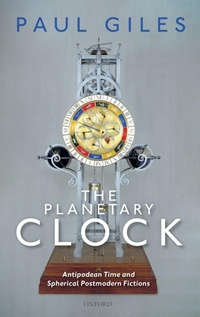
The Planetary Clock
Antipodean Time and Spherical Postmodern Fictions
Published on 23. February 2021
Book
Hardback
436 pages
978-0-19-885772-3 (ISBN)
Description
The theme of The Planetary Clock is the representation of time in postmodern culture and the way temporality as a global phenomenon manifests itself differently across an antipodean axis. To trace postmodernism in an expansive spatial and temporal arc, from its formal experimentation in the 1960s to environmental concerns in the twenty-first century, is to describe a richer and more complex version of this cultural phenomenon. Exploring different scales of time from a Southern Hemisphere perspective, with a special emphasis on issues of Indigeneity and the Anthropocene, The Planetary Clock offers a wide-ranging, revisionist account of postmodernism, reinterpreting literature, film, music, and visual art of the post-1960 period within a planetary framework.
By bringing the culture of Australia and New Zealand into dialogue with other Western narratives, it suggests how an antipodean impulse, involving the transposition of the world into different spatial and temporal dimensions, has long been an integral (if generally occluded) aspect of postmodernism. Taking its title from a Florentine clock designed in 1510 to measure worldly time alongside the rotation of the planets, The Planetary Clock ranges across well-known American postmodernists (John Barth, Toni Morrison) to more recent science fiction writers (Octavia Butler, Richard Powers), while bringing the US tradition into juxtaposition with both its English (Philip Larkin, Ian McEwan) and Australian (Les Murray, Alexis Wright) counterparts. By aligning cultural postmodernism with music (Messiaen, Ligeti, Birtwistle), the visual arts (Hockney, Blackman, Fiona Hall), and cinema (Rohmer, Haneke, Tarantino), this volume enlarges our understanding of global postmodernism for the twenty-first century.
By bringing the culture of Australia and New Zealand into dialogue with other Western narratives, it suggests how an antipodean impulse, involving the transposition of the world into different spatial and temporal dimensions, has long been an integral (if generally occluded) aspect of postmodernism. Taking its title from a Florentine clock designed in 1510 to measure worldly time alongside the rotation of the planets, The Planetary Clock ranges across well-known American postmodernists (John Barth, Toni Morrison) to more recent science fiction writers (Octavia Butler, Richard Powers), while bringing the US tradition into juxtaposition with both its English (Philip Larkin, Ian McEwan) and Australian (Les Murray, Alexis Wright) counterparts. By aligning cultural postmodernism with music (Messiaen, Ligeti, Birtwistle), the visual arts (Hockney, Blackman, Fiona Hall), and cinema (Rohmer, Haneke, Tarantino), this volume enlarges our understanding of global postmodernism for the twenty-first century.
Reviews / Votes
Always challenging conventional wisdom and armed with an impressively vast archive of primary source material, Giles's work consistently expands the scope and scale of contemporary cultural analysis...The threads of reciprocal relation that Giles weaves together provocatively reframe both postmodernism and the antipodean in insightful and innovative ways...In illuminating the antipodean imaginary that runs through postmodernism, The Planetary Clock makes an important and innovative contribution to our understanding of that historical moment. * Mitchum Huehls, University of California, Los Angeles, ALH Online Review * Giles never fails to astonish and impress with his comprehensiveness and percipience, the products of a superb ability to research and synthesise... One of the effects of this remarkable and erudite book is to convince the scholar of world literature that Antipodean cultural production is not just something worth their while but is at the very base of an informed contemporary conception of what world literature should be We are lucky to have such a book as The Planetary Clock: erudite, opinionated, congenial, inclusive, and no doubt, in the future, stimulating of many other explorations in such modes. * Nicholas Birns, Journal of the Association for the Study of Australian Literature *More details
Language
English
Place of publication
Oxford
United Kingdom
Target group
Professional and scholarly
Illustrations
22 colour and 16 black and white Illustrations
Dimensions
Height: 240 mm
Width: 161 mm
Thickness: 28 mm
Weight
816 gr
ISBN-13
978-0-19-885772-3 (9780198857723)
Copyright in bibliographic data and cover images is held by Nielsen Book Services Limited or by the publishers or by their respective licensors: all rights reserved.
Schweitzer Classification
Other editions
Additional editions
E-Book
02/2021
1st Edition
OUP eBook
€81.99
Available for download
E-Book
02/2021
1st Edition
OUP eBook
€81.99
Available for download
Person
Paul Giles is Challis Professor of English at the University of Sydney. He has worked at the Universities of Nottingham, Cambridge, Oxford, and Portland State and he is currently serving as President of the International Association of University Professors of English.
Content
Introduction: Antipodean Time and the Anthropocenic Imaginary
1: Repetition Planetaire: Upside Down Postmodernism
2: Antipodean Alice: Cold War Fetishism and Frozen Time
3: Queer Poetic Time: Crosstemporal Parataxis and Disjunctions of Scale
4: "Reverse-Thinking": Metahistorical Arts and Fictions
5: Two-way Time Travel: Recursive Science and "Backward-Flowing" Fiction
6: Postmodern Slave Narratives: Anachronism and Disorientation
7: Reorchestrating the Past: Long Songs and Antipodean Relations
Conclusion: The Long Postmodernism
1: Repetition Planetaire: Upside Down Postmodernism
2: Antipodean Alice: Cold War Fetishism and Frozen Time
3: Queer Poetic Time: Crosstemporal Parataxis and Disjunctions of Scale
4: "Reverse-Thinking": Metahistorical Arts and Fictions
5: Two-way Time Travel: Recursive Science and "Backward-Flowing" Fiction
6: Postmodern Slave Narratives: Anachronism and Disorientation
7: Reorchestrating the Past: Long Songs and Antipodean Relations
Conclusion: The Long Postmodernism