

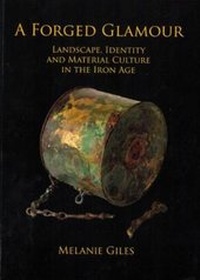
A Forged Glamour
Landscape, Identity and Material Culture in the Iron Age
Published on 10. January 2013
Book
Paperback/Softback
224 pages
978-1-905119-46-2 (ISBN)
Description
A Forged Glamour, which takes its title from a poem, is an exploration of the lives and deaths of ironworking communities renowned for their spectacular material culture, who lived in modern-day East and North Yorkshire, between the 4th and 1st centuries BC. It evaluates settlement and funerary evidence, analyses farming and craftwork, and explores what some of their ideas and beliefs might have been. It situates this regional material within the broader context of Iron Age Britain, Ireland and the near Continent, and considers what manner of society this was. In order to do this it makes use of theoretical ideas on personhood, and relationships with material culture and landscape, arguing that the making of identity always takes work. It is the character, scale and extent of this work (revealed through objects as small as a glass bead, or as big as a cemetery; as local as an earthenware pot or as exotic as coral-decoration) which enables archaeologists to investigate the web of relations which made up their lives, and explore the means of power which distinguished their leaders.
Reviews / Votes
'The book will serve as an excellent introduction for students interested in British prehistory... For professionals in the field of archaeology, it is a model of how big questions can be addressed by close attention to the archaeological data. ' -- Proceedings of the Prehistoric Society Proceedings of the Prehistoric Society Giles' book is much more than an account of the archaeology of East Yorkshire; frequent theoretical discussions exploring varied aspects-from how to interpret burial evidence to the nature of identity and performance-are of much broader resonance; this is certainly not a book to be read only by those interested in the Iron Age. It is an excellent example of how to bring the past to life whilst presenting complex archaeological data. -- Antiquity Antiquity This is a richly detailed book that lives up to the promise of its title and introduction. As well as a sophisticated synthesis, it provides a satisfying exposition of how landscape may be constituted through objects. -- Landscapes Landscapes ...a comprehensive and provocative volume which will be essential reading for all those interested in Iron Age Britain...this book provides an important addition to our knowledge of Iron Age Britain, promoting some of its most spectacular archaeology -- Peter Halkon The Archaeological JournalMore details
Language
English
Place of publication
Macclesfield
United Kingdom
Target group
College/higher education
Illustrations
50 b/w + col illus.
ISBN-13
978-1-905119-46-2 (9781905119462)
Copyright in bibliographic data and cover images is held by Nielsen Book Services Limited or by the publishers or by their respective licensors: all rights reserved.
Schweitzer Classification
Other editions
Additional editions
E-Book
05/2014
1st Edition
Windgather Press
€21.99
Available for download
Person
Melanie Giles teaches archaeology at the University of Manchester, specialising in the Iron Age, particularly Celtic art, as well as the bog bodies of north-western Europe. She works not just on the analysis and interpretation of burials but on aspects of visualisation and display.
Content
1. Archaeological Approaches to Landscape, Identity and Material Culture
2. History Making: Linear Earthworks in the Landscape
3. Building Biographies: Houses and Households
4. Life and Death in an Iron Age Community
5. From Hand-to-Hand: Biographies of Grave Goods
6. Actors and Props: the Theatre of Life and Death
7. Making Tracks: Journeying with the Dead
8. Conclusion
2. History Making: Linear Earthworks in the Landscape
3. Building Biographies: Houses and Households
4. Life and Death in an Iron Age Community
5. From Hand-to-Hand: Biographies of Grave Goods
6. Actors and Props: the Theatre of Life and Death
7. Making Tracks: Journeying with the Dead
8. Conclusion