

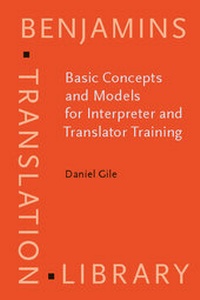
Basic Concepts and Models for Interpreter and Translator Training
Published on 2. February 1995
Book
Hardback
278 pages
978-90-272-1605-2 (ISBN)
Description
This book is based on the author's many years of experience as a practitioner, teacher and researcher in translation and conference interpreting. It is written for I/T trainers who are in search of a methodological basis for their teaching program. The author deals with essential translation and interpretation phenomena and difficulties encountered by students and professionals alike. The underlying theory is based on insights from psycholinguistics, cognitive psychology and I/T research. The 'concepts' and 'models' are easy to understand and the chapters include teaching suggestions and examples.Suitable for I/T trainers and practitioners.
More details
Series
Language
English
Place of publication
Amsterdam
Netherlands
Target group
College/higher education
Professional and scholarly
Dimensions
Height: 245 mm
Width: 164 mm
Weight
500 gr
ISBN-13
978-90-272-1605-2 (9789027216052)
Copyright in bibliographic data and cover images is held by Nielsen Book Services Limited or by the publishers or by their respective licensors: all rights reserved.
Schweitzer Classification
Other editions
New editions
Daniel Gile
Basic Concepts and Models for Interpreter and Translator Training
<strong>Revised edition</strong>
Book
11/2009
2nd Edition
John Benjamins Publishing Co
€111.30
Shipment within 10-15 days
Person
Content
Part 1 Theoretical components in interpreter and translator training: the role of training in interpretation and translation; the components of translation expertise; the variability of training requirements; the need for optimization in translation training; the process-oriented approach in I/T training; potential benefits of theoretical components in interpreter and translator training; criteria for theoretical components; where and how to find theoretical components for I/T training; the models; main ideas. Part 2 Communication and quality in interpretation and translation: professional translation - an act of communication; components of acts of communication in translation; professional loyalty; quality; social status and quality; teaching suggestions; main ideas. Part 3 Fidelity in interpretation and translation: an experiment in fidelity; phase one - verbalizing a simple idea; principles of fidelity; secondary information - an obstacle and a help; teaching suggestions; main ideas. Part 4 Comprehension in interpretation and translation: the comprehension equation; translation and the comprehension of specialized texts; the translator's comprehension requirements; teaching the principles of comprehension; main ideas. Part 5 A sequential model of translation: the model; comments; interpretation vs translation in the light of the model; teaching the model; main ideas. Part 6 Knowledge acquisition in interpretation and translation: differences between interpretation and translation - a reminder; knowledge acquisition in written translation; knowledge acquisition in interpretation; long-term knowledge acquisition in interpretation and translation; teaching suggestions; main ideas. Part 7 The effort models in interpretation: processing capacity and interpretation efforts; an effort model of simultaneous interpretation; processing capacity-related problems; an effort model of consecutive interpretation; efforts in sight translation; simultaneous with text; the effort models and translation; processing capacity and interpretation students; teaching suggestions; main ideas. Part 8 Coping tactics in interpretation: tactics in simultaneous interpretation; the selection of tactics in simultaneous interpretation; tactics in consecutive interpreting and in simultaneous with text.