

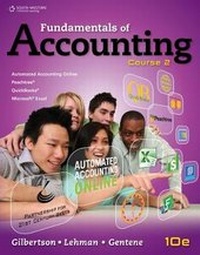
Fundamentals of Accounting
Course 2
10th Edition
Will be published approx. on 18. January 2013
Book
Paperback/Softback
296 pages
978-1-111-58118-3 (ISBN)
Description
Transform your accounting course with FUNDAMENTALS OF ACCOUNTING 10E, the leader in accounting education for more than 100 years. Input from educators, accounting professionals, content experts, and accounting students has informed the tenth edition's new critical-thinking activities, real-world applications, updated Accounting instruction, and enhanced online learning solutions, including Online Working Papers and Automated Accounting Online computerized accounting software.
FUNDAMENTALS OF ACCOUNTING 10E maintains its renowned instructional design and step-by-step approach to teaching the mechanics of accounting. Greater emphasis on conceptual understanding and financial statement analysis in the tenth edition encourages students to apply accounting concepts to real-world situations and make informed business decisions. New features like Forensic Accounting, Think Like an Accountant, Financial Literacy, and Why Accounting? are a few examples of the expanded opportunities for students to master valued skills, such as critical thinking and technology use, as defined by the Partnership for 21st Century Skills. In addition, commercial technology, integrated throughout the text, equips students to work with Microsoft Excel (R), Peachtree (R), QuickBooks (R), and Automated Accounting Online, with step-by-step instructions and the flexibility to use multiple versions of software.
Trust the dedicated leader in accounting education to transform your accounting course with a time-tested instructional design, enhanced digital solutions, and a comprehensive package to address your contemporary classroom needs and prepare your students for success in the 21st century.
FUNDAMENTALS OF ACCOUNTING 10E maintains its renowned instructional design and step-by-step approach to teaching the mechanics of accounting. Greater emphasis on conceptual understanding and financial statement analysis in the tenth edition encourages students to apply accounting concepts to real-world situations and make informed business decisions. New features like Forensic Accounting, Think Like an Accountant, Financial Literacy, and Why Accounting? are a few examples of the expanded opportunities for students to master valued skills, such as critical thinking and technology use, as defined by the Partnership for 21st Century Skills. In addition, commercial technology, integrated throughout the text, equips students to work with Microsoft Excel (R), Peachtree (R), QuickBooks (R), and Automated Accounting Online, with step-by-step instructions and the flexibility to use multiple versions of software.
Trust the dedicated leader in accounting education to transform your accounting course with a time-tested instructional design, enhanced digital solutions, and a comprehensive package to address your contemporary classroom needs and prepare your students for success in the 21st century.
Reviews / Votes
PART 3 ACCOUNTING FOR A MERCHANDISING BUSINESS ORGANIZED AS A CORPORATION--ADJUSTMENTS AND VALUATION. 18. Acquiring Capital for Growth and Development. 19. Accounting for Plant Assets, Depreciation, and Intangible Assets. 20. Accounting for Inventory. RA3, Part A - An Accounting Cycle for a Corporation: Journalizing and Posting Transactions. 21. Accounting for Accruals, Deferrals, and Reversing Entries. 22. End-of-Fiscal-Period Work for a Corporation. RA3, Part B - An Accounting Cycle for a Corporation: End-of-Fiscal-Period Work. Simulation Marketing Page for Digital Diversions. PART 4 ADDITIONAL ACCOUNTING PROCEDURES. 23. Accounting for Partnerships. 24. Recording International and Internet Sales. App. A: Accounting Concepts. App. B: Analyzing Nike's Financial Statements. App. C: Using a Calculator and Computer Keypad. App. D: Recycling Problems. App. E: Answers to Audit Your Understanding. English Glossary. Spanish Glossary. Index.More details
Edition
10th edition
Language
English
Place of publication
Mason
United States
Publishing group
Cengage Learning, Inc
Target group
College/higher education
Dimensions
Height: 12 mm
Width: 213 mm
Thickness: 274 mm
Weight
590 gr
ISBN-13
978-1-111-58118-3 (9781111581183)
Copyright in bibliographic data and cover images is held by Nielsen Book Services Limited or by the publishers or by their respective licensors: all rights reserved.
Schweitzer Classification
Persons
Claudia B. Gilbertson was a high school instructor for 11 years and a community college instructor for 25 years. Currently retired from North Hennepin Community College, Claudia serves as a consultant for accounting online learning solutions. She is active in the National Business Education Association, North Central Business Education Association, and Minnesota Business Educators, Inc. Mark W. Lehman, assistant professor emeritus of Accountancy at the Richard C. Adkerson School of Accountancy at Mississippi State University, teaches Accounting Information Systems and Forensic Accounting. A former auditor with PricewaterhouseCoopers, Dr. Lehman is a Certified Public Accountant and a Certified Fraud Examiner. Dr. Lehman writes journal articles and consults with accountants on the use of software in fraud detection. He was awarded Outstanding Educator by the Mississippi Society of Certified Public Accountants in 2007. Debra Harmon-Gentene has taught business education at the high school level for 20 years and currently teaches at Mason High School in Ohio. A former community college instructor and corporate training manager, Debra has been active in the National Business Education Association, serving on the Entrepreneurship Standards Committee. Debra recently won the Leavey Award and Warren County's Innovative Teacher of the Year award.
Content
PART 3 ACCOUNTING FOR A MERCHANDISING BUSINESS ORGANIZED AS A CORPORATION--ADJUSTMENTS AND VALUATION.
18. Acquiring Capital for Growth and Development.
19. Accounting for Plant Assets, Depreciation, and Intangible Assets.
20. Accounting for Inventory.
RA3, Part A - An Accounting Cycle for a Corporation: Journalizing and Posting Transactions.
21. Accounting for Accruals, Deferrals, and Reversing Entries.
22. End-of-Fiscal-Period Work for a Corporation.
RA3, Part B - An Accounting Cycle for a Corporation: End-of-Fiscal-Period Work.
Simulation Marketing Page for Digital Diversions.
PART 4 ADDITIONAL ACCOUNTING PROCEDURES.
23. Accounting for Partnerships.
24. Recording International and Internet Sales.
App. A: Accounting Concepts.
App. B: Analyzing Nike's Financial Statements.
App. C: Using a Calculator and Computer Keypad.
App. D: Recycling Problems.
App. E: Answers to Audit Your Understanding.
English Glossary.
Spanish Glossary.
Index.
18. Acquiring Capital for Growth and Development.
19. Accounting for Plant Assets, Depreciation, and Intangible Assets.
20. Accounting for Inventory.
RA3, Part A - An Accounting Cycle for a Corporation: Journalizing and Posting Transactions.
21. Accounting for Accruals, Deferrals, and Reversing Entries.
22. End-of-Fiscal-Period Work for a Corporation.
RA3, Part B - An Accounting Cycle for a Corporation: End-of-Fiscal-Period Work.
Simulation Marketing Page for Digital Diversions.
PART 4 ADDITIONAL ACCOUNTING PROCEDURES.
23. Accounting for Partnerships.
24. Recording International and Internet Sales.
App. A: Accounting Concepts.
App. B: Analyzing Nike's Financial Statements.
App. C: Using a Calculator and Computer Keypad.
App. D: Recycling Problems.
App. E: Answers to Audit Your Understanding.
English Glossary.
Spanish Glossary.
Index.