

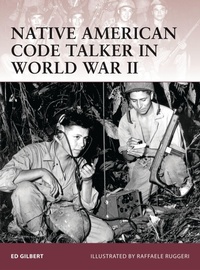
Native American Code Talker in World War II
Published on 2. April 2008
Book
Paperback/Softback
64 pages
978-1-84603-269-1 (ISBN)
Description
'Were it not for the Navajo Code Talkers the Marines would never have taken Iwo Jima and other places' (Anonymous, Marine Corps signal officer). Ed Gilbert uses personal interviews with veterans to tell their fascinating story. Beginning with the first operational use of Native American languages in World War I, he explores how in World War II the US again came to employ this subtle, but powerful 'weapon.' Despite all efforts, the Japanese were never able to decode their messages and the Navajo code talkers contributed significantly to US victories in the Pacific. Approximately 400 Navajos served in this crucial role. Their legend of the 'code talker' has been celebrated by Hollywood in films, such as Windtalkers, and this book reveals the real-life story of their extraordinary involvement in World War II.
More details
Series
Language
English
Place of publication
United Kingdom
Publishing group
Bloomsbury Publishing PLC
Product notice
Paperback (trade)
Unsewn / adhesive bound
Illustrations
50 b/w; 8 col
Dimensions
Height: 248 mm
Width: 183 mm
Thickness: 5 mm
Weight
218 gr
ISBN-13
978-1-84603-269-1 (9781846032691)
Copyright in bibliographic data and cover images is held by Nielsen Book Services Limited or by the publishers or by their respective licensors: all rights reserved.
Schweitzer Classification
Other editions
Additional editions
Ed Gilbert
Native American Code Talker in World War II
E-Book
04/2012
1st Edition
Osprey Publishing
€14.49
Available for download
Ed Gilbert
Native American Code Talker in World War II
E-Book
04/2012
1st Edition
Osprey Publishing
€14.49
Available for download
Persons
Ed Gilbert was a Marine artilleryman and a Battalion Training NCO in the Marine Corps Reserve. He holds a Ph.D. in geology, and is now a geologist and geophysicist involved in petroleum exploration in South Asia, the Middle East, Africa and South America. Ed has written for hobby, historical, and veteran's magazines, and is the author of oral and operational histories of the Marine Corps' armored units in World War II and the Korean War. He is currently at work on a history of the Marine Corps tank battalions in the Vietnam conflict.
Richard Hook was born in 1938 and trained at Reigate College of Art. After national service with 1st Bn, Queen's Royal Regiment, he became art editor of the much-praised magazine Finding Out during the 1960s. He has worked as a freelance illustrator ever since, earning an international reputation particularly for his deep knowledge of Native American material culture; and has illustrated more than 50 Osprey titles.
Richard Hook was born in 1938 and trained at Reigate College of Art. After national service with 1st Bn, Queen's Royal Regiment, he became art editor of the much-praised magazine Finding Out during the 1960s. He has worked as a freelance illustrator ever since, earning an international reputation particularly for his deep knowledge of Native American material culture; and has illustrated more than 50 Osprey titles.
Content
Introduction ? Recruitment ? Training ? Uniform and Equipment ? Belief and Belonging ? On Campaign ? In Battle ? After the War ? Glossary ? Bibliography ? Color Plate Commentary ? Index