

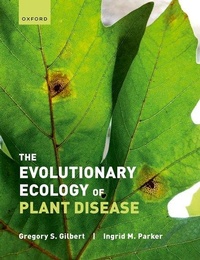
The Evolutionary Ecology of Plant Disease
Published on 16. May 2023
Book
Hardback
336 pages
978-0-19-879787-6 (ISBN)
Description
Understanding the symbiosis between plants and pathogenic microbes is at the core of effective disease management for crops and managed forests. At the same time, plant-pathogen interactions comprise a wonderfully diverse set of ecological relationships that are powerful and yet so commonplace that they often go unnoticed. Ecologists and evolutionary biologists are increasingly exploring the terrain of plant disease ecology, investigating topics such as how pathogens shape diversity in plant communities, how features of plant-microbe interactions including host range and mutualism/antagonism evolve, and how biological invasions, climate change, and other agents of global change can drive disease emergence. Traditional training in ecology and evolutionary biology seldom provides structured exposure to plant pathology or microbiology, and training in plant pathology rarely offers depth in the theoretical frameworks of evolutionary ecology or includes examples from complex wild ecosystems. This novel textbook seeks to unite the research communities of plant disease ecology and plant pathology by bridging this gap.
Reviews / Votes
This is a true learning tool. I can't wait to use it in introductory plant pathology courses and to share it with the public when they say, "You're a what? Plant pathologist?" * Alejandra Huerta, Assistant Professor, Department of Entomology and Plant Pathology, North Carolina State University, USA * Essential reading for students of all levels: from the scientifically curious layperson to the seasoned specialist. * Charles Mitchell, Professor, Department of Biology, University of North Carolina, Chapel Hill, USA * This treatise is impressive in its comprehensive and understandable introduction to the basic biology of diverse plant pathogens, and the complex interactions that they have with their plant hosts. There is a lot to learn and think about in this book! * Steven E. Lindow, Professor Emeritus, Department of Plant and Microbial Biology, University of California, Berkeley, USA * The Evolutionary Ecology of Plant Disease successfully bridges the disciplines of disease evolutionary ecology and plant pathology. It should serve as a very good textbook for undergraduate and graduate students, as a resource for ecologists studying plant diseases, and for plant pathologists. * Rodrigo P. P. Almeida, The Quarterly Review of Biology * This is an easy-to-read book that merges current knowledge of plant pathology and evolutionary ecology, while describing basic concepts in simple terms...[It's] a great resource for educators and students in plant pathology and mycology and provides a refreshing perspective by going beyond agricultural settings to exploring the role of plant disease in natural ecosystems. * Terry J. Torres Cruz, Inoculum * This is an easy-to-read book that merges current knowledge of plant pathology and evolutionary ecology, while describing basic concepts in simple terms...[It's] a great resource for educators and students in plant pathology and mycology and provides a refreshing perspective by going beyond agricultural settings to exploring the role of plant disease in natural ecosystems. * Terry J. Torres Cruz, Inoculum * This book has clear yet concise details and takes the reader through the course at an achievable pace. There are colourful illustrations, useful learning tips such as a mnemonic to remember rust spore types and insert boxes to highlight key processes or techniques, such as serological testing using ELISA. To help non-experts, there are primers on some mathematical analyses such as population models. New terms are highlighted in bold; a glossary of these words would be a useful addition. * Dr Alex Waller FRSB, The Biologist * This book has clear yet concise details and takes the reader through the course at an achievable pace. There are colourful illustrations, useful learning tips such as a mnemonic to remember rust spore types and insert boxes to highlight key processes or techniques, such as serological testing using ELISA. To help non-experts, there are primers on some mathematical analyses such as population models. New terms are highlighted in bold; a glossary of these words would be a useful addition. * Dr Alex Waller FRSB, The Biologist *More details
Language
English
Place of publication
Oxford
United Kingdom
Target group
College/higher education
Product notice
sewn/stitched
Cloth over boards
Dimensions
Height: 252 mm
Width: 195 mm
Thickness: 21 mm
Weight
907 gr
ISBN-13
978-0-19-879787-6 (9780198797876)
Copyright in bibliographic data and cover images is held by Nielsen Book Services Limited or by the publishers or by their respective licensors: all rights reserved.
Schweitzer Classification
Other editions
Additional editions
Gregory Gilbert | Ingrid Parker
The Evolutionary Ecology of Plant Disease
E-Book
06/2023
1st Edition
OUP eBook
€39.49
Available for download
Gregory Gilbert | Ingrid Parker
The Evolutionary Ecology of Plant Disease
Book
05/2023
Oxford University Press
€52.50
Shipment within 15-20 days
Persons
Gregory S. Gilbert is Professor in the Department of Environmental Studies, University of California Santa Cruz, USA. He is a plant pathologist and forest ecologist, and his research interests include the dynamics of plant and fungal communities, as well as the application of evolutionary ecology to environmental problem solving. He is the Director of the UCSC Forest Ecology Research Plot, and is a Research Associate at the Smithsonian Tropical Research Institute, Panama.
Ingrid M. Parker is Professor in the Department of Ecology and Evolutionary Biology, University of California Santa Cruz, USA. She is a plant evolutionary ecologist, and her research interests include plant disease ecology, the invasion of non-native species, the evolution of domestication, ecological restoration, and plant conservation. She is a Research Associate at the Smithsonian Tropical Research Institute, Panama.
Ingrid M. Parker is Professor in the Department of Ecology and Evolutionary Biology, University of California Santa Cruz, USA. She is a plant evolutionary ecologist, and her research interests include plant disease ecology, the invasion of non-native species, the evolution of domestication, ecological restoration, and plant conservation. She is a Research Associate at the Smithsonian Tropical Research Institute, Panama.
Author
ProfessorPresidential Chair for Integral Ecology and Environmental Justice, Department of Environmental Studies and Rachel Carson College, University of California Santa Cruz, USA
ProfessorProfessor of Ecology and Evolutionary Biology, Department of Ecology and Evolutionary Biology, University of California Santa Cruz, USA
Content
Preface
Part 1: Plant Pathogens and Disease
1: Thinking like a plant disease ecologist
2: How to be a plant
3: How to be a fungus
4: How to be an oomycete
5: How to be a bacterium
6: How to be a virus
7: How to be a macroparasite
8: Types of diseases
9: How to do disease ecology
Part 2: Evolutionary Ecology of Plant-Pathogen Symbioses
10: The population ecology of plant disease
11: Spatial ecology
12: Physiology and genetics
13: Evolution
14: Community ecology
15: The plant microbiome
16: Global change
17: Disease management
Epilogue
Part 1: Plant Pathogens and Disease
1: Thinking like a plant disease ecologist
2: How to be a plant
3: How to be a fungus
4: How to be an oomycete
5: How to be a bacterium
6: How to be a virus
7: How to be a macroparasite
8: Types of diseases
9: How to do disease ecology
Part 2: Evolutionary Ecology of Plant-Pathogen Symbioses
10: The population ecology of plant disease
11: Spatial ecology
12: Physiology and genetics
13: Evolution
14: Community ecology
15: The plant microbiome
16: Global change
17: Disease management
Epilogue