

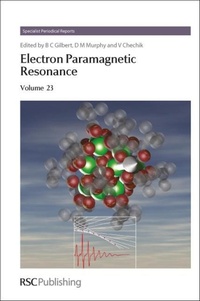
Electron Paramagnetic Resonance
Volume 23
Published on 30. November 2012
Book
Hardback
311 pages
978-1-84973-168-3 (ISBN)
Description
Specialist Periodical Reports provide systematic and critical review coverage in major areas of chemical research. Compiled by teams of leading authorities in the relevant subject, the series creates a unique service for the active research chemist with regular critical in-depth accounts of progress in particular areas of chemistry. Subject coverage of all volumes is very similar and publication is on an annual or biennial basis. As EPR continues to find new applications in virtually all areas of modern science, including physics, chemistry, biology and materials science, this series caters not only for experts in the field, but also those wishing to gain a general overview of EPR applications in a given area.
More details
Series
Language
English
Place of publication
Cambridge
United Kingdom
Target group
College/higher education
Product notice
Unsewn / adhesive bound
Dimensions
Height: 234 mm
Width: 156 mm
Thickness: 17 mm
Weight
631 gr
ISBN-13
978-1-84973-168-3 (9781849731683)
Copyright in bibliographic data and cover images is held by Nielsen Book Services Limited or by the publishers or by their respective licensors: all rights reserved.
Schweitzer Classification
Other editions
Additional editions
E-Book
11/2012
1st Edition
Royal Society of Chemistry
€413.99
Available for download
Persons
Professor Bruce Gilbert is emeritus Professor at the University of York and Chairs the Specialist Periodical Report editorial board. Dr Victor Chechik is at the University of York. Dr Damien Murphy is at the Cardiff University.
Content
Electron Paramagnetic Resonance (EPR) highlights major developments in this area, with results being set into the context of earlier work and presented as a set of critical yet coherent overviews. The topics covered describe contrasting types of application, ranging from biological areas such as EPR studies of free-radical reactions in biology and medically-related systems, to experimental developments and applications involving EPR imaging, the use of very high fields, and time-resolved methods. Critical and up-to-the-minute reviews of advances involving the design of spin-traps, advances in spin-labelling, paramagnetic centres on solid surfaces, exchange-coupled oligomers, metalloproteins and radicals in flavoenzymes are also included. As EPR continues to find new applications in virtually all areas of modern science, including physics, chemistry, biology and materials science, this series caters not only for experts in the field, but also those wishing to gain a general overview of EPR applications in a given area.