

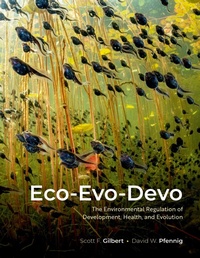
Eco-Evo-Devo
The Environmental Regulation of Development, Health, and Evolution
Will be published approx. on 13. August 2026
Book
Paperback/Softback
536 pages
978-0-19-766402-5 (ISBN)
Description
Recent discoveries in fields ranging from molecular and cell biology to ecology and evolution have given rise to 'ecological and evolutionary developmental biology' (or simply, 'eco-evo-devo'), the new science aimed at clarifying how the interplay between genes and environment shapes how organisms develop, interact, and evolve.
Eco-Evo-Devo: The Environmental Regulation of Development, Health, and Evolution provides a synthetic overview of this new field, which merges evolution with ecological developmental biology. The book discusses such major themes as how multicellular organisms function, develop, and evolve as consortia of different symbiotic organisms, how many organisms can generate numerous traits depending on the environmental conditions they experience via phenotypic plasticity, and how living things have evolved several layers of inheritance that do not rely on the transmission of genes from parent to offspring. As the book details, these themes question many of our longstanding assumptions about how biology works, as well as having practical implications in preventing many diseases and mitigating biodiversity loss.
Written for any undergraduate and graduate students with a basic knowledge of biology, Eco-Evo-Devo promises to stimulate new thinking about inheritance, development, ecology, evolution, and health.
Eco-Evo-Devo: The Environmental Regulation of Development, Health, and Evolution provides a synthetic overview of this new field, which merges evolution with ecological developmental biology. The book discusses such major themes as how multicellular organisms function, develop, and evolve as consortia of different symbiotic organisms, how many organisms can generate numerous traits depending on the environmental conditions they experience via phenotypic plasticity, and how living things have evolved several layers of inheritance that do not rely on the transmission of genes from parent to offspring. As the book details, these themes question many of our longstanding assumptions about how biology works, as well as having practical implications in preventing many diseases and mitigating biodiversity loss.
Written for any undergraduate and graduate students with a basic knowledge of biology, Eco-Evo-Devo promises to stimulate new thinking about inheritance, development, ecology, evolution, and health.
More details
Language
English
Place of publication
New York
United States
Target group
College/higher education
Product notice
Paperback (trade)
Unsewn / adhesive bound
Illustrations
136 colour figures
Dimensions
Height: 278 mm
Width: 216 mm
Thickness: 23 mm
Weight
1479 gr
ISBN-13
978-0-19-766402-5 (9780197664025)
Copyright in bibliographic data and cover images is held by Nielsen Book Services Limited or by the publishers or by their respective licensors: all rights reserved.
Schweitzer Classification
Persons
Scott F. Gilbert is the Howard A. Schneiderman Professor of Biology, emeritus, at Swarthmore College, where he has taught developmental genetics, embryology, and the history and critiques of biology. He is also a Finland Distinguished Professor, emeritus, at the University of Helsinki. He received his B.A. in both biology and religion from Wesleyan University and he earned his PhD in biology and his MA in the history of science from Johns Hopkins University. His research has investigated how developmental alterations caused by changes in gene expression or symbiosis can cause selectable variation.
David W. Pfennig is Professor of Biology at the University of North Carolina, Chapel Hill. He earned his PhD from the University of Texas, Austin and was previously on the faculty at the University of Illinois, Urbana-Champaign. He is co-author of numerous scientific papers and two books: Evolution's Wedge: Competition and the Origins of Diversity (2012) and Phenotypic Plasticity:
Causes, Consequences, Controversies (2021).
David W. Pfennig is Professor of Biology at the University of North Carolina, Chapel Hill. He earned his PhD from the University of Texas, Austin and was previously on the faculty at the University of Illinois, Urbana-Champaign. He is co-author of numerous scientific papers and two books: Evolution's Wedge: Competition and the Origins of Diversity (2012) and Phenotypic Plasticity:
Causes, Consequences, Controversies (2021).
Content
Part I: Eco-Evo-Devo: Basic Concepts Chapter 1: A New Way of Thinking About Life Chapter 2: Ecology and Evolution: An Intertwined Relationship
Chapter 3: History of Life: Patterns and Processes
Chapter 4: Development: The Origin of Phenotypic Variation Part II: Eco-Evo-Devo: Putting the Concepts Together Chapter 5: Ecology and Development: Another Intertwined Relationship
Chapter 6: The Organism as Ecosystem: Symbiosis in Development and Evolution
Chapter 7: Inheritance: An Ecological Perspective
Chapter 8: Evolution through Developmental Regulatory Genes
Chapter 9: Phenotypic Plasticity and Evolution
Chapter 10: The Origins of Complexity in Development and Evolution: From Genomes to Societies Part III: Eco-Evo-Devo: Applying the Concepts Chapter 11: Teratogenesis: Environmental Assaults on Development
Chapter 12: Endocrine Disruptors
Chapter 13: Developmental Origins of Adult Health and Disease
Chapter 14: Eco-Evo-Devo and the Biodiversity Crisis
Chapter 3: History of Life: Patterns and Processes
Chapter 4: Development: The Origin of Phenotypic Variation Part II: Eco-Evo-Devo: Putting the Concepts Together Chapter 5: Ecology and Development: Another Intertwined Relationship
Chapter 6: The Organism as Ecosystem: Symbiosis in Development and Evolution
Chapter 7: Inheritance: An Ecological Perspective
Chapter 8: Evolution through Developmental Regulatory Genes
Chapter 9: Phenotypic Plasticity and Evolution
Chapter 10: The Origins of Complexity in Development and Evolution: From Genomes to Societies Part III: Eco-Evo-Devo: Applying the Concepts Chapter 11: Teratogenesis: Environmental Assaults on Development
Chapter 12: Endocrine Disruptors
Chapter 13: Developmental Origins of Adult Health and Disease
Chapter 14: Eco-Evo-Devo and the Biodiversity Crisis