

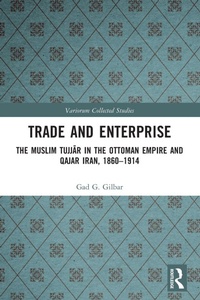
Trade and Enterprise
The Muslim Tujjar in the Ottoman Empire and Qajar Iran, 1860-1914
1st Edition
Published on 8. October 2024
Book
Paperback/Softback
284 pages
978-1-032-01160-8 (ISBN)
Description
Until recently, the historiography of Middle Eastern economic elites during the first globalization has ignored the significant role played by Muslim tujjar (big merchant-entrepreneurs). Foreign firms and local minorities were considered the prime agents of economic change and the initiators of economic growth.
The 12 studies in this volume show that the Muslim tujjar played a major economic role in various regions of the Middle East during the late nineteenth and early twentieth centuries. Their investments, mainly in commercial agriculture, resulted in economic growth and changed economic structures and social relations in many Middle Eastern communities. They were also involved in political developments, some of which had a dramatic effect on the history of their countries, as for instance in late Qajar Iran. They also played a unique role in the process of cultural change. Although they supported the ?ulama? financially, they also contributed to the establishment of new educational and cultural institutions. The story of the tujjar is unique in the sense that it was the only indigenous elite group in the pre-World War I Middle East to bridge between traditional forces and concepts and Western attitudes and practices. (CS 1108).
The 12 studies in this volume show that the Muslim tujjar played a major economic role in various regions of the Middle East during the late nineteenth and early twentieth centuries. Their investments, mainly in commercial agriculture, resulted in economic growth and changed economic structures and social relations in many Middle Eastern communities. They were also involved in political developments, some of which had a dramatic effect on the history of their countries, as for instance in late Qajar Iran. They also played a unique role in the process of cultural change. Although they supported the ?ulama? financially, they also contributed to the establishment of new educational and cultural institutions. The story of the tujjar is unique in the sense that it was the only indigenous elite group in the pre-World War I Middle East to bridge between traditional forces and concepts and Western attitudes and practices. (CS 1108).
More details
Series
Language
English
Place of publication
London
United Kingdom
Publishing group
Taylor & Francis Ltd
Target group
Professional and scholarly
Academic
Illustrations
14 s/w Tabellen
14 Tables, black and white
Dimensions
Height: 234 mm
Width: 156 mm
Thickness: 16 mm
Weight
459 gr
ISBN-13
978-1-032-01160-8 (9781032011608)
Copyright in bibliographic data and cover images is held by Nielsen Book Services Limited or by the publishers or by their respective licensors: all rights reserved.
Schweitzer Classification
Other editions
Additional editions
E-Book
10/2022
1st Edition
Routledge
€55.49
Available for download
Book
10/2022
1st Edition
Routledge
€186.50
Shipment within 10-20 days
E-Book
10/2022
1st Edition
Routledge
€55.49
Available for download
Person
Gad G. Gilbar is Professor Emeritus of Economic History of the Middle East in Modern Times at the University of Haifa, Israel. His publications include: The Economic Development of the Modern Middle East (Hebrew, 1990); (ed.), Ottoman Palestine, 1800-1914: Studies in Economic and Social History (1990); Population Dilemmas in the Middle East (1997); The Middle East Oil Decade and Beyond (1998); (co-ed.), The Baha'is of Iran, Transcaspia and the Caucasus, 2 vols. (2011).
Content
1 The Muslim Big Merchant-Entrepreneurs of the Middle East, 1860-1914 / 2 Muslim Tujjar of the Middle East and Their Commercial Networks in the Long Nineteenth Century / 3 The Qadi, the Big Merchant and Forbidden Interest (Riba) / 4 Images of the Tujjar: Between Shechrazad and Ibn Khaldun / 5 Paradigms of Trade and Finance in Ottoman Historiography / 6 Changing Patterns of Economic Ties: The Syrian and Iraqi Provinces in the Long 19th Century / 7 The Growing Economic Involvement of Palestine with the West, 1865-1914 / 8 The Opening Up of Qajar Iran: Some Economic and Social Aspects / 9 Resistance to Economic Penetration: The Karguzar and Foreign Firms in Qajar Iran / 10 The Mysterious Death of a Commercial Agent and the Karguzar of Mashhad, 1890/ 11 The Rise and Fall of the Tujjar Councils of Representatives in Iran, 1884-85 / 12 The Tujjar and the Persian Constitutional Revolution of 1906