

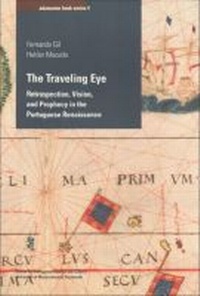
The Traveling Eye
Retrospection, Vision, and Prophecy in the Portuguese Renaissance
Published on 30. August 2009
Book
Paperback/Softback
440 pages
978-1-933227-29-0 (ISBN)
Description
The idea for The Traveling Eye came as a new departure in an old dialogue between the two authors, one a literary scholar, the other a philosopher. Our focus was initially centered on a philosophical hypothesis concerning evidence, with specific reference to the prophetic writings of Father Antonio Vieira, but it occurred to us that this perspective could be applied to literary works, particularly those of the Portuguese Renaissance. The studies that one of us had dedicated to the initiatory aspects of The Lusiads and to the codification of esoteric meanings in the work of Bernardim Ribeiro suggested a possible convergence of our two lines of research. But there are other issues raised by the Portuguese Renaissance: voyages, the new, the encounter with difference and how to understand it. The most obvious and direct expression of these issues is found in the chronicles of voyage and empire, whose importance is duly noted in the study by Luis de Sousa Rebelo included in Chapter III of this book. The literary treatment of this material seems to us no less revealing. Seeing (""seeing clearly seen"" as Camoes says in The Lusiads) poses the problem of simultaneously seeing ""what is there"" and of how what is there could be seen. This questioning from the outside by ""the traveling eye"" went hand in hand with new ways of relating to oneself and to others. Three key Renaissance authors, Luis de Camoes (1525?-1580), Francisco de Sa de Miranda (1481?-1558?) and Bernardim Ribeiro (b.1480s?), address the human subject's relationship as a perplexing issue. Their works transform the feeling of love into a multifaceted investigation that questions the identity of the individual. A recurring theme in this book is the metamorphoses of the self brought about by love.
More details
Series
Language
English
Place of publication
Amherst
United States
Publishing group
University of Massachusetts Press
Target group
Professional and scholarly
Product notice
Paperback (trade)
Unsewn / adhesive bound
Illustrations
7 colour illustrations
Dimensions
Height: 233 mm
Width: 154 mm
Thickness: 30 mm
Weight
694 gr
ISBN-13
978-1-933227-29-0 (9781933227290)
Copyright in bibliographic data and cover images is held by Nielsen Book Services Limited or by the publishers or by their respective licensors: all rights reserved.
Schweitzer Classification
Persons
Fernando Gil (1937-2006) was Directeur d'Etudes at the Ecole des Hautes Etudes en Sciences Sociales (Paris), Professor of Philosophy at the University of Lisbon and Visiting Professor at The Johns Hopkins University, the Hebrew University of Jerusalem and universities in Brazil and Spain. In Portugal, he was the founding president of the Gabinete de Filosofia do Conhecimento, the founding editor of the academic journal Analise, and adviser to the President of the Republic, the Minister for Science and Technology, and the Calouste Gulbenkian Foundation. He was awarded the Fernando Pessoa Prize for his contribution to Portuguese culture and was Grande Oficial of the Order of Infante Dom Henrique. His work includes twelve philosophical treatises and books on literature, music and painting.
Helder Macedo (b. 1935) is Professor Emeritus of Portuguese at King's College, University of London, where he was Camoens Professor and founding editor of the academic journal Portuguese Studies. He has been Visiting Professor at Harvard University, Ecole des Hautes Etudes en Sciences Sociales, and universities in Brazil and Spain. He was Deputy Minister for Culture in the Portuguese Government and is a member of the Portuguese Academy of Sciences and Comendador of the Order of Santiago da Espada. His published work includes ten books of literary criticism, five collections of poetry and five novels.
Helder Macedo (b. 1935) is Professor Emeritus of Portuguese at King's College, University of London, where he was Camoens Professor and founding editor of the academic journal Portuguese Studies. He has been Visiting Professor at Harvard University, Ecole des Hautes Etudes en Sciences Sociales, and universities in Brazil and Spain. He was Deputy Minister for Culture in the Portuguese Government and is a member of the Portuguese Academy of Sciences and Comendador of the Order of Santiago da Espada. His published work includes ten books of literary criticism, five collections of poetry and five novels.
Content
Introductory Note
The Poetics of Truth in The Lusiads - Helder Macedo
The Lusiads Effect - Fernando Gil
The Traveling Eye: The Seas of The Lusiads - Fernando Gil - Translated by K. David Jackson
Fernao Lopes, the Seventh Age and the House of Avis - Helder Macedo - Translated by Kenneth Krabbenhoft
The Sixteenth-Century Portuguese Chronicles - Luis de Sousa Rebelo
The Deceiving Eye - Helder Macedo - Translated by Kenneth Krabbenhoft
Sa de Miranda and the Ambiguities of Knowledge - Helder Macedo
The Groundless Self - Fernando Gil - Translated by Kenneth Krabbenhoft
Bernardim Ribeiro's Obscure Clarities - Helder Macedo
Modes of Absent Love - Fernando Gil
Convergence and Dissent - Helder Macedo - Translated by Anna M. Klobucka
Appetite and Reason in Camoes's Lyric Poetry - Helder Macedo - Translated by Richard Zenith
Nationalism and Pastoralism - Helder Macedo - Translated by Richard Zenith
Two Views of Antonio Vieira
How to Prove Prophecy: Base the Original on the Copy - Fernando Gil
The Coming of the Fifth Empire and Biblical Prophecy - Fernando Gil - Translated by Kenneth Krabbenhoft
Index - Compiled by Valeria M. Souza
The Poetics of Truth in The Lusiads - Helder Macedo
The Lusiads Effect - Fernando Gil
The Traveling Eye: The Seas of The Lusiads - Fernando Gil - Translated by K. David Jackson
Fernao Lopes, the Seventh Age and the House of Avis - Helder Macedo - Translated by Kenneth Krabbenhoft
The Sixteenth-Century Portuguese Chronicles - Luis de Sousa Rebelo
The Deceiving Eye - Helder Macedo - Translated by Kenneth Krabbenhoft
Sa de Miranda and the Ambiguities of Knowledge - Helder Macedo
The Groundless Self - Fernando Gil - Translated by Kenneth Krabbenhoft
Bernardim Ribeiro's Obscure Clarities - Helder Macedo
Modes of Absent Love - Fernando Gil
Convergence and Dissent - Helder Macedo - Translated by Anna M. Klobucka
Appetite and Reason in Camoes's Lyric Poetry - Helder Macedo - Translated by Richard Zenith
Nationalism and Pastoralism - Helder Macedo - Translated by Richard Zenith
Two Views of Antonio Vieira
How to Prove Prophecy: Base the Original on the Copy - Fernando Gil
The Coming of the Fifth Empire and Biblical Prophecy - Fernando Gil - Translated by Kenneth Krabbenhoft
Index - Compiled by Valeria M. Souza