

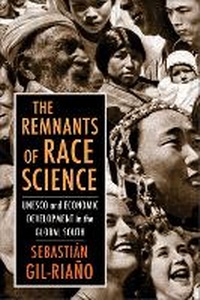
The Remnants of Race Science
UNESCO and Economic Development in the Global South
Published on 29. August 2023
Book
Hardback
392 pages
978-0-231-19434-1 (ISBN)
Description
After World War II, UNESCO launched an ambitious international campaign against race prejudice. Casting racism as a problem of ignorance, it sought to reduce prejudice by spreading the latest scientific knowledge about human diversity to instill "mutual understanding" between groups of people. This campaign has often been understood as a response led by British and U.S. scientists to the extreme ideas that informed Nazi Germany. Yet many of its key figures were social scientists either raised in or closely involved with South America and the South Pacific.
The Remnants of Race Science traces the influence of ideas from the Global South on UNESCO's race campaign, illuminating its relationship to notions of modernization and economic development. Sebastian Gil-Riano examines the campaign participants' involvement in some of the most ambitious development projects of the postwar period. In challenging race prejudice, these experts drew on ideas about race that emphasized plasticity and mutability, in contrast to the fixed categories of scientific racism. Gil-Riano argues that these same ideas legitimated projects of economic development and social integration aimed at bringing ostensibly "backward" indigenous and non-European peoples into the modern world. He also shows how these experts' promotion of studies of race relations inadvertently spurred a deeper reckoning with the structural and imperial sources of racism as well as the aftermath of the transatlantic slave trade.
Shedding new light on the postwar refashioning of ideas about race, this book reveals how internationalist efforts to dismantle racism paved the way for postcolonial modernization projects.
The Remnants of Race Science traces the influence of ideas from the Global South on UNESCO's race campaign, illuminating its relationship to notions of modernization and economic development. Sebastian Gil-Riano examines the campaign participants' involvement in some of the most ambitious development projects of the postwar period. In challenging race prejudice, these experts drew on ideas about race that emphasized plasticity and mutability, in contrast to the fixed categories of scientific racism. Gil-Riano argues that these same ideas legitimated projects of economic development and social integration aimed at bringing ostensibly "backward" indigenous and non-European peoples into the modern world. He also shows how these experts' promotion of studies of race relations inadvertently spurred a deeper reckoning with the structural and imperial sources of racism as well as the aftermath of the transatlantic slave trade.
Shedding new light on the postwar refashioning of ideas about race, this book reveals how internationalist efforts to dismantle racism paved the way for postcolonial modernization projects.
Reviews / Votes
Brilliantly and provocatively, The Remnants of Race Science reveals that the so-called decline of racial thought in human biology was really just a substitution of other more flexible ideas of human difference-mostly from the Global South-for the rigid racist typologies of the Global North. This more inclusive refiguring of racial difference would make possible the economic 'development' of people once excluded from modernity-which meant in practice their neocolonial incorporation into the netherworlds of global capitalism. In this paradigm-shifting book, Gil-Riano thus offers us a new 'southern' vocabulary to talk about racism and antiracism. -- Warwick Anderson, author of <i>Colonial Pathologies: American Tropical Medicine, Race, and Hygiene in the Philippines</i> Starting with scientific research from the Southern Hemisphere, this important book overturns the common story of antiracist science as simplistically rooted in rejecting fixed biological kinds. Drawing from a transnational archive, Gil-Riano shows how so-called anti-racist science was caught up in projects of improvement that rested on a multitude of other racisms. -- M. Murphy, author of <i>The Economization of Life</i> Latin Americanists have long maintained that race and biology are shaped by culture, social organization, and economic conditions. In this deeply researched study, Gil-Riano shows how Latin American racial ideas shaped the post-World War II human sciences and UNESCO projects. The human sciences did not renounce racial explanation-as so many believe-but folded them into global ideas about economic development. -- Karin Rosemblatt, author of <i>The Science and Politics of Race in Mexico and the United States, 1910-1950</i> Offers useful historical context to current debates about how to successfully build solidarity in science and society. * Science * An important and timely contribution to the social sciences that any scholar interested in these fields, their history, or antiracism ought to seek out. * Journal of Anthropological Research * An intellectual history-and a brilliant one at that-which provides a fresh, complex, and compelling perspective on UNESCO. -- Michelle Brattain, Georgia State University * American Historical Review *More details
Series
Language
English
Place of publication
New York
United States
Target group
Professional and scholarly
Product notice
Trade binding
Illustrations
10 figures
Dimensions
Height: 229 mm
Width: 152 mm
ISBN-13
978-0-231-19434-1 (9780231194341)
Copyright in bibliographic data and cover images is held by Nielsen Book Services Limited or by the publishers or by their respective licensors: all rights reserved.
Schweitzer Classification
Other editions
Additional editions
E-Book
08/2023
1st Edition
Columbia University Press
€33.99
Available for download
Person
Sebastian Gil-Riano is an assistant professor in the History and Sociology of Science Department and the Center for Latin American and Latinx Studies at the University of Pennsylvania.
Content
Acknowledgments
Introduction: The Remnants of Race Science
Part I: Confronting Racism in the Southern Hemisphere, 1890-1951
1. Substituting Race: Arthur Ramos, Bahia, and the "Nina Rodrigues School"
2. Relocating Race Science After World War II: Situating the 1950 UNESCO Statement on Race in the Southern Hemisphere
3. Vikings of the Sunrise: Alfred Metraux, Te Rangi Hiroa, and Polynesian Racial Resilience
Part II: Race in the Tropics and Highlands and the Quest for Economic Development, 1945-1962
4. A Tropical Laboratory: Race, Evolution, and the Demise of UNESCO's Hylean Amazon Project
5. "Peasants Without Land": Race and Indigeneity in the ILO's Puno-Tambopata Project
Part III: Engineering Racial Harmony and Decolonization, 1952-1961
6. A Brazilian Racial Dilemma: Modernization and UNESCO's Race Relations Studies in Brazil
7. A White World Perspective and the Collapse of Global Race Relations Inquiry
Conclusion: "Racism Continues to Haunt the World"
Notes
Index
Introduction: The Remnants of Race Science
Part I: Confronting Racism in the Southern Hemisphere, 1890-1951
1. Substituting Race: Arthur Ramos, Bahia, and the "Nina Rodrigues School"
2. Relocating Race Science After World War II: Situating the 1950 UNESCO Statement on Race in the Southern Hemisphere
3. Vikings of the Sunrise: Alfred Metraux, Te Rangi Hiroa, and Polynesian Racial Resilience
Part II: Race in the Tropics and Highlands and the Quest for Economic Development, 1945-1962
4. A Tropical Laboratory: Race, Evolution, and the Demise of UNESCO's Hylean Amazon Project
5. "Peasants Without Land": Race and Indigeneity in the ILO's Puno-Tambopata Project
Part III: Engineering Racial Harmony and Decolonization, 1952-1961
6. A Brazilian Racial Dilemma: Modernization and UNESCO's Race Relations Studies in Brazil
7. A White World Perspective and the Collapse of Global Race Relations Inquiry
Conclusion: "Racism Continues to Haunt the World"
Notes
Index