

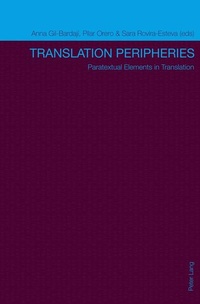
Translation Peripheries
Paratextual Elements in Translation
Published on 10. March 2012
Book
Paperback/Softback
196 pages
978-3-0343-1038-3 (ISBN)
Description
This book investigates different elements which have direct implications for translations but are not the actual text. These features are usually presented in a particular format - written, oral, digital, audio-visual or musical. They are furnished with, for example, illustrations, prologues, introductions, indexes or appendices, or are accompanied by an ensemble of information outside the text such as an interview with the author, a general or specialist press review, an advertisement or a previous translation.
However, the boundaries of paratextuality are not limited to the aforementioned examples, since paratextuality has a direct implication for areas as diverse as censorship, a contracting economy, decisions taken by the various actors in the political or cultural context in which the text occurs. Therefore it is obvious that most of the key concepts in Translation Studies cannot be fully understood without reference to the part played by paratextual elements, examined here taking into account different language pairs from Turkish to Catalan.
The content presented in this book is gathered from a conference on Paratextual Elements in Translation, held at the Universitat Autònoma de Barcelona in 2010.
More details
Edition
New edition
Language
English
Place of publication
Lausanne
Switzerland
Target group
Tranlators ; Academics in the humanities ; PG students
Edition type
New edition
Dimensions
Height: 21 cm
Width: 14.8 cm
Weight
330 gr
ISBN-13
978-3-0343-1038-3 (9783034310383)
DOI
10.3726/978-3-0351-0360-1
Schweitzer Classification
Other editions
Additional editions
Anna Gil Bardaji | Pilar Orero | Sara Rovira-Esteva
Translation Peripheries
Paratextual Elements in Translation
E-Book
03/2012
180th Edition
Peter Lang Verlag
€94.19
Available for download
Persons
Anna Gil-Bardají, Pilar Orero and Sara Rovira-Esteva lecture at the Department of Translation and Interpreting at Universitat Autònoma de Barcelona, Spain. As experts in translation of many genres such as poetry, films and documentaries from Arabic, English and Mandarin, they have a common interest in the body of external apparatus which accompany texts: from drawings or facial gestures to orthotypography. They have published widely in journals and are part of research teams in their different areas of interest.
Content
Contents: Anna Gil-Bardaji/Pilar Orero/Sara Rovira-Esteva: Introduction: Translation Peripheries. The Paratextual Elements in Translation - Neslihan Kansu-Yetkiner /Luetfiye Oktar: Hayri Potur vs. Harry Potter: A Paratextual Analysis of Glocalization in Turkish - Mary Louise Wardle: Alice in Busi-Land: The Reciprocal Relation Between Text and Paratext - Leah Gerber: Marking the Text: Paratextual Features in German Translations of Australian Children's Fiction - Ellen McRae: The Role of Translators' Prefaces to Contemporary Literary Translations into English: An Empirical Study - Elizabete Manterola Agirrezabalaga: What Kind of Translation is it? Paratextual Analysis of the Work by Bernardo Atxaga - Ulf Norberg: Literary Translators' Comments on their Translations in Prefaces and Afterwords: The Case of Contemporary Sweden - Jose Yuste Frias: Paratextual Elements in Translation: Paratranslating Titles in Children's Literature - Rocio Garcia Jimenez: Translation and Paratext: Two Italian Songs in 1960s Spain - Madeleine Stratford: Reviewed and Rectified: Pizarnik's 'Negative Paintings' in German Translation - Miquel Edo: Paratextual Discord: The Reception of Carducci's Poetry in Catalan and Spanish Literature.