

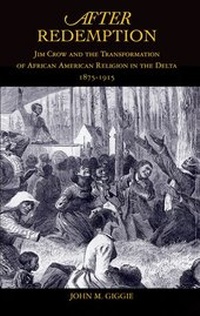
After Redemption
Jim Crow and the Transformation of African American Religion in the Delta, 1875-1915
Published on 6. December 2007
Book
Hardback
336 pages
978-0-19-530403-9 (ISBN)
Description
Challenging the traditional interpretation that the years between Reconstruction and World War I were a period when blacks made only marginal advances in religion, politics, and social life, John Giggie contends that these years marked a critical turning point in the religious history of southern blacks. In this ground-breaking first book, Giggie connects these changes in religious life in the Delta region - whose popularity was predominantly black but increasingly
ruled by white supremacists - to the Great Migration and looks at how they impacted the new urban lives of those who made the exodus to the north. Rather than a straight narrative, the chapters present a range of ways blacks in the Delta experimented with new forms of cultural expression and how they
looked for spiritual meaning in the face of racial violence. Giggie traces how experiences with the railroad became a part of spiritual life, how consumer marketing built religious identities, ways that fraternal societies became tied in with churches, the role of material culture in unifying religious identity across the Delta, and the backlash against the worldliness of black churches and the growth of alternate practices. The study take into account folk religion as well as a panopoly of
institutions - black Baptist churches, African Methodist Episcopal church, Colored Methodist Episcopal Church, black conferences of the Methodist Episcopal Church, and churches that formed the African-American Holiness movement - and looks at how they vigorously quarreled over the proper definition of
religious organization, worship, and consumption. Vivid evidence comes from black denominational newspapers, published and unpublished ex-slave interviews conducted by the Works Progress Administration, legal transcripts, autobiographies, and recordings of black music and oral expression. This work is an excellent fit with the strengths of the OUP lists in African American, Southern, and religious history.
ruled by white supremacists - to the Great Migration and looks at how they impacted the new urban lives of those who made the exodus to the north. Rather than a straight narrative, the chapters present a range of ways blacks in the Delta experimented with new forms of cultural expression and how they
looked for spiritual meaning in the face of racial violence. Giggie traces how experiences with the railroad became a part of spiritual life, how consumer marketing built religious identities, ways that fraternal societies became tied in with churches, the role of material culture in unifying religious identity across the Delta, and the backlash against the worldliness of black churches and the growth of alternate practices. The study take into account folk religion as well as a panopoly of
institutions - black Baptist churches, African Methodist Episcopal church, Colored Methodist Episcopal Church, black conferences of the Methodist Episcopal Church, and churches that formed the African-American Holiness movement - and looks at how they vigorously quarreled over the proper definition of
religious organization, worship, and consumption. Vivid evidence comes from black denominational newspapers, published and unpublished ex-slave interviews conducted by the Works Progress Administration, legal transcripts, autobiographies, and recordings of black music and oral expression. This work is an excellent fit with the strengths of the OUP lists in African American, Southern, and religious history.
Reviews / Votes
A significant contribution to understanding the post-Civil War black community. Highly recommended. * T.F. Armstrong, CHOICE * An impressive work of historical imagination. * Douglas Carl Abrams, The Journal of American History * An intriguing interpretation.... After Redemption demostrates that black religion was not an unchanging monolith and that this era was vital for it shistorical development. * Christopher H. Owen, Arkansas Historical Quarterly * John Giggie's After Redemption describes tragedy, resolve, and transformation among African Americans who, a century ago, defined their region, faith, and America simultaneously. Deeply researched and engagingly written, Giggie's portrait of the Delta provides a haunting portrait of possibilities lost amidst bigotry and hate and recovered through human bravery and amazing spiritual fortitude. * Jon Butler, Yale University * John Giggie does a masterful job in shedding new light on the meaning and practice of religion among a people whose divine and supernatural visions combined to create a religious conviction that derived more from historical and contemporary experience than formal doctrine. He is especially adept in making spiritual connections between religion and the blues and in showing how an evolving, adaptive religious faith allowed Delta blacks to construct a world they couldnot always control but could always claim as their own. * James C. Cobb, author of Away Down South: A History of Southern Identity *
More details
Language
English
Place of publication
New York
United States
Target group
College/higher education
Illustrations
19 b/w halftones
Dimensions
Height: 242 mm
Width: 160 mm
Thickness: 22 mm
Weight
604 gr
ISBN-13
978-0-19-530403-9 (9780195304039)
Copyright in bibliographic data and cover images is held by Nielsen Book Services Limited or by the publishers or by their respective licensors: all rights reserved.
Schweitzer Classification
Other editions
Additional editions

John M. Giggie
After Redemption
Jim Crow and the Transformation of African American Religion in the Delta, 1875-1915
Book
11/2007
Oxford University Press Inc
€52.40
Shipment within 15-20 days
Person
John M. Giggie is Assistant Professor of History at the University of Alabama. He is the co-editor of Faith in the Market: Religion and the Rise of Urban Commercial Culture.
Content
INTRODUCTION: AFRICAN AMERICAN RELIGION IN THE AGE OF SEGREGATION IN THE DELTA; CONCLUSION: DELTA JOURNEYS; NOTES; BIBLIOGRAPHY